A Short History of the Canadian Law and Society Association By W. Wesley Pue, with Ravi Malhotra and Lyndsay Campbell
Pre-history
Two forces converged in the early 1980s to lead to the formation of the Canadian Law and Society Association/Association canadienne droit et société. The first was the participation of a number of Canadian scholars in the work of the USA "Law and Society Association" (LSA). The second was an effervescence of intellectual energy across Canada. Law and society teaching had been part of significant undergraduate programmes at Carleton University and York University for some time, while university law faculties had also moved - tentatively - in interdisciplinary directions during the 1970s. Creative forces converged in the early 1980s. Simultaneously product of and impetus for this bubbling of intellectual energy focused on law, the "Arthurs Report", published by the Social Sciences and Humanities Research Council of Canada in 1983 as Law and Learning marked a coming of age of sorts for Canadian legal scholarship. Making use of the 1982 Toronto conference of the USA LSA, Harry Arthurs, John Hagan and Fred Zemans called together a group of Canadian law teachers and social scientists to discuss the formation of a Canadian movement dedicated to the advance of interdisciplinarity in legal and socio-legal scholarship. Many Canadians had in fact been long and centrally involved in the work of the USA LSA and the first meeting was largely procedural. Many of the participants - Carl Baar, Ellen Baar, John McLaren, Peter Russell, for example - were to become long-term stalwarts of Canadian Law and Society. Mark Galanter and other USA colleagues urged the formation of a Canadian scholarly association as a means of fostering law & society research and scholarship in Canada. In the same year that Law and Learning was published (1983) a second, more formal, meeting was convened by Ellen Baar and Jane Banfield at the "Learneds" (as the annual "learned societies" conference, the meetings that morphed into the Congress of Humanities and Social Sciences, was commonly known) in Vancouver. On this occasion papers were presented, and steps taken to make law and society an annual feature of the Learneds. This necessitated some kind of organization recognizable to the Canadian Association of Learned Societies.
Origins
If the Arthurs report was catalytic, so too was the fact that many Canadian law and society scholars had become increasing frustrated with the limited opportunity provided by other groupings to provide intellectual stimulus and community. There was, for example, no organization dedicated to law-related scholarship that provided a comfortable and welcoming home for scholars who were not engaged in law school teaching. In 1984 the only existing body of university teachers working in law-related fields - the Canadian Association of Law Teachers - decided to meet in Toronto rather than with the rest of the "Learned" societies at the University of Guelph. A group of law and society scholars (notably at York University and the University of Calgary) launched into the work of creating a scholarly association. The embryonic ACDS/CLSA, organized by Ellen Baar and Jane Banfield, had a full day mini-conference at the University of Montreal "learneds" in 1985. The participants, drawn from a range of disciplines, decided to work toward the formal establishment of both the CLSA/ACDS and a scholarly journal. A group from the University of Calgary, coming together in that University's Socio-Legal Research Unit (including Marsha Hanen, Gus Brannigan, John McLaren, Lou Knafla, Ted Morton, and Rainer Knopf) took the bull by the horns. John McLaren (Calgary) was elected president of the fledgling organization with Peter Russell (Toronto) as vice-president. Claude Thomasset, Rene Laperriere (both of UQAM), Ellen Baar and Jane Banfield (both of York) were also on the executive. Ted Morton served as Secretary Treasurer, Rainer Knopf (both from Calgary) became founding editor of the Canadian Journal of Law and Society and Professor Louise Arbour – later Madame Justice Arbour of the Supreme Court of Canada – provided the French language style for l'Association canadienne droit et société. Other pivotal early meetings included those in Winnipeg (1986) and Hamilton (1987 - when an outstanding conference was co-convened by Claude Thomasset and Neil Sargent). The Association obtained formal "learned society" status under the Presidency of Peter Russell.
Under the spirited editorship of University of Calgary Political Scientist Rainer Knopf, the journal produced its first volume in 1986. Published by the University of Calgary Press, the first issue included articles by a number of people in the forefront of thinking about and working towards the formation of the CLSA (Harry Arthurs, Peter Russell, John Hagan, Carl Baar, John McLaren). That first issue has stood the test of time. The journal has been well served by all of its editors, becoming one of the leading law and society journals.
Development
The CLSA/ACDS has served as a "broad church" community of scholars in which all forms of interdisciplinary legal studies flourish: criminology, socio-legal studies, legal history, sociology of law, legal theory, feminist legal scholarship, critical race theory, among others. The Association and its journal have been successful both on their own and in co-operative endeavors with other bodies. These have included collaboration with the Canadian Association of Law Teachers and Canadian law commissions on the "Legal Dimensions" project and various joint conferences, including one with the Australia and New Zealand Legal History Association, July 3-5, 1998, (Empires/Colonies/Legal Cultures, Melbourne) and one with the Law and Society Association in Vancouver in 2002.
Reading the original account
W. Wesley Pue’s four-page account is dated 26 December 2002. On page 1 he describes the history as drawing on collective memory; page 2 connects the 1985 Montréal mini-conference with the decision to develop an association and journal. Page 3 describes collaborations, including the Melbourne meeting of 3–5 July 1998, and page 4 lists Congress/Learneds host universities from 1980. Those host entries do not establish that CLSA itself held annual meetings before it was formed. Use the account’s date and scope when citing it; do not turn the host list into an invented pre-1985 CLSA conference calendar.
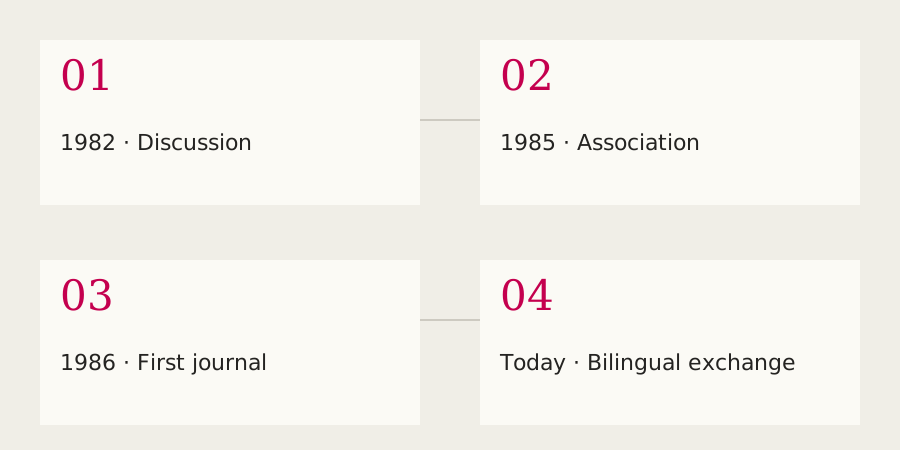
- 011982 · Discussion
- 021985 · Association
- 031986 · First journal
- 04Today · Bilingual exchange
A 1982 discussion led to organisational work, the 1985 association and the first journal volume in 1986.