Keep the sources separate
Begin with one claim that can be checked. Keep the original account separate from your interpretation, and record what you have actually read. A surviving catalogue record proves that an item was listed; it does not establish what its unseen pages say.
Canada’s Legal Pasts: Looking Forward, Looking Back was published by University of Calgary Press in May 2020, edited by Lyndsay Campbell, Ted McCoy and Mélanie Méthot. The short discussion below uses checked passages by Méthot and Campbell; the worksheet and diagram are new. This exercise concerns reading sources, not advice on present law.
A disagreement is a finding to preserve
Méthot describes a disagreement in the Philomène Déry case: a Montreal Star report attributed the complaint to a priest, while subsequently located court documents identified her partner. The discussion situates the newspaper in 1870.
Locator: Méthot, physical PDF page 50, printed page 38. We checked this chapter, not the underlying newspaper issue or court file.
| Montreal Star, as discussed by Méthot | A priest — Conflicts with the next row |
|---|---|
| Later-located court file, as discussed by Méthot | Déry’s partner — Underlying file not independently inspected here |
An eight-field evidence log
- Write one bounded question, such as who submitted a complaint in a named historical case. Record the relevant place and date range.
- Create a row for each source you have inspected. Include author or issuing body, source date, document genre, repository, identifier and exact page. Mark catalogue-only records as not inspected.
- Record the claim in your own words and a separate field for the source’s position or interest. Do not replace two conflicting rows with a single confident sentence.
- Check whether accounts could share a report or author. Multiple copies and repeated articles do not automatically provide independent corroboration.
- Use an observed date, name or publisher to choose the next source. If keyword search returns nothing, inspect available page images and record the search limits.
- Close with a bounded result: supported by the inspected sources, contested between named sources, or not yet established. List the exact next item needed rather than filling a gap.
| Question | One claim; place and period. |
|---|---|
| Source and date | Author or issuing body; document date. |
| Genre / perspective | Newspaper, court record or later interpretation; standpoint. |
| Repository and exact locator | Repository, identifier, physical and printed page. |
| Claim observed | Claim actually observed; no unseen content. |
| Compared with | Second source and possible shared origin. |
| Disagreement or missing field | Exact conflicting or absent information. |
| Next check | Named next item and reason for checking it. |
Completed reading note: the Déry comparison
The chapter reports a source disagreement. Cite Méthot for this comparison; do not present the unseen file as your own discovery.
| Question | Who was reported as the complainant in the Déry case? |
|---|---|
| Source and date | Méthot’s 2020 chapter discusses a Montreal Star report from 1870 and a later-located court file. The date of that file is not established by the passage used here. |
| Genre / perspective | Inspected source: a scholarly comparison. Underlying sources described: newspaper and judicial record. |
| Repository and exact locator | Canada’s Legal Pasts, physical p.50 / printed p.38 |
| Claim observed | The chapter attributes “priest” to the newspaper and “partner” to the court document. |
| Compared with | Two accounts as discussed by Méthot; not two original documents independently inspected by this site. |
| Disagreement or missing field | Identity of the complainant differs. Original court identifier and full newspaper context remain unverified here. |
| Next check | Locate the cited newspaper issue and court record, then inspect their wording and dates before making a new historical claim. |
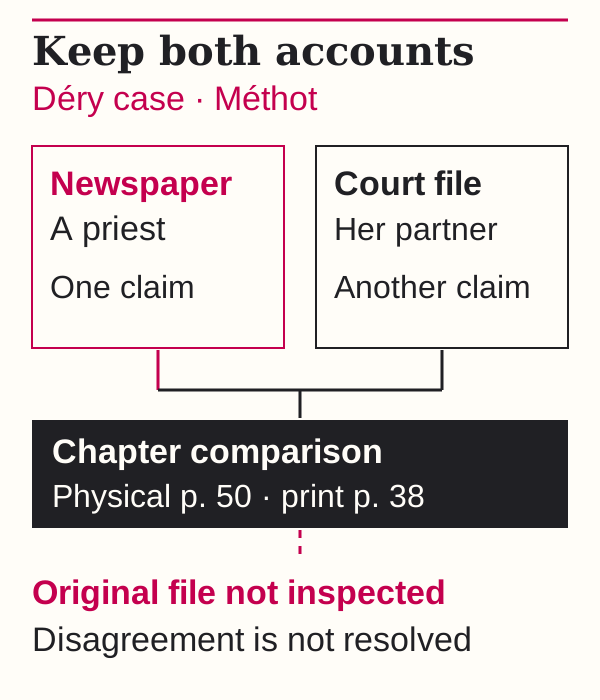
Question → source A and source B → record each claim → compare → preserve disagreement → identify the next item. Copies are not automatically independent confirmation.
Use dates and publishers to choose the next search
For Julie Morin, dates in a prison ledger and preliminary documents narrowed the newspaper search. The author found 24 articles in six papers; none covered the April 1880 trial completely. Locator: physical pages 51–52 / printed pages 39–40.
For the Morin study, a useful log would keep 24 article entries grouped by six newspapers and record which procedural stage each covers. It would leave unsupported stages visibly blank instead of claiming that any one newspaper supplies the full trial.
Campbell recommends establishing the author, title and publisher of a pamphlet. A publisher also operating a newspaper can provide another research trail, as can rival newspapers. Locator: physical page 58 / printed page 46.
Your next action should follow an observed clue: a dated procedural stage, a publisher’s name or a repository identifier. Record which editions and periods are missing. A larger list of copies is not a stronger conclusion by itself.
Record a failed search without inventing absence
Campbell identifies unreliable OCR and undigitized newspapers as obstacles, and discusses page-by-page reading and checking coverage before and after a trial. Locator: physical page 59 / printed page 47.
Example log: keyword=complainant name; collection=newspaper index; period=case month; result=no match. Conclusion: this keyword search returned no match. Next check: spelling variants and available page images before and after the event. Do not conclude that no report existed unless the relevant coverage has actually been examined. This is an illustrative log, not a search performed on the Déry file.
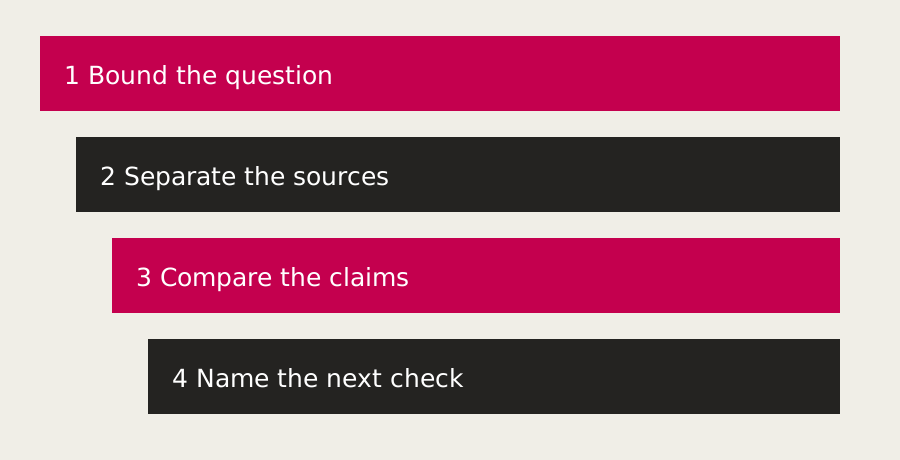
Bound the question → Separate the sources → Compare the claims → Name the next check