An interdisciplinary conversation on law & society
Explore the Association +
research
A bilingual forum for research
Discover CJLS / RCDS, its open-access model and a practical route into scholarly publishing.
08
Reading note · CLSA / ACDS
The Canadian Journal of Law and Society / Revue canadienne Droit et Société is a bilingual, peer-reviewed periodical publishing interdisciplinary research on the relationships between law and society. Its fields include sociology, history, criminology, human rights, political science, gender studies and political economy.
The journal is published by Cambridge University Press for the Association and is housed at Carleton University. In January 2023 it moved to Gold Open Access. The Association states that its articles are published under a CC-BY licence and that authors can publish open access without fees.
Before submitting
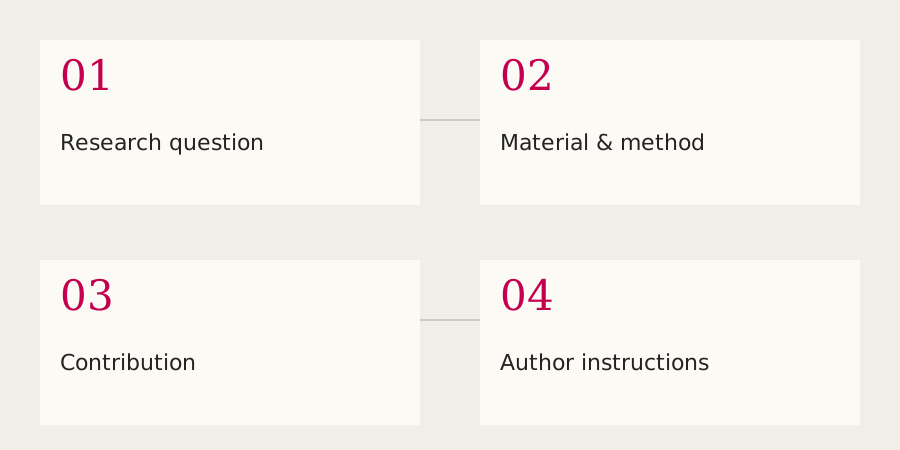
Define a socio-legal question, identify your material and method, and state the contribution to scholarship. Consult the publisher’s current instructions for word limits, references, anonymisation and the submission process.
Reading worksheet
Record the research question, evidence, method, central argument and limitation of an article. Compare two articles using the same five fields, then identify what your proposed paper adds.
Put it into practice
Use the submission preflight to check files and disclosures, or the article-reading template to separate evidence from interpretation. The publisher’s live instructions take precedence over older calls.
A documented publishing milestone
The 2015 anniversary invitation announced a reception at Club SAW in Ottawa on Thursday 4 June at 5:30pm. The Association’s spring bulletin independently identifies 4 June 2015. This is an event record, not a current invitation. The earlier report of 3 July 2013 documents the journal’s move to Cambridge and its bilingual publishing commitments. Read the submission preflight for a worked special-issue planning example drawn from these records.
Check the licence of the article and the item you want to reuse
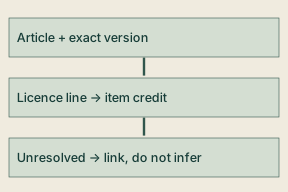
A journal’s open-access policy is a starting point, not the final licence record for every object on a page. Cambridge’s CJLS/RCDS policy directs readers to the copyright line of the article for reuse terms. Record that line alongside the exact article version, and inspect any separate image or table credit before copying it.
A complete licence-check procedure
Identify the article: retain its title, authors, DOI, publication information, version and publisher URL. A search-result label or an unlocked PDF alone does not state a licence.
Find the actual terms: open the article’s copyright/licence statement and follow its licence link. Keep the licence name, version, source location and date checked. Do not substitute the journal’s general promise when that article’s statement is unavailable.
Identify the intended item: text paragraph, author-created figure, third-party photograph or supplementary file. Read its own credit and exclusions. An article-level licence does not establish that an excluded third-party item is covered.
Prepare the attribution before reuse: name the creators and work, link to the source and the applicable licence, and identify your changes. Do not imply that the authors endorse your adaptation. If the evidence remains incomplete, link to the source while seeking clarification rather than inventing permission.
A filled record with an honest unresolved field
For Tracking (In)Justice: Documenting Fatal Encounters with Police in Canada, DOI 10.1017/cls.2025.1, the publisher’s article page checked on 14 November 2026 explicitly states CC BY 4.0 in its copyright section. Crossref independently supplies the same licence URL, although its content-version field is “unspecified”. Retain the publisher page as the evidence for the article statement; this still does not identify the terms of every separate figure.
Completed decision: article and publisher copyright line identified; CC BY 4.0 observed; the intended figure’s own credit and the exact downloaded version remain to be matched before reusing that figure. No figure from the paper is reproduced in this exercise. Keeping “not yet checked” visible is a completed evidence record, not a claim that the paper lacks permission.
Card: article/DOI/version ___; exact licence statement/location ___; licence/version/link ___; intended item ___; separate credit/exclusion ___; proposed change ___; attribution draft ___; unresolved permission ___; decision/date ___. Consult the actual terms and competent advice for a particular use; this reading procedure is not a legal determination.