Make a record you can check again
Read once for the argument and again for the evidence. Keep the authors’ finding, your interpretation and your next question in separate fields. Add a page or section locator so a seminar participant can check the passage without guessing.
An abstract is an entry point. It does not establish that you have read the full methods, coding choices, uncertainty analysis or underlying data. Mark those fields as pending until you inspect them.
Five passes through the article
- Identify the question and the unit of analysis: people, cases, decisions, institutions, interviews or another defined unit.
- Record place, period, inclusion criteria and sources. Note what the material excludes or cannot observe.
- Describe the method in a sentence that another reader can understand. Separate collection from analysis.
- Locate the principal finding. Distinguish an observed pattern from a proposed explanation or a causal conclusion.
- Write one limitation and one follow-up source. Check the full article before presenting an abstract-level note as a full review.
Worked record: Tracking (In)Justice
Andrew Crosby and eight co-authors published “Tracking (In)Justice: Documenting Fatal Encounters with Police in Canada” in CJLS / RCDS 40(1), pages 23–47, in 2025. The record below paraphrases its abstract; it is not an independent replication.
| Question | How can deaths involving police use of force across Canada be documented when existing knowledge is incomplete? |
|---|---|
| Material | The abstract reports 745 cases involving intentional police force in Canada, 2000–2023, assembled from publicly available sources. |
| Approach | A collaborative, interdisciplinary database and data governance that includes affected communities and families. |
| Reported pattern | The authors describe rising deaths, especially shootings, and overrepresentation of Black and Indigenous people. |
| Boundary | This historical case series is not a count of all police contacts, a present-day total or an individual risk forecast. |
| Next check | Read the article’s definitions, collection process and treatment of gaps before comparing rates or reproducing totals. |
Copy this blank record into your notes
| Reference | Author(s), exact title, year, journal or publisher, DOI or stable URL. |
|---|---|
| Question | What does the article ask? |
| Material | Unit, place, period, sources, inclusions and exclusions. |
| Method | Collection and analysis; what is directly observed? |
| Claim + locator | Finding in your own words; page or section. |
| Limit | What does the design leave unresolved? |
| My next step | One question and the source needed to answer it. |
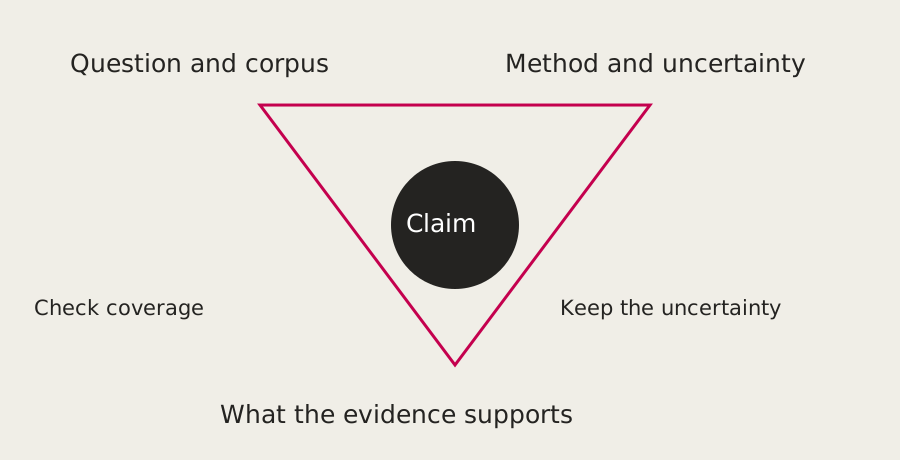
A claim must remain connected to its research question, the material collected and the method’s uncertainty.