Start with who answered, not a headline percentage
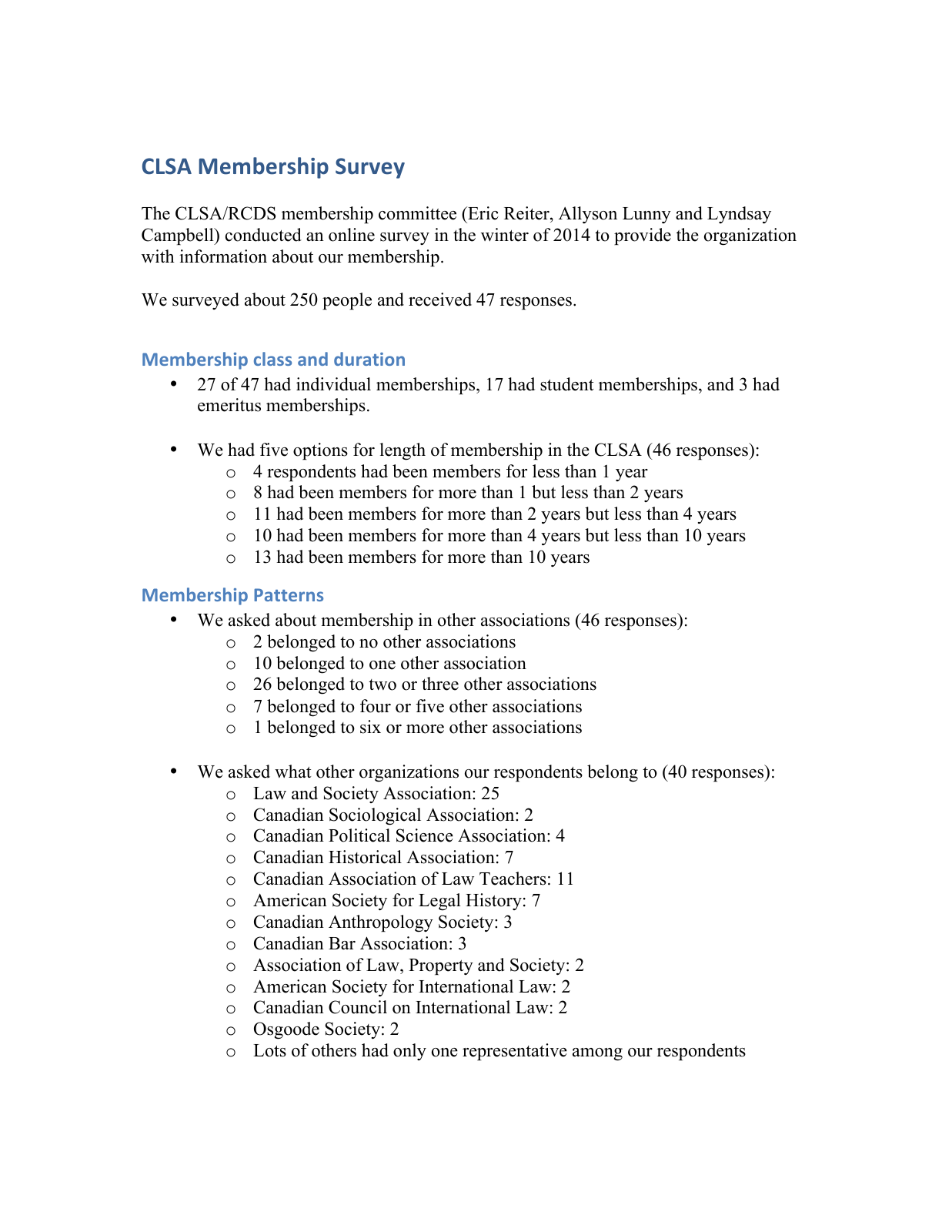
The membership committee—Eric Reiter, Allyson Lunny and Lyndsay Campbell—ran an online survey in winter 2014. Its four-page summary says about 250 people were surveyed and 47 responded. These are observations about that exercise, not the present membership or a representative census of Canadian sociolegal scholars. The summary does not give the full questionnaire, sampling frame or a nonresponse analysis.
Every question has its own base. Page 1 uses 47 for membership class, 46 for duration and number of other memberships, and 40 for the names of other associations. Page 3 uses 46 for methodologies and 38 for publication destinations. Page 4 reports 44 answers about SSHRC grant applications. Copy the base before doing any division.
About 250 people surveyed; 47 responses. Membership class: 27 individual, 17 student and 3 emeritus. Other questions have different bases.
Make three different kinds of count visible
The affiliation question explicitly permits more than one affiliation. A list of organisations or degrees likewise cannot be read as a partition merely because it appears in bullets. Methodology counts sum to 131 selections across 46 respondents; dividing each selection by 46 produces percentages that can legitimately add to more than 100%. This does not establish which combinations any individual selected.
| People answering | The methodology question has 46 respondents; do not replace this with the 47 total responses. |
|---|---|
| Selections | Methodologies include theoretical 27, empirical interdisciplinary 24 and historical/archival 19. They are not mutually exclusive categories. |
| Unknown or unclear | The SSHRC question totals 35 yes + 7 no + 2 unclear = 44. Keep unclear visible instead of silently excluding it. |
Worked calculations: keep the sentence with the number
| Individual memberships | 27 ÷ 47 × 100 = 57.4%, rounded to one decimal. Sentence: 27 of the 47 respondents reported individual membership. |
|---|---|
| Student memberships | 17 ÷ 47 × 100 = 36.2%. The 17 are respondents, not the total student membership in 2014 or today. |
| Historical/archival methodology | 19 ÷ 46 × 100 = 41.3% selected this methodology. It is not a 41.3% exclusive category of scholars. |
| SSHRC answers | 35 ÷ 44 × 100 = 79.5% answered yes. The count includes two unclear answers in the base; it concerns applying, not receiving a grant. |
| Invitations and response | 47 ÷ about 250 is approximately 19%. Since the invitation number is approximate, a precise response rate would overstate the source. |
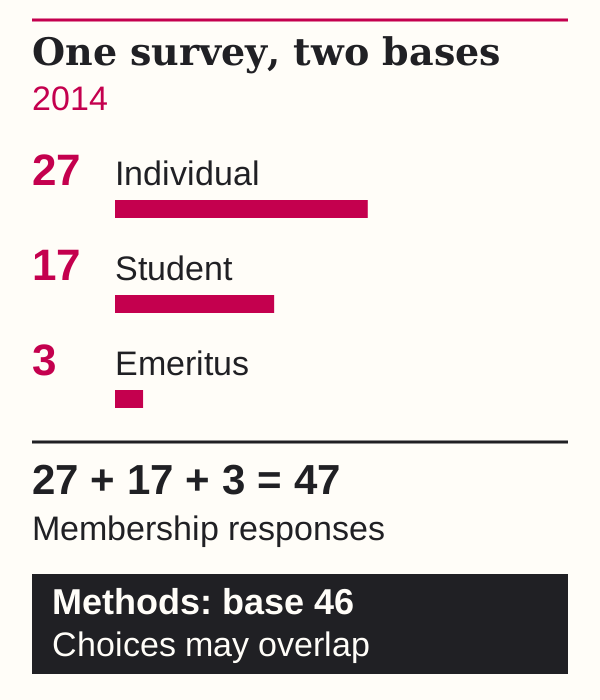
27 individual + 17 student + 3 emeritus = 47 respondents. The separate methodology base is 46; multiple selections are allowed.
A five-pass procedure for any summary
- Record the source, year, authoring committee and physical page. Identify what the summary does not supply.
- For each question, write its exact base and whether choices overlap. Leave unknowns explicit.
- Check sums against the stated base only where the categories form a partition. Never force a multiple-choice list to sum to the number of people.
- Write the calculation and a complete sentence identifying the population of respondents. State rounding.
- Separate what the survey describes from an action you propose. A new priority requires current evidence, not an old percentage alone.
Copy a complete reading sheet
| Source and timing | Title / source URL / year of collection / physical page / authoring committee. |
|---|---|
| Question and unit | Question wording as supplied / people or selections / base / multiple answers allowed? |
| Computation | Numerator / denominator / formula / rounding / unknowns retained. |
| Claim and limit | What the summary establishes / missing questionnaire or data / what cannot be generalized. |
| Possible next step | A specific follow-up question / evidence needed / no invented updated result. |
A completed decision note
Question: should a methods workshop offer a route for historical and archival research? Source: methodology question, physical page 3, winter 2014, 46 respondents, multiple selections. Observation: 19 selections for historical/archival work, alongside theoretical, comparative and interdisciplinary methods. Decision to investigate: ask current prospective participants which sources and methodological obstacles they face. Do not claim that 41.3% of today’s membership needs this workshop or that the old categories predict demand.
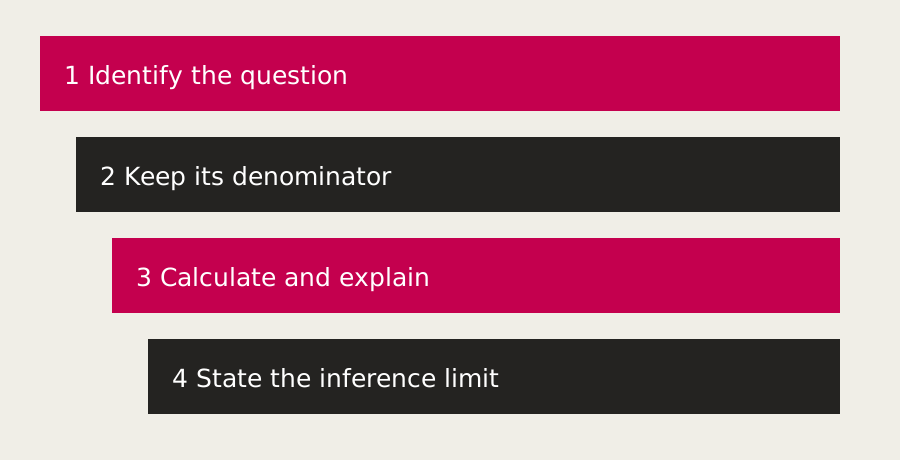
Identify the question → Keep its denominator → Calculate and explain → State the inference limit