Three sources, three different research problems
The 2003 Law and Risk call asks how law can manage, increase or create risk; physical page 2 distinguishes prediction, prevention, responsibility and redress. The 2004 programme’s legal knowledge panels ask what counts as legal knowledge, including quantitative judicial analysis, ownership of knowledge and law/technology theory (physical pages 1–2). The 2005 Indigenous Legal Traditions call asks how traditions are identified, practised and recognised, and how multiple legal systems relate (pages 2–3). These are starting points for research design, not statements that a particular paper proved an answer.
The 2004 document labels itself a preliminary schedule subject to change. The LawForum copies recovered from the English and French directories have identical normalised bilingual text; they are not two different meetings. The 2003 and 2005 calls describe closed competitions with their original deadlines, awards and deliverables. Their old funding and submission routes are not current opportunities.
Use a specific conceptual contrast
| Risk — call page 2 | Managing an existing risk versus creating vulnerability through a legal relationship. Ask which rule, actor and outcome you will examine. |
|---|---|
| Knowledge — programme pages 1–2 | A numerical account of decisions versus a claim about their legal meaning. Define your observation unit before treating a count as an explanation. |
| Pluralism — call pages 2–3 | Recognition by state institutions versus how a particular community describes its legal tradition. Do not treat one account as a complete substitute for the other. |
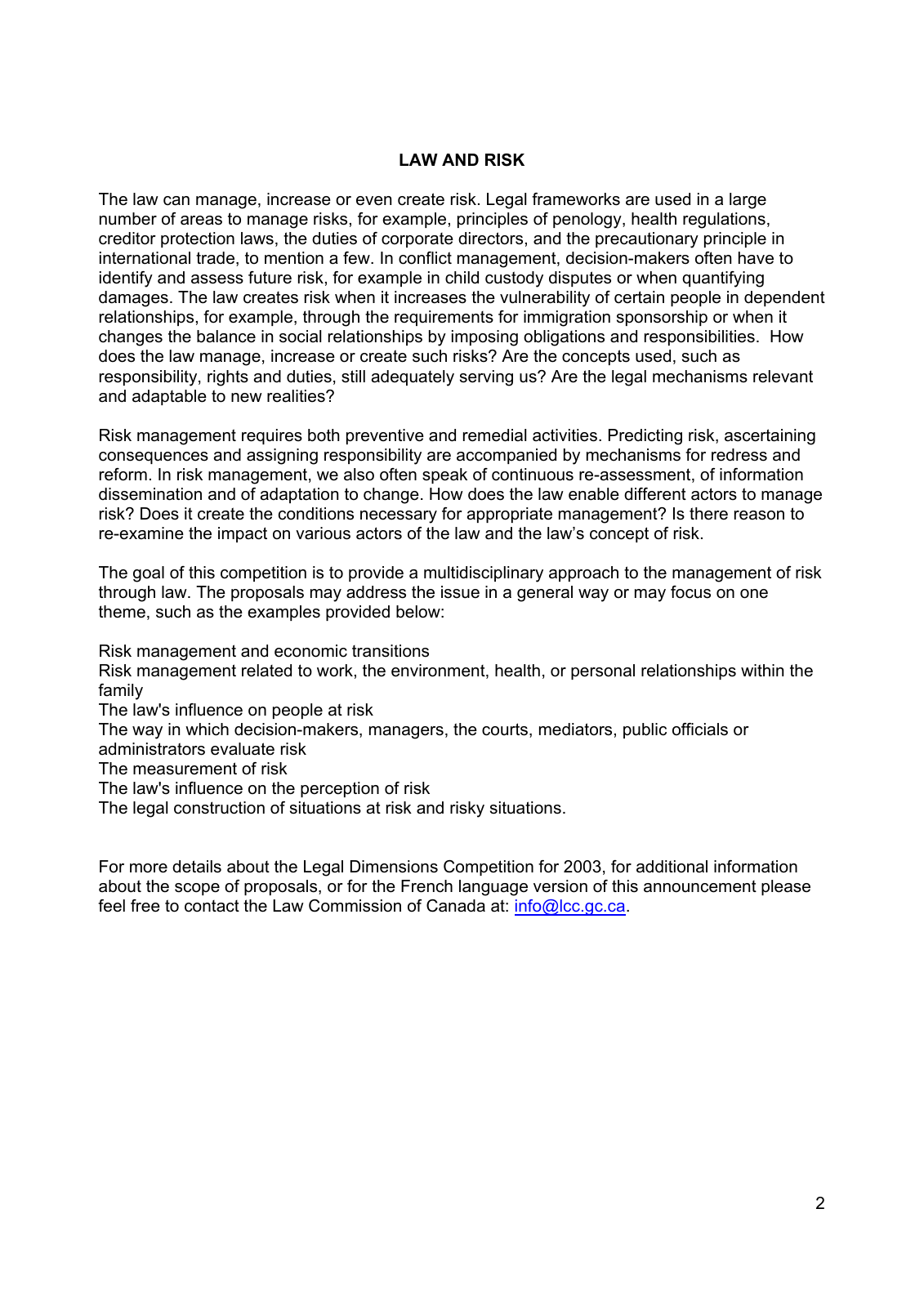
The source distinguishes managing risk, creating vulnerability, evaluating consequences and providing redress. A research question must choose an actor and mechanism.
Read a paper title as a research lead
Thaddeus Hwong’s 2004 scheduled paper asks whether quantitative analysis of judicial decision-making constitutes legal knowledge. Samuel E. Trosow’s scheduled paper considers ownership and commodification of legal knowledge, and Arthur J. Cockfield’s addresses a law/technology theory (page 2). In the later 2005 call, pages 4–5 list past 2003 contributions, including Dayna Nadine Scott on the precautionary principle and Mariana Valverde on legal knowledges of risk. A title supplies a lead to locate the paper; it does not supply its methods, findings or publication status.
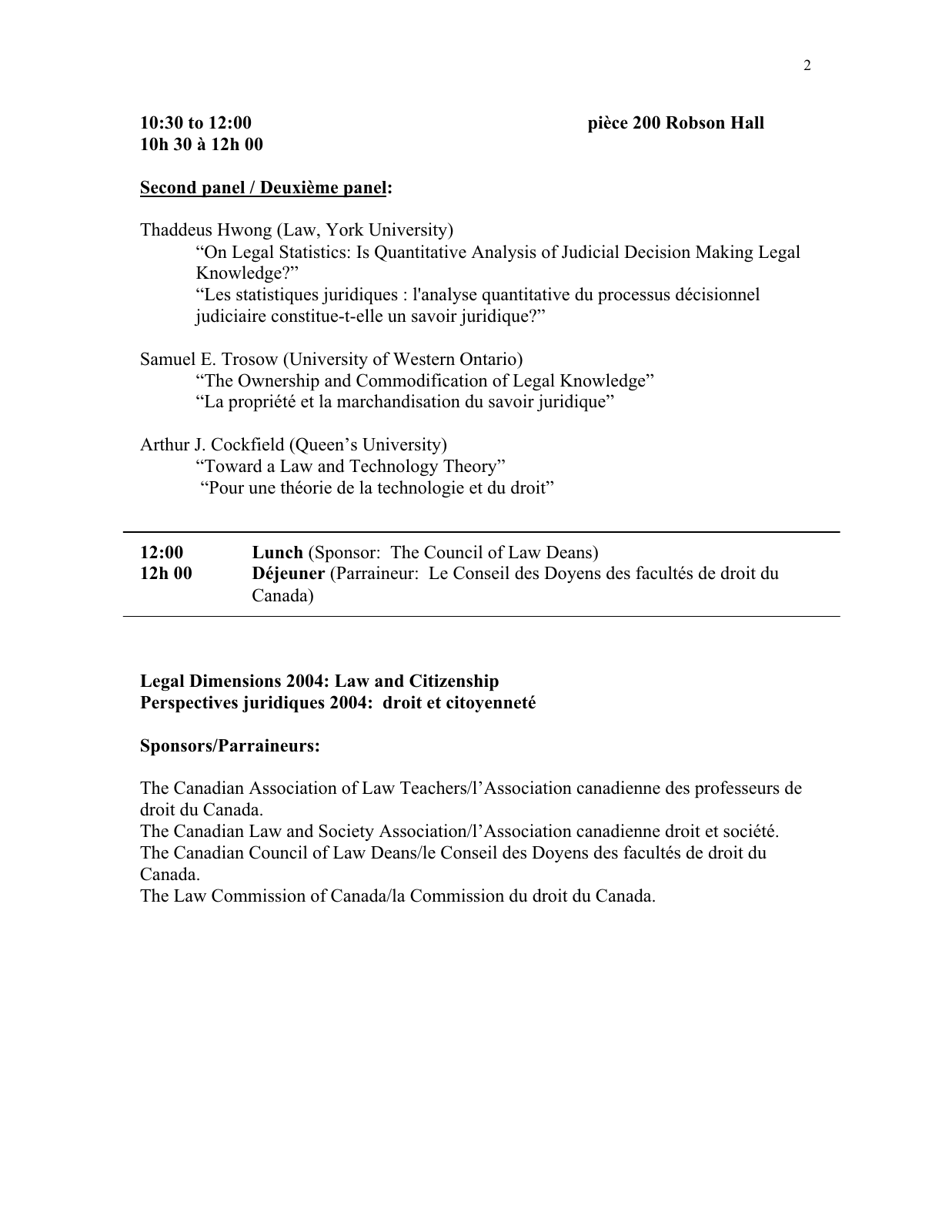
Three scheduled approaches: judicial statistics, ownership of legal knowledge, and law/technology theory. Read the full papers before reporting conclusions.
Build your question in six steps
- Choose one contrast from a source and record the source page. Do not begin with a sweeping theme such as law and society.
- Specify a jurisdiction, institution, period and observable decision or document.
- Write one question joining a legal mechanism to a social relation or outcome.
- Choose materials that can answer that question and record a justified selection rule. Do not invent interviews or observations.
- Define coding categories, a comparison and one possible counterexample before reading for confirmation.
- State what this material cannot establish; then revise the question or add appropriate evidence.
Worked design: risk in a written appeal procedure
This is a teaching design, not an investigation already conducted. Imagine comparing two publicly available versions of the same institution’s administrative appeal guidance. Ask: how does each version distribute the responsibility for supplying missing evidence, and what opportunity does it provide to correct an incomplete submission? The mechanism is allocation of responsibility; the possible vulnerability is losing a hearing because a procedural step was misunderstood.
| Materials and selection | Two complete public guidance versions for the same procedure, with publication dates and all linked instructions; no personal case records. |
|---|---|
| Unit and coding | Unit: one instruction about evidence or correction. Code responsible actor, required action, deadline, consequence, assistance route and ambiguity. |
| Comparison | Match equivalent instructions across versions. A new help paragraph is a text change; it is not proof that people obtained better outcomes. |
| Counterexample and limit | Look for a correction route that already existed in the earlier version. Without implementation or outcome evidence, report documentary differences, not measured risk reduction. |
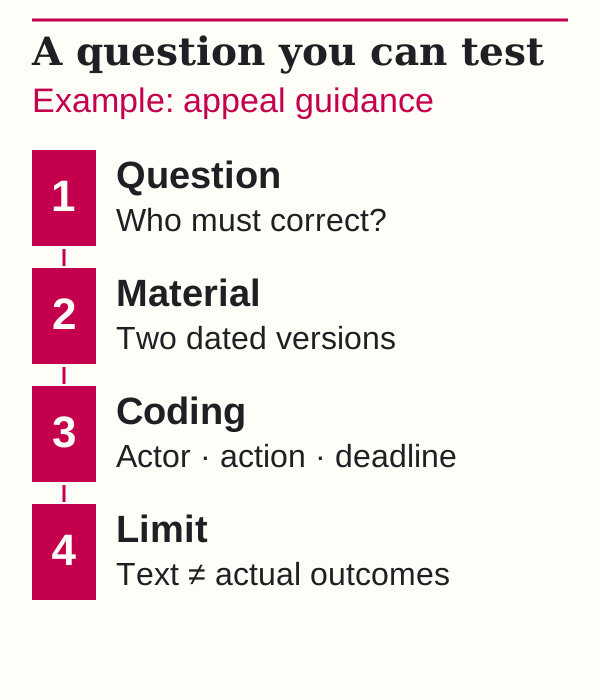
Question: allocation of responsibility. Material: two guidance versions. Coding: action, deadline, correction. Limit: textual change cannot establish practical outcomes.
Copy the design card and check it
Where research involves a community’s knowledge, people or restricted records, a publicly accessible call is not permission to collect or reproduce that material. Establish the appropriate access and ethical requirements for your actual project. The worked example above deliberately uses only public institutional texts and makes no claim about lived experiences.
| Question | One sentence / conceptual contrast / source page. |
|---|---|
| Scope | Institution-jurisdiction / period / decision or document unit. |
| Evidence | Materials / selection rule / access and ethical requirements / exact locators. |
| Analysis | Coding categories / comparison / possible counterexample. |
| Conclusion boundary | Claim this evidence could support / what it cannot support / next source needed. |
Test the fit between a question and a method
A proposal becomes useful when the question, material and method fit each other. A 2021 Carleton course outline by Pierre Cloutier de Repentigny provides a documented teaching example: start with the topic and bibliography, compare methods, then state how the analysis will work. The worksheet below is a new reading exercise; it is not a current course assignment or a reconstruction of the Congress 2021 programme.
The initial assignment connected the topic, research question and candidate methods (p. 4). A later task linked five annotated scholarly sources to each other and required a reasoned method choice (p. 5). The final proposal separated theory, methodology, analysis and dissemination (p. 5). Its 2021 deadlines remain dates of that course, not deadlines for present readers.
- Write one question with a place, time period and observable object. Separate what a public document can reveal from what would require interviews.
- Create a source log. For each source record its date, author, type, locator, argument or observable detail, and relevance to the question. Do not treat five copies of one text as five independent sources.
- Compare at least two plausible methods. Say what each can show, what it cannot establish, and what evidence it needs. Choose the method that answers the actual question.
- Define an analysis rule before reading the whole corpus: the unit, categories, treatment of missing information and test for inconsistent coding.
- Write the limits and the intended output. If people or non-public records are involved, seek the required ethical review and permissions before collecting anything.
Completed exercise: what do two online-hearing notices tell a reader?
Hypothetical exercise; not a claim about a court, institution or research result.
The evidence answers a narrow question about the wording of instructions. It does not answer the broader question of experienced access. That distinction is the point of choosing a method before claiming a result.
| Question | How do two hypothetical public hearing notices explain access to an online hearing? |
|---|---|
| Material and selection | Two invented notices dated in the same hypothetical month. A: “Request a viewing link by email.” B: “The hearing is online; details follow.” These sentences are invented exercise data. |
| Method and alternative | Document comparison identifies what instructions are present. Interviews could examine lived experience, but this exercise has no interview data. |
| Analysis unit and categories | Unit: one notice. Codes: an access channel named; an advance action named; a time limit named; missing information recorded as missing. |
| Completed coding | A: channel=email; advance action=request link; time limit=not stated. B: channel=not stated; advance action=not stated; time limit=not stated. |
| Limit | Neither notice establishes whether anyone obtained access, whether access was equitable, or whether the process complied with law. No such outcome is inferred. |
| Output | A two-row instruction table plus a request for the missing channel and time information. The example demonstrates a reproducible comparison, not a finding about real hearings. |
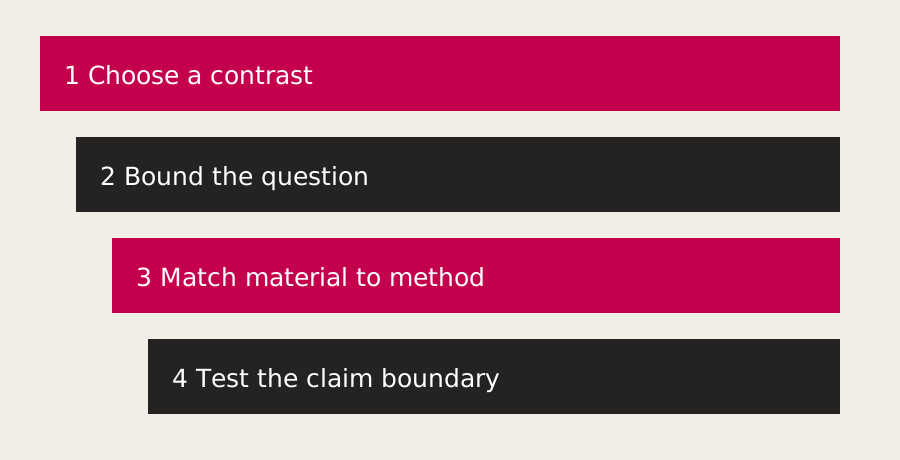
Choose a contrast → Bound the question → Match material to method → Test the claim boundary