Nine issues: a route through the research community
These nine issues let us study scholarly activity at several scales: the architecture of a panel, the roles of a student caucus, a directory of university teaching, and the work needed to circulate a journal and newsletter. Their value lies in the relationship between concrete questions and the machinery of a research community. A programme names intended contributions; minutes record what their author reported; a call sets requirements for a future activity. Keeping those differences visible makes the collection useful for literature reviews, teaching histories and association research.
The sources were published between autumn 2001 and autumn 2005. The period on each cover identifies the issue; publication day is not inferred. Event dates and deadlines retain their original years. Old admissions, contacts, grants and membership forms are not current offers.
| Autumn 2001 — design a panel, not just a list of papers | Physical PDF pages 7. The Vancouver joint-meeting call distinguished paper sessions, roundtables and book panels. A fully formed paper session was expected to identify a chair, a discussant where appropriate, and three or four individual papers. Its organisers encouraged diversity across countries, disciplines, intellectual perspectives and career stages. The same page described collaborative research networks as a route into international research conversations; it welcomed both existing networks and new ones. Use this page to analyse how a scholarly conversation is assembled: what question joins the papers, whose perspectives are included, and who supplies a response? The proposal deadline printed here was 17 December 2001. These are the requirements of that call, not the rules of a current conference. |
|---|---|
| Spring 2002 — separate research discussion from student representation | Physical PDF pages 3. Susan Ellis’s Student Caucus report described a planned informal workshop around Lesley Jacobs’s paper on civil rights and the new anti-terrorist law, C-36. The paper was to circulate before the workshop scheduled for 29 May 2002, 17:00–18:30. A separate student business meeting was scheduled for 30 May, 12:00–13:00, to elect two representatives and discuss student concerns. The report also noted support for graduate students to participate as speakers and chairs at the preceding Laval meeting. For a researcher studying participation, record academic preparation, speaking roles and elected representation in different fields. A scheduled workshop is evidence of a plan; this bulletin alone does not show who attended or how discussion changed anyone’s work. |
| Autumn 2002 — compare university programmes without confusing their credentials | Physical PDF pages 8. The undergraduate directory described a law-and-society minor at Dalhousie and a minor programme at Memorial. It also described Brock’s criminology and moral-regulation concentration, certificate or diploma options, and a collaborative policing and criminal-justice programme. Laurentian’s entry made an explicit distinction between critical study of law’s social implications and training for legal practice. Ryerson’s justice-studies entry, on the same page, described a degree-completion route for diploma graduates. This is a useful source for reconstructing how socio-legal teaching was described in 2002. Build separate columns for institution, academic home, credential, intended audience and pedagogical purpose. Names, admissions and programme availability require fresh university verification before giving present-day study advice. |
| Spring 2003 — follow the transition to electronic communication | Physical PDF pages 2. The co-editors described an expanded website serving communication with members and related associations. They linked electronic newsletter mailings and other modifications with additional resources for member initiatives. The column reported the creation of a Future Tasks Committee to suggest directions for the Association. It also announced a preliminary Halifax conference schedule and an extension of the directory of undergraduate programmes. The useful question is organisational, not technological fashion: which communication tasks changed, what resources did the editors say were released, and which body was asked to propose uses for them? Compare this contemporary account with the subsequent AGM report rather than treating an announcement as a completed outcome. |
| Autumn 2003 — distinguish an AGM report from the proposals beside it | Physical PDF pages 3, 4. The bulletin included minutes of the AGM held at Dalhousie on 3 June 2003. Within the financial report, Bruce Ryder attributed savings in newsletter production and distribution to electronic delivery, while explicitly excluding translation costs. The report described a SSHRC travel grant of $4,455 for student members and 21 applications that year. It also said the Board might supplement the grant. The possible supplement was not a decision already made in that passage. Record the amount as a reported 2003 grant and the application count as a separate measure. Do not divide them to invent an award per student: allocation depended on travel distance, and the final supplemented budget was not given. This is a compact example of reading a financial record without manufacturing a statistic. |
| Spring 2004 — trace the questions inside a preliminary programme | Physical PDF pages 1, 5. The cover identified the 2004 programme as subject to change. Page 5 placed citizenship questions alongside a paper by Richard Devlin and Dianne Pothier on legal responses to disability and a theory of “Disitizenship”. The same page listed a graduate law-reform research session, “Audacity of Imagination”, including Fiona Kelly’s child-custody and access-law topic and Kirsty Robertson’s protest, place and justice topic. Other parallel sessions included legal history and workers and discrimination. A thematic reading can connect citizenship, disability and the location of justice without claiming that the presenters shared a method or reached a common conclusion. Capture the exact paper title, session and role first; use the programme to find the question, then seek a paper or later publication for the argument. |
| Autumn 2004 — unpack a research call into its separate stages | Physical PDF pages 8. The 2005 Legal Dimensions Initiative call named “Indigenous Legal Traditions” as its theme. It requested a one- or two-page proposal and a brief CV, and invited legal and socio-legal scholars without a disciplinary restriction. The source gave distinct milestones: proposals by 31 January 2005, draft papers by 23 May 2005 and final texts by 29 August 2005. It described presentations of drafts at the CALT and/or CLSA annual meetings and proposed publication through UBC Press and Les Presses de l’Université Laval. Use these stages to reconstruct a research-to-publication process. A proposal, draft presentation and submitted final text are different outputs; the call does not establish which papers were selected or published. All three deadlines have passed. No application route or award amount on this page should be treated as a present offer. |
| Spring 2005 — keep a conflicting schedule visible | Physical PDF pages 1, 8, 12. The cover described the 2005 conference schedule as preliminary and subject to change. In its overview, physical page 8 placed the CLSA/ACDS AGM in the 28 June lunch period, 12:30–13:30, and delegate departures on Thursday 30 June. Physical page 12 instead printed “Thursday, June 29” above delegate departures. This is a conflict inside the same issue, not a licence to select a convenient date. Page 12 also gave Jean Barman’s keynote title and the separate date Sunday 26 June 2005. For a timeline, record the AGM as scheduled in the preliminary overview, not proven to have occurred. Leave the departure date unresolved until another reliable programme or contemporaneous record settles it. The completed evidence record below shows exactly how to preserve that uncertainty. |
| Autumn 2005 — recognise continuity without repeating a “first-ever” claim | Physical PDF pages 3. Mariana Valverde’s presidential letter described a committee preparing a half-day graduate workshop for the York meetings in 2006. It named Emma Cunliffe, Marie Andree Jacob, Mohsen Ahmed and Rashmee Singh as committee members. The letter also discussed coordination between membership dues and journal subscriptions, and planning for joint CLSA–LSA meetings in Montréal in 2008. These were descriptions of organisational work and future plans at that time. The letter called the planned workshop “first-ever”, while Spring 2002 already described a shorter graduate workshop. Preserve the attributed wording if quoting it, but do not conclude that no earlier student workshop existed. Duration, format and organisers provide a more precise comparison than an unsupported claim of absolute priority. |
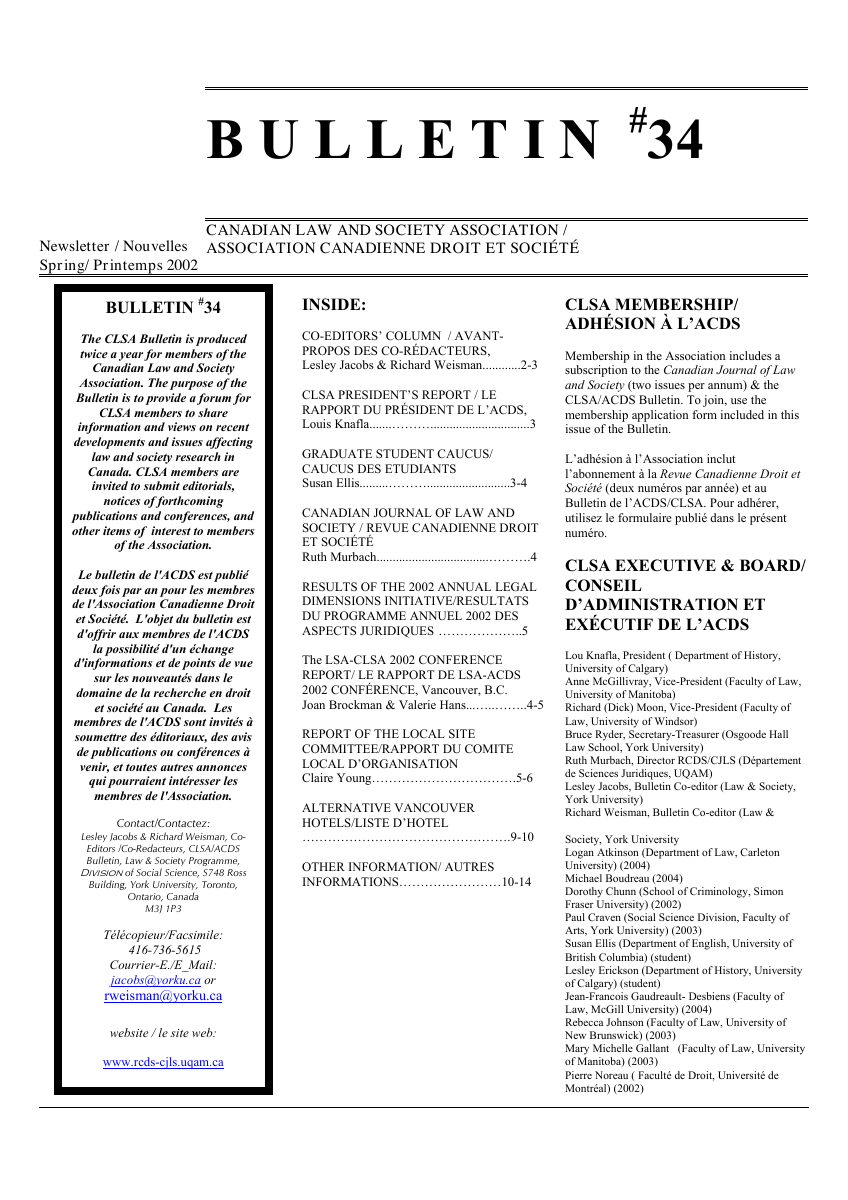
Spring 2002. Canadian Law and Society Association / Association canadienne Droit et Société. This issue includes Susan Ellis’s Student Caucus report.
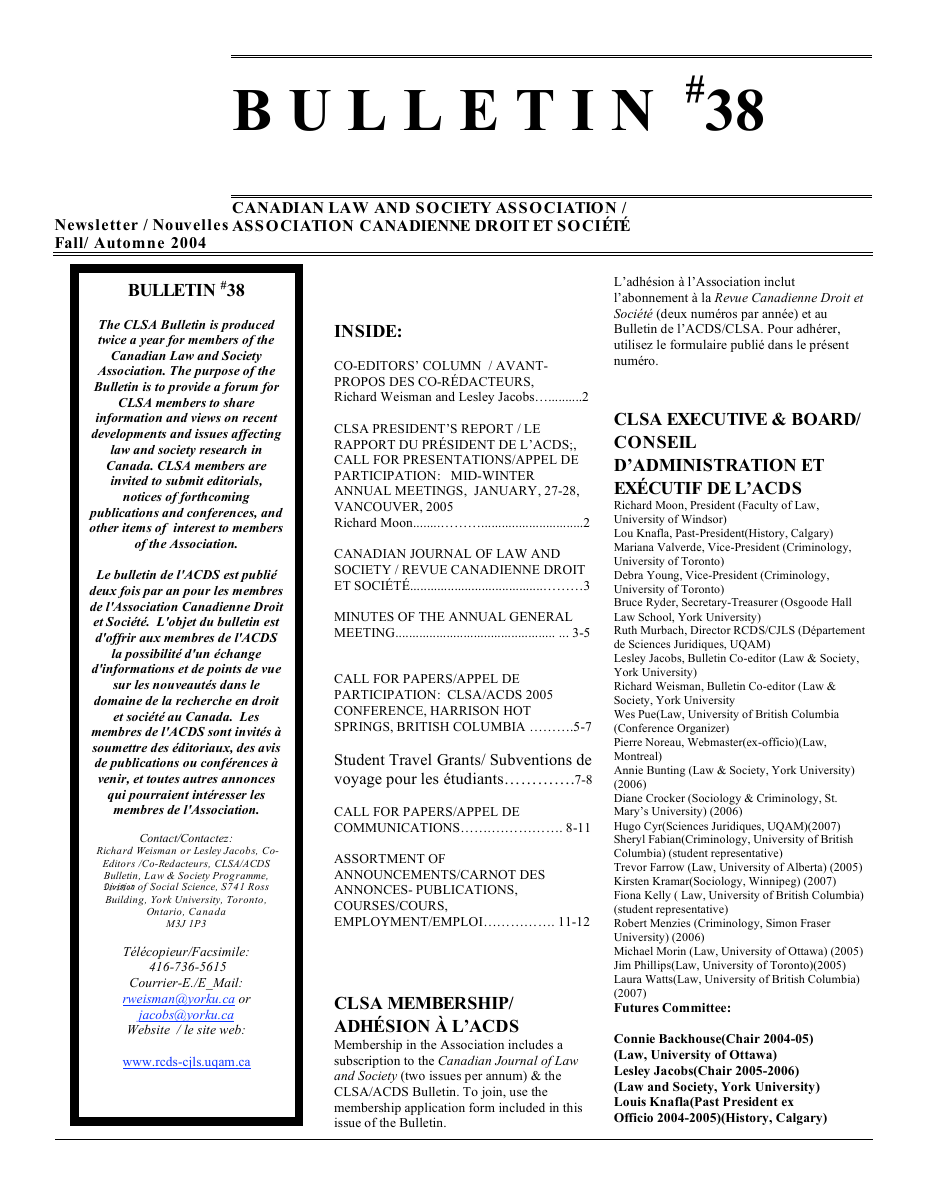
Autumn 2004. The contents distinguish minutes, conference participation, student travel and research calls. The source’s old dates remain separate from publication today.
Follow organisational work across issues
The Spring 2003 column linked electronic mailings with resources for new initiatives (p. 2). The Autumn 2003 AGM financial report then attributed newsletter savings to electronic distribution while excluding translation (p. 4). These are two contemporary accounts that can be compared; they do not supply a cost series or isolate technology as a measured cause.
Student participation has more than one form. In Spring 2002, reading a circulated paper and electing representatives were separate activities (p. 3). In Autumn 2005, a half-day workshop was being planned for York (p. 3). Compare purpose, preparation, duration and representation. The later letter’s “first-ever” wording does not erase the earlier workshop.
The 2002 teaching directory described different credentials and audiences, rather than a single model of socio-legal education (p. 8). Its comparison fields remain useful: academic home, credential, audience and purpose. Its institutional descriptions are evidence about 2002, not verification of programmes open today.
A programme question is not a published conclusion
The Spring 2004 programme places citizenship, disability, legal history and graduate law-reform research in a common timetable (p. 5). This lets a reader build a thematic route, but not attribute one method or a shared conclusion to every participant. Preserve the exact title, session and named role; seek a paper or later article before describing its argument.
The Autumn 2004 call makes the distinction especially clear: a proposal by 31 January 2005, a draft by 23 May and a final text by 29 August were separate stages (p. 8). Selection and publication would require additional records. The diagrams describe a reading method, not the outcomes of that competition.
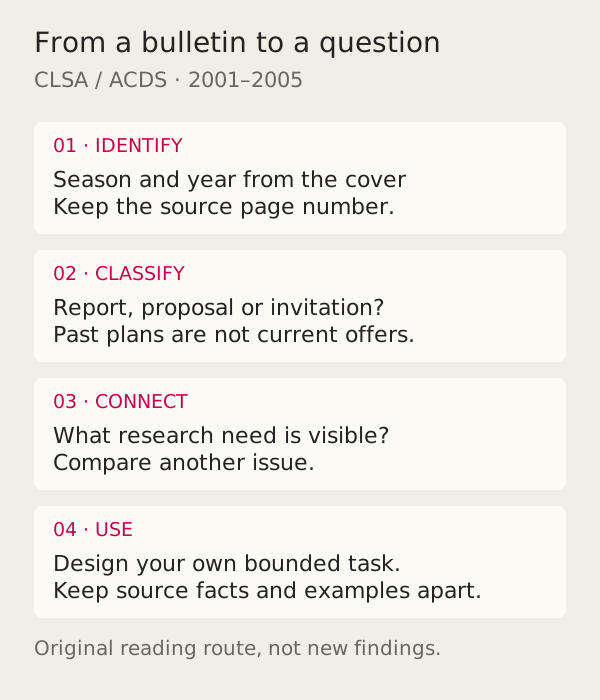
Call → requirements and intended outputs. Preliminary programme → scheduled contributions, not proven attendance. Report or minutes → attributed account. In every case record issue, physical page, claim and its limit.
Build a traceable research note in five steps
- Choose a question narrow enough to answer. For example: how did the bulletin distinguish student discussion from representation, or how did electronic delivery enter the Association’s finances? A question about a specific process is more workable than a complete history of everything in nine issues.
- Identify the issue and the section independently. Record the season and year on the cover, the PDF’s physical page and the local section heading. Do not derive the year from a downloaded filename or use a repeated issue number as the sole identifier.
- Classify the evidence before making a claim. Mark each passage as a call, preliminary schedule, report, minutes or directory. Write its publication period separately from the event date. A planned deadline is not an outcome and an old degree description is not current admission advice.
- Compare the smallest relevant pair. For electronic communication, compare Spring 2003 p. 2 with the Autumn 2003 financial report on p. 4. For student workshops, compare Spring 2002 p. 3 with Autumn 2005 p. 3. Keep each voice attributed rather than turning two reports into a measured causal study.
- Write the bounded finding and retain the unresolved field. State what the passage establishes, what it cannot establish, and which source would settle the remaining question. A schedule conflict stays a conflict. Use a later programme, approved minutes or published paper when the research question requires an outcome.
A complete evidence-record template
Copy these eleven fields into your notes and fill every one. Write “not stated” when information is absent. The field for an unresolved conflict is part of the method, not a failure to finish the record.
| Research question | Your entry — source wording or bounded paraphrase; use “not stated” when absent. |
|---|---|
| Issue: season/year | Your entry — source wording or bounded paraphrase; use “not stated” when absent. |
| Document identity: URL + SHA256 | Your entry — source wording or bounded paraphrase; use “not stated” when absent. |
| Section / physical PDF page | Your entry — source wording or bounded paraphrase; use “not stated” when absent. |
| Evidence type | Your entry — source wording or bounded paraphrase; use “not stated” when absent. |
| Source’s claim, paraphrased | Your entry — source wording or bounded paraphrase; use “not stated” when absent. |
| Event date or deadline, if given | Your entry — source wording or bounded paraphrase; use “not stated” when absent. |
| What the source does not establish | Your entry — source wording or bounded paraphrase; use “not stated” when absent. |
| Conflict or missing information | Your entry — source wording or bounded paraphrase; use “not stated” when absent. |
| Next source to seek | Your entry — source wording or bounded paraphrase; use “not stated” when absent. |
| Permitted wording for the research note | Your entry — source wording or bounded paraphrase; use “not stated” when absent. |
Worked example: the Spring 2005 schedule
The cover calls this a preliminary schedule subject to change. The completed record below retains a real internal discrepancy rather than silently repairing it.
| Research question | What can the Spring 2005 bulletin establish about the AGM and departures? |
|---|---|
| Issue: season/year | Spring 2005; no exact publication day inferred. |
| Document identity: URL + SHA256 | https://web.archive.org/web/20070708184337id_/http://www.acds-clsa.org/bulletins/2005Spring.pdf · SHA256 e5ed98bbb55dfdac3b6e1c343d5b1febbe7b55ff165f35cf4e4870d2a16d02dd |
| Section / physical PDF page | Cover p. 1: preliminary programme; overview p. 8; detailed schedule p. 12. |
| Evidence type | Preliminary schedule, explicitly subject to change. |
| Source’s claim, paraphrased | The overview schedules the AGM in the lunch period of Tuesday 28 June, 12:30–13:30. It lists departures on Thursday 30 June. |
| Event date or deadline, if given | AGM: 28 June 2005 as scheduled. Departure: 30 June on p. 8, but 29 June on p. 12. |
| What the source does not establish | Whether the AGM occurred at that time; who attended; a definitive departure date. |
| Conflict or missing information | The same issue gives two different departure dates. The cover flags possible programme changes. |
| Next source to seek | A later final programme or contemporaneous record for departures; approved AGM minutes for the meeting itself. |
| Permitted wording for the research note | The Spring 2005 preliminary programme scheduled the AGM for the 28 June lunch period (PDF p. 8). Its departure listings conflict (pp. 8 and 12), so this document alone cannot establish a final departure date. |
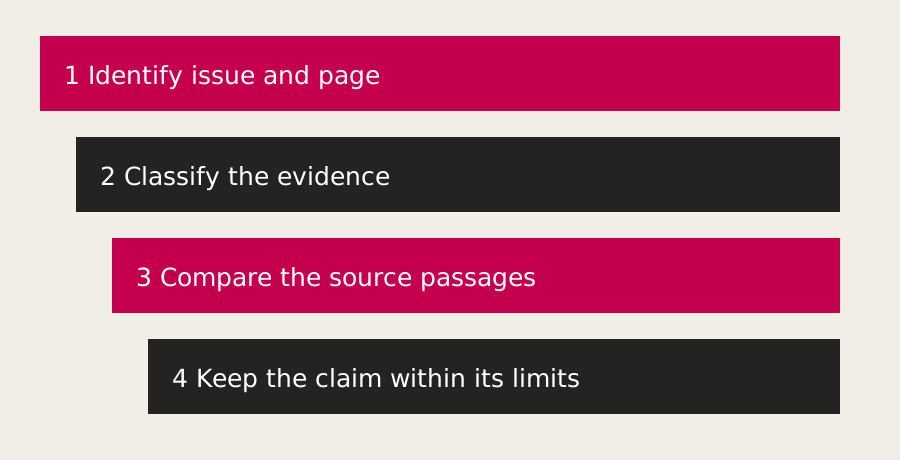
Calls state requirements; preliminary programmes schedule activity; reports and minutes give attributed accounts. Record unknowns and contradictions instead of inventing outcomes.