Recovered participant records
University CVs record presentations on migrant justice and online-hearing access. An organizer profile lists Ling Chen’s climate-law education presentation and CLSA endorsement. These selected records help identify research themes; they do not replace the missing full programme.
| Jérémy Boulanger-Bonnelly | Public Access to Online Hearings: Balancing Transparency with Privacy · 2021-06-04 · page 9 |
|---|---|
| Jen Rinaldi, Shanti Fernando | Migrant Justice & the Meat Industry in COVID Times · 2021-06-02 · page 7 |
| Ling Chen | Climate Change and Legal Education: A Case Study of Canadian Law Schools · Presentation date not established · Pre-event profile; presentation announced |
School policing: a fourth contribution
Lisa M. Kelly’s March 2022 curriculum vitae records this Toronto-focused paper at the virtual Canadian Law and Society Association conference in June 2021. The CV lists a separate presentation with the same title at the Law and Society Association in May 2021. These are two events, not two versions of the Congress programme.
| Lisa M. Kelly | The Rise and Fall of School Policing: A Toronto Case Study · June 2021 · CV page 6; exact day unknown |
|---|
Environmental and social regulation: a dated panel
Alexandra Bahary-Dionne’s 2025 CV places Environmental and Social Regulation: Lessons for the Future in its panel-moderation section. It identifies the CLSA annual meeting, held online on 4 June 2021. The record establishes moderation of a panel, not authorship of a paper. Its date falls within the association’s documented 2–4 June meeting.
| Person and role | Alexandra Bahary-Dionne · panel moderator |
|---|---|
| Day and format | 4 June 2021 · online annual meeting |
| Source locator | 2025 CV, physical page 12, panel-moderation section |
| Still unknown | Panel number, start time, other participants and abstracts. No links to other recovered contributions are inferred. |
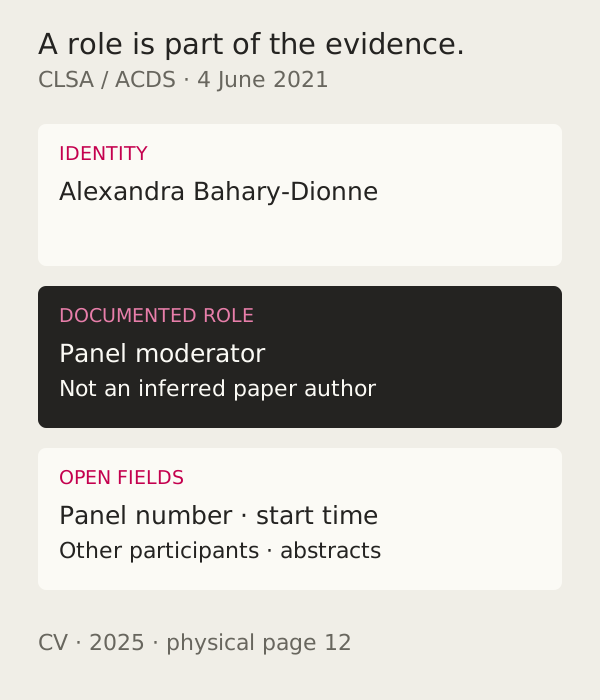
The CV identifies Alexandra Bahary-Dionne as moderator on 4 June 2021. It does not name the other panel participants or give a timetable. Record that role and leave the absent fields unanswered.
Trace a contribution
- Start with an exact paper title and named author.
- Check association and date: LSA and CLSA are different meetings.
- Separate a pre-event announcement from a retrospective presentation record.
- Record missing chair, panel and time as unknown rather than filling gaps.
A worked distinction
The McGill CV distinguishes the CLSA presentation on 4 June 2021 from a differently titled LSA presentation on 27 May 2021. Preserve both conference identities; matching an author or topic does not make them the same session.
Limits of this recovery
The long and short Congress 2021 programmes remain unavailable. Three CVs identify selected presentations; an organizer profile announces Ling Chen’s presentation. The fee schedule confirms association dates, while the roundtable report describes one open session. None supplies a complete panel timetable. A report or award-profile publication date is not an independently established presentation date.
A further CV now documents one panel moderator and an exact day; it still does not supply either missing programme.
Another 2021 Association contribution
Danardo Jones lists a virtual Canadian Law and Society Association paper presentation titled Darkscapes in 2021. His record supplies no exact date or panel and does not explicitly identify Congress2021.
| Danardo Jones | Darkscapes · 2021 · virtual; date and Congress connection not established |
|---|
2–4 June 2021: which fee was zero?
The Federation’s 2021 schedule identifies CLSA/ACDS as association 229 and marks June 2, 3 and 4. Its association-conference fee is shown as $0 for members and non-members. The registration instructions distinguish this fee from Congress registration and association membership dues; this row does not show the total cost of attending Congress.
| Association meeting | CLSA/ACDS #229 · June 2–4, 2021 · $0 M & N |
|---|---|
| Congress registration | Separate category; the association’s $0 row does not establish this amount. |
| Membership | Separate from both conference charges. No current dues inferred from the 2021 schedule. |

The columns run May 27–June 4; CLSA’s marks correspond to June 2, 3 and 4.

Association 229, meeting June 2–4, 2021: $0 for members and non-members. This is not the total Congress cost.
Arctic oceans: six perspectives
Valerie Leow’s Federation report, published 3 June 2021, describes a CLSA open roundtable. The report’s publication date is not a confirmed session date.
| Sara Seck · moderator | Intersecting injustices in ocean governance. |
|---|---|
| Dalee Sambo Dorough | Inuit knowledge and participation in conservation. |
| Margherita Paola Poto | Information, participation and access to justice in water governance. |
| Tahnee Prior | Women and community participation in fisheries decisions. |
| Olga Koubrak | Walrus habitat protection. |
| Desai Shan | Arctic shipping and seafarer working conditions. |
Use the session to structure a reading note
Choose one decision, rather than treating “Arctic governance” as a single undifferentiated subject. The following worksheet is an editorial reading method, not a transcript of the roundtable or a statement of applicable law.
- Define the decision and place: a proposed shipping route, a fishery-management measure or a habitat-protection proposal. Record whether the document discusses a proposal, an adopted rule or observed practice.
- Identify affected people in the source. Separate the people described by an author from participants who supplied evidence and those with a documented decision-making role. Do not infer consent from consultation alone.
- Record evidence type and scope: interview, local observation, legal instrument or administrative record. Write the date, jurisdiction and locator. A general conference description supplies no local measurements.
- Trace the proposed route for participation and review. Record a named process only if the source specifies it; otherwise write an unanswered question. Verify any present-day legal route against its current official instrument.
- Finish with a bounded conclusion: what this source establishes, what it leaves open and which document would answer the next question. Keep your interpretation separate from the speaker’s recorded topic.
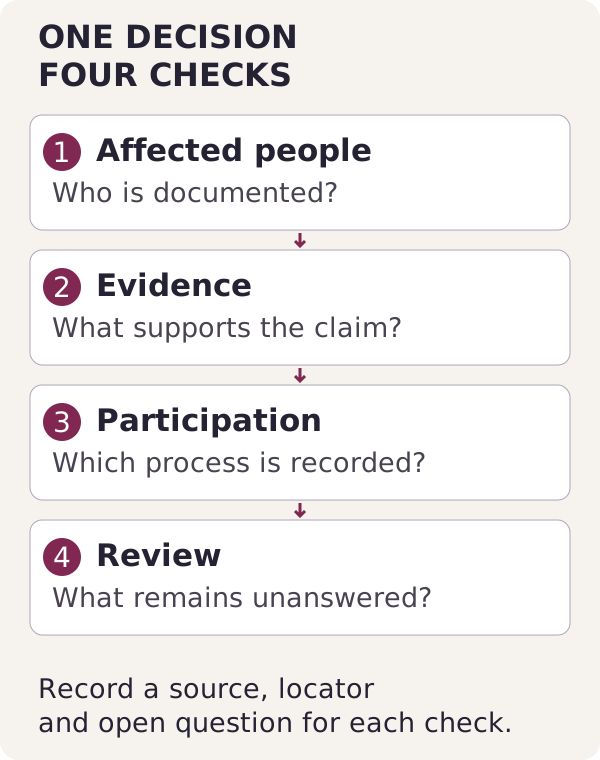
Start with one decision. Check affected people, evidence, participation and review. For every check record a source, a locator and an unresolved question.
Worked example: a proposed supply route
Suppose you are reading a fictional proposal to change a vessel’s supply route. It says community access and wildlife effects will be considered but gives no meeting record, habitat data or review procedure. Your note can identify the proposed change and the two stated concerns. It cannot conclude that a community agreed, that impacts were measured or that a permit was granted.
| People | Not named → ask which affected communities are documented. |
|---|---|
| Evidence | No local data → locate the assessment and its observation dates. |
| Participation | Only an intention → locate the actual process or record. |
| Review | Not specified → identify the relevant authority before claiming a route. |
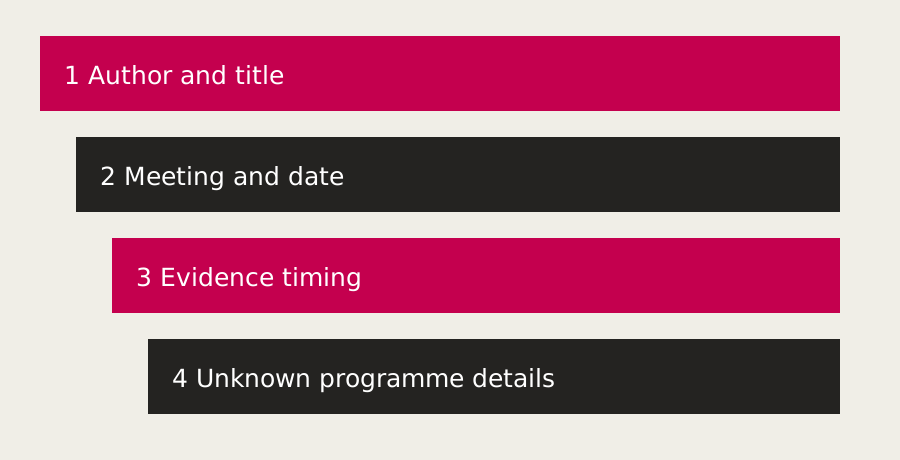
Three CVs supply presentation records. Organizer material supplies a planned paper, one reported session and association dates. The full panel timetable remains unknown.