Plan for the actual panel
Obtain the organiser’s time limit, format, accessibility arrangements and discussion plan before preparing slides. The allocation below is a rehearsal example, not a CLSA conference rule. Acadia 2026 was held on 10–12 June; its programme is a resource for studying panel structure, not an open registration call.
Turn a draft into a talk
- State one question that can be answered within the allotted time. Cut background that the argument does not need.
- Choose one piece of evidence or one comparison that listeners can examine. Give its source and scope.
- Explain how the material was selected and analysed. Say what the method cannot establish.
- Develop the argument in two or three connected moves, using transitions that describe what changes between them.
- Finish with one take-away and a precise discussion question. Rehearse aloud, including pauses and reading figures.
- Prepare a shorter fallback: keep the question, strongest evidence and conclusion if the chair reduces your time.
Worked ten-minute outline
Hypothetical example: comparing how a selected tribunal’s reasons describe participation barriers. The outline demonstrates a structure; it does not report completed research.
| 0:00–1:30 · Question | Ask how descriptions of participation barriers enter the reasons. Explain why that matters. |
|---|---|
| 1:30–3:30 · Material | Introduce a defined corpus and show two short, sourced passages. State period and inclusion criteria. |
| 3:30–5:00 · Method | Explain a coding comparison and how disagreements or missing documents are handled. |
| 5:00–8:30 · Argument | Compare the passages; explain what the comparison would support and what remains uncertain. |
| 8:30–10:00 · Discussion | Restate the contribution and ask what additional material would test the interpretation. |
Make the visuals readable
Use a title that states the point of each slide. Label axes and units on charts, read important values aloud, and give a plain-text version of a diagram. Do not communicate a distinction by colour alone. Avoid packing an entire manuscript table into a slide.
Before the session, check that the file opens, images remain legible at the back of the room and sources can be followed. Ask the chair how questions and handouts will be handled.
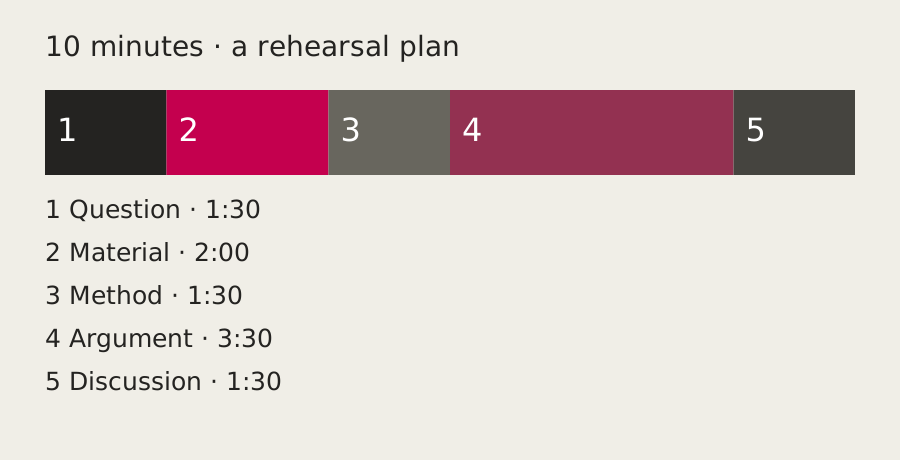
A ten-minute example allocates 90 seconds to the question, 120 to material, 90 to method, 210 to the argument and 90 to discussion.
Fit the organiser’s time limit
Enter 5–30 whole minutes. The tool allocates a rehearsal plan; it does not set conference rules. Nothing is sent or saved.
| Question | 1:30 |
|---|---|
| Material | 2:00 |
| Method | 1:30 |
| Argument | 3:30 |
| Discussion | 1:30 |