Choose the conversation before choosing the organisation
The Association’s related-sites directory connects six organisations. This is a reading route, not a statement that they share governance, membership or an enduring partnership. Match the kind of exchange you need to the organisation’s own resources.
Law and Society Association
The LSA brings empirical, interpretive and historical approaches into interdisciplinary conversations about law. Begin with its research communities and current meeting information if your question crosses several disciplines.
Law and Society Association of Australia and New Zealand
LSAANZ centres law and society in Australia and New Zealand. Its own website identifies the journal Legalities and association activities. Region, journal scope and meeting information are distinct starting points.
Oñati International Institute for the Sociology of Law
The Oñati institute provides routes into postgraduate study, workshops, its library and socio-legal publications. Use the specific programme page for admission requirements; an institute listing is not an admission offer.
Socio-Legal Studies Association
The UK SLSA is a route into the UK socio-legal community. Compare its current events and research resources with your disciplinary question rather than assuming that an association name determines a method.
The Osgoode Society for Canadian Legal History
Use the Osgoode Society as a starting point for Canadian legal history and its published work. Record a book’s author, period and subjects before linking it to a contemporary legal problem.
Consortium of Undergraduate Law and Justice Programs
The CULJP is a route into undergraduate law-and-justice teaching. Its current official website is culjp.com; the old directory’s culjp.org address is no longer the usable route.
A comparison card
Question: __. Region or setting: __. Desired resource: conference, publication, library, teaching exchange or programme. Organisation: __. Exact resource page: __. Date and eligibility of any opportunity: __. For example, an undergraduate curriculum question belongs on a teaching-programme route; a Canadian legal-history question begins with books and historical materials.
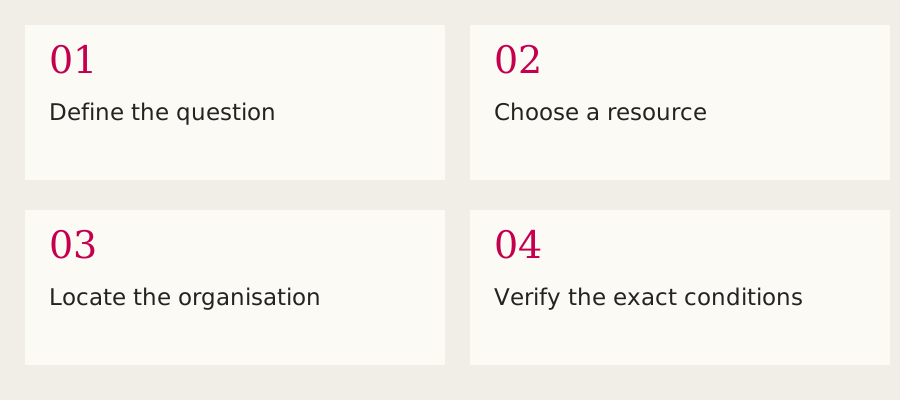
- 01Define the question
- 02Choose a resource
- 03Locate the organisation
- 04Verify the exact conditions
A conference, library, publication and teaching exchange answer different needs. Select the resource first, then check its own page.