Reading note · CLSA / ACDS
Scholtz & Polataiko — Article Prize honourable mention documents an award description, nomination route or recognition statement. Distinguish eligibility rules from the committee’s explanation of a particular winning work. A citation is a useful way into the research, not a substitute for the book or article.
Make a reading card
Record the author, exact title, year and publication details. Note which contribution the committee recognises, then read the original work and identify its evidence and argument. If using the rules for a nomination, confirm the applicable year, language, publication window and destination with the Association.
Reading card template
Author: __. Work: __. Publication: __. Award year: __. Source page: __. Committee’s stated reason: __. Question to investigate in the work itself: __.
1 pages of text
Source-language text, including both languages where the original is bilingual. Page numbering follows the obtained document.
Page 1
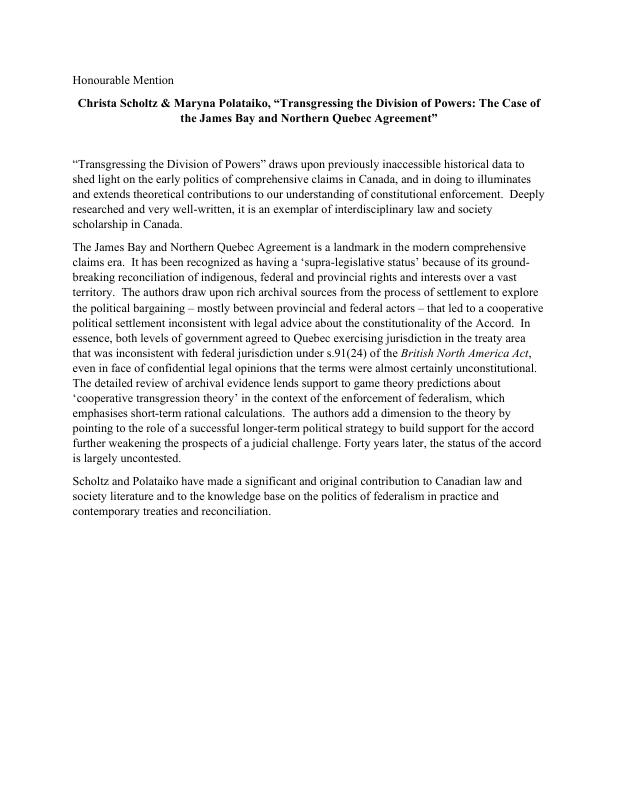
Honourable Mention Christa Scholtz & Maryna Polataiko, “Transgressing the Division of Powers: The Case of the James Bay and Northern Quebec Agreement” “Transgressing the Division of Powers” draws upon previously inaccessible historical data to shed light on the early politics of comprehensive claims in Canada, and in doing to illuminates and extends theoretical contributions to our understanding of constitutional enforcement. Deeply researched and very well-written, it is an exemplar of interdisciplinary law and society scholarship in Canada. The James Bay and Northern Quebec Agreement is a landmark in the modern comprehensive claims era. It has been recognized as having a ‘supra-legislative status’ because of its ground- breaking reconciliation of indigenous, federal and provincial rights and interests over a vast territory. The authors draw upon rich archival sources from the process of settlement to explore the political bargaining – mostly between provincial and federal actors – that led to a cooperative political settlement inconsistent with legal advice about the constitutionality of the Accord. In essence, both levels of government agreed to Quebec exercising jurisdiction in the treaty area that was inconsistent with federal jurisdiction under s.91(24) of the British North America Act, even in face of confidential legal opinions that the terms were almost certainly unconstitutional. The detailed review of archival evidence lends support to game theory predictions about ‘cooperative transgression theory’ in the context of the enforcement of federalism, which emphasises short-term rational calculations. The authors add a dimension to the theory by pointing to the role of a successful longer-term political strategy to build support for the accord further weakening the prospects of a judicial challenge. Forty years later, the status of the accord is largely uncontested. Scholtz and Polataiko have made a significant and original contribution to Canadian law and society literature and to the knowledge base on the politics of federalism in practice and contemporary treaties and reconciliation.