Reading note · CLSA / ACDS
Perverting Justice — IJR volume 14 call, 2024 records a call with its own topic, eligibility and timetable. An available document does not establish that submissions are still accepted. Read the deadline and organiser’s route in the source before taking action.
Evaluate a call
First compare your research question with the theme. Then identify the required format, length, language, eligible participants and deadline. Make a checklist using the exact wording and page number. Ask the organiser about any ambiguous criterion; do not infer an extension from an old or differently named file.
Submission planning sheet
Call and edition: __. Theme fit: __. Required format: __. Language: __. Deadline stated in source: __. Current status confirmed with: __. Submission route: __. Outstanding question: __.
2 pages of text
Source-language text, including both languages where the original is bilingual. Page numbering follows the obtained document.
Page 1
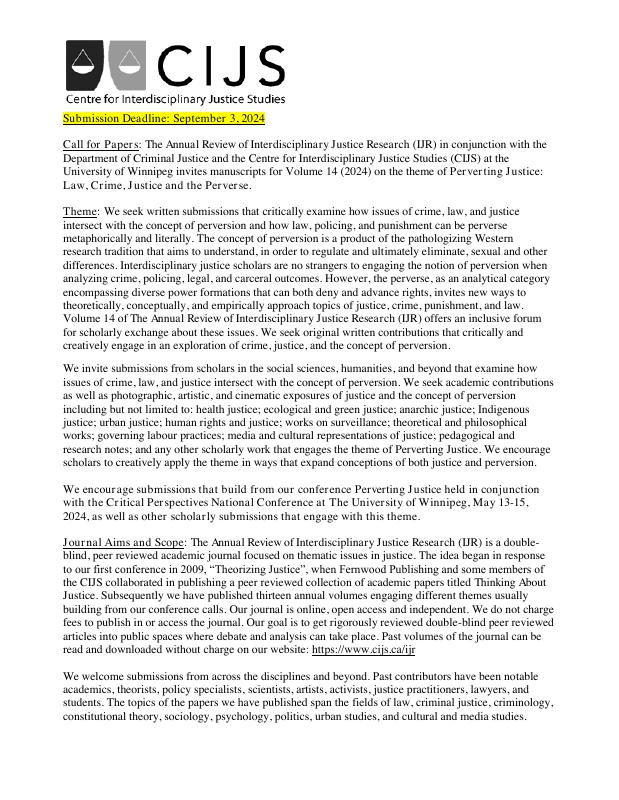
Submission Deadline: September 3, 2024 Call for Papers: The Annual Review of Interdisciplinary Justice Research (IJR) in conjunction with the Department of Criminal Justice and the Centre for Interdisciplinary Justice Studies (CIJS) at the University of Winnipeg invites manuscripts for Volume 14 (2024) on the theme of Perverting Justice: Law, Crime, Justice and the Perverse. Theme: We seek written submissions that critically examine how issues of crime, law, and justice intersect with the concept of perversion and how law, policing, and punishment can be perverse metaphorically and literally. The concept of perversion is a product of the pathologizing Western research tradition that aims to understand, in order to regulate and ultimately eliminate, sexual and other differences. Interdisciplinary justice scholars are no strangers to engaging the notion of perversion when analyzing crime, policing, legal, and carceral outcomes. However, the perverse, as an analytical category encompassing diverse power formations that can both deny and advance rights, invites new ways to theoretically, conceptually, and empirically approach topics of justice, crime, punishment, and law. Volume 14 of The Annual Review of Interdisciplinary Justice Research (IJR) offers an inclusive forum for scholarly exchange about these issues. We seek original written contributions that critically and creatively engage in an exploration of crime, justice, and the concept of perversion. We invite submissions from scholars in the social sciences, humanities, and beyond that examine how issues of crime, law, and justice intersect with the concept of perversion. We seek academic contributions as well as photographic, artistic, and cinematic exposures of justice and the concept of perversion including but not limited to: health justice; ecological and green justice; anarchic justice; Indigenous justice; urban justice; human rights and justice; works on surveillance; theoretical and philosophical works; governing labour practices; media and cultural representations of justice; pedagogical and research notes; and any other scholarly work that engages the theme of Perverting Justice. We encourage scholars to creatively apply the theme in ways that expand conceptions of both justice and perversion. We encourage submissions that build from our conference Perverting Justice held in conjunction with the Critical Perspectives National Conference at The University of Winnipeg, May 13-15, 2024, as well as other scholarly submissions that engage with this theme. Journal Aims and Scope: The Annual Review of Interdisciplinary Justice Research (IJR) is a double- blind, peer reviewed academic journal focused on thematic issues in justice. The idea began in response to our first conference in 2009, “Theorizing Justice”, when Fernwood Publishing and some members of the CIJS collaborated in publishing a peer reviewed collection of academic papers titled Thinking About Justice. Subsequently we have published thirteen annual volumes engaging different themes usually building from our conference calls. Our journal is online, open access and independent. We do not charge fees to publish in or access the journal. Our goal is to get rigorously reviewed double-blind peer reviewed articles into public spaces where debate and analysis can take place. Past volumes of the journal can be read and downloaded without charge on our website: https://www.cijs.ca/ijr We welcome submissions from across the disciplines and beyond. Past contributors have been notable academics, theorists, policy specialists, scientists, artists, activists, justice practitioners, lawyers, and students. The topics of the papers we have published span the fields of law, criminal justice, criminology, constitutional theory, sociology, psychology, politics, urban studies, and cultural and media studies.
Page 2
Editorial and Peer Review: Submissions are selected by the IJR editorial board from manuscripts received through our yearly call for papers. To ensure editorial and academic integrity, all submissions are subject to a double-blind, peer review process. Submission Guidelines and Procedures: Submissions must be original work not published or submitted elsewhere for review. If you submit an article, you are agreeing to our exclusive submission policy. Manuscripts should range between 6000-8000 words including all references and notes. Please remove all identifying information from the body of the manuscript. Your identifying information should appear on a separate cover page, along with contact information, including your email address, mailing address and affiliation. Your work must include an abstract of under 200 words as well as a title and keywords. If you are interested in submitting a book review, a research note or another form of written scholarship other than a research article, please contact us well in advance of the submission deadline for further information. Usually we do not accept book reviews that are longer than 2500 words or research notes or commentaries that are longer than 5000 words. An abstract of under 150 words is required for these submissions. We welcome artistic works that relate to themes of justice, including visual art, poetry, prose and other art work. Please contact us in advance before submitting artistic works. Citations and references should conform to APA guidelines. Tables and figures can be costly and time consuming to reproduce. Please keep tables and figures to an absolute minimum. Lengthy footnotes are also to be avoided. Footnotes should be used sparingly and not in place of in-text citations. All submissions are subject to double-blind peer review and subsequent editorial acceptance prior to publication. All submissions must be submitted electronically in MS Word format. Submissions will be reviewed by the editorial collective and sent out for double-blind peer review to scholars who are suitably versed in the subject matter of the submission. Two to three double blind peer reviews will be sought. Following the peer review process the manuscript will be either accepted, accepted subject to revisions, requested to be revised and resubmitted within a certain time frame, or declined. Revisions must be completed strictly within the specified timeframe to ensure we meet our deadline for annual publication. Submissions or revisions received beyond the specified due dates will not be published in the current volume but may be considered for future volumes of the journal. Acceptance of a piece will include open access publication through the CIJS webpage and physical publication in a volume of the Annual Review. Your work will be publicized and available through Facebook, Twitter and Academia.edu. All submissions and inquiries should be made via our email: CIJS@uwinnipeg.ca Submission Deadline: September 3, 2024