Reading note · CLSA / ACDS
Bulletin — Autumn 2009 records information for a particular institution, meeting or decision. Use its date and context before drawing a conclusion about present arrangements.
Read with context
Identify who issued the document, what action or decision it records, and the period to which it applies. Separate a proposed action from a confirmed decision. For a policy, appointment or venue, seek the institution’s latest notice before relying on it.
Evidence note
Issuer: __. Date: __. Action or decision: __. People or institutions named: __. Source page: __. Later confirmation needed: __.
12 pages of text
Source-language text, including both languages where the original is bilingual. Page numbering follows the obtained document.
Page 1
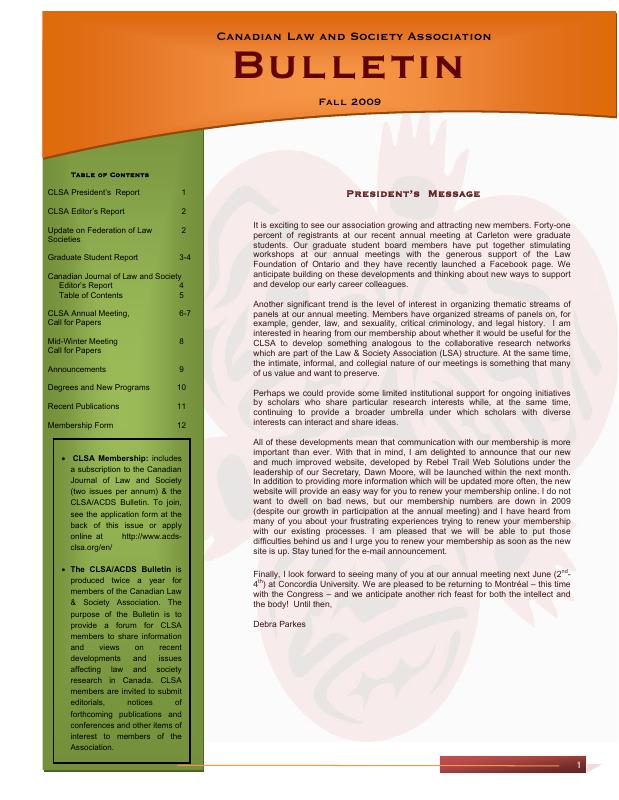
Canadian Law and Society Association Bulletin Fall 2009 Table of Contents CLSA President’s Report 1 President’s Message CLSA Editor’s Report 2 It is exciting to see our association growing and attracting new members. Forty-one Update on Federation of Law 2 Societies percent of registrants at our recent annual meeting at Carleton were graduate students. Our graduate student board members have put together stimulating Graduate Student Report 3-4 workshops at our annual meetings with the generous support of the Law Foundation of Ontario and they have recently launched a Facebook page. We Canadian Journal of Law and Society anticipate building on these developments and thinking about new ways to support Editor’s Report 4 and develop our early career colleagues. Table of Contents 5 Another significant trend is the level of interest in organizing thematic streams of CLSA Annual Meeting, 6-7 panels at our annual meeting. Members have organized streams of panels on, for Call for Papers example, gender, law, and sexuality, critical criminology, and legal history. I am interested in hearing from our membership about whether it would be useful for the Mid-Winter Meeting 8 CLSA to develop something analogous to the collaborative research networks Call for Papers which are part of the Law & Society Association (LSA) structure. At the same time, the intimate, informal, and collegial nature of our meetings is something that many Announcements 9 of us value and want to preserve. Degrees and New Programs 10 Perhaps we could provide some limited institutional support for ongoing initiatives Recent Publications 11 by scholars who share particular research interests while, at the same time, continuing to provide a broader umbrella under which scholars with diverse Membership Form 12 interests can interact and share ideas. All of these developments mean that communication with our membership is more important than ever. With that in mind, I am delighted to announce that our new CLSA Membership: includes and much improved website, developed by Rebel Trail Web Solutions under the a subscription to the Canadian leadership of our Secretary, Dawn Moore, will be launched within the next month. Journal of Law and Society In addition to providing more information which will be updated more often, the new (two issues per annum) & the website will provide an easy way for you to renew your membership online. I do not CLSA/ACDS Bulletin. To join, want to dwell on bad news, but our membership numbers are down in 2009 see the application form at the (despite our growth in participation at the annual meeting) and I have heard from back of this issue or apply many of you about your frustrating experiences trying to renew your membership with our existing processes. I am pleased that we will be able to put those online at http://www.acds- difficulties behind us and I urge you to renew your membership as soon as the new clsa.org/en/ site is up. Stay tuned for the e-mail announcement. The CLSA/ACDS Bulletin is Finally, I look forward to seeing many of you at our annual meeting next June (2nd- produced twice a year for 4th) at Concordia University. We are pleased to be returning to Montréal – this time members of the Canadian Law with the Congress – and we anticipate another rich feast for both the intellect and & Society Association. The the body! Until then, purpose of the Bulletin is to provide a forum for CLSA Debra Parkes members to share information and views on recent developments and issues affecting law and society research in Canada. CLSA members are invited to submit editorials, notices of forthcoming publications and conferences and other items of interest to members of the Association. 1
Page 2
CLSA Bulletin Spring 2009 Board Of Directors Officers/Executive Editor’s Note Debra Parkes I would like to take this opportunity to introduce myself as the new editor of the President CLSA Bulletin. My thanks to Kimberly White for making this transition as smooth Faculty of Law as possible, and to Sana Affara for her time and tremendous expertise in helping University of Manitoba me to put this together and to imagine what else we may do with a newsletter. I debra_parkes@umanitoba.ca also want to express my appreciation to Dominque Nanoff for her assistance with Tel: 204-474-9776 French translation. Finally, my thanks to all the members who sent in your news, announcements, and reports. In addition to the President’s Report (on the front Richard Weisman cover), in this Fall Bulletin you will find the table of contents for the next Canadian Vice-President Journal of Law and Society, guest edited by Lorne Sossin and Anna Pratt, a report Law & Society Program from the Graduate Students, including information about their new Facebook page, Division of Social Sciences information about the upcoming Mid-winter meeting at York University, February 5- York University 6, an impressive list of new publications since the last bulletin, and much more. rweisman@yorku.ca Tel: 416-736-2100 ext. 70452 I look forward to continuing to work with all of you in communicating our news and business. Please do let me know if you have ideas or suggestions for future Dawn Moore Bulletins. Secretary CJLS/RCDS Managing Editor Amanda Glasbeek Department of Law Carlton University moore@ccs.carleton.ca Tel: 520-2600 ext. 3823 Update on the Federation of Law Societies’ Augustine Park Report on Legal Education Treasurer Department of Sociology and The Federation of Law Societies of Canada is anticipating the final report of its Anthropology Task Force on the Accreditation of Canadian Law Degrees early this fall. Many Carleton University CLSA members offered countless hours, incredible energy, and hard work in Augustine_SJ_Park@carleton.ca developing the brief submitted jointly with the Canadian Association of Law Tel: 613 520 2600 ext. 2593 Teachers (CALT) to the Task Force about the problems potentially posed by increased professional regulation over legal education. Informed sources suggest Mariana Valverde that our carefully-argued brief has not significantly altered the ultimate CJLS/RCDS Editor (English recommendations that the Task Force will make shortly. While the list of Co-Editor) "mandatory competencies" being set forth may have altered slightly, it seems that Centre of Criminology there will be a new list of compulsory requirements, and an oversight process to University of Toronto supervise and enforce the new rules. m.valverde@utoronto.ca Tel: 416-978-6438 ext. 229 The Federation has no implementation authority for any of its rules until it receives agreement from each provincial law society. Consequently, once the Task Force Michel Coutu Report is made public, the arena of debate will shift to the Law Societies in each CJLS/RCDS French Co-Editor province. If some of the Law Societies can be convinced Faculty of Arts & Sciences - to step back from the Task Force's problematic recommendations, the whole School of Industrial Relations process might go back to the drawing board for more reflective and evidence- University of Montreal based analysis. michel.coutu@umontreal.ca Tel : 514-343-6095 At this stage we would recommend the following: Amanda Glasbeek 1) Watch for the release of the Task Force Report, which we will post to the Newsletter Editor CLSA website as soon as it becomes available Division of Social Sciences York University 2) Working groups should be established in each province to lobby against the aglasbee@yorku.ca approval of the Task Force recommendations at the level of the provincial law Tel: (416) 736-2100 x 33749 society. EDITOR’S NOTE: The Federation’s Final Report has since been received. See acds-clsa.org for a further update. 2
Page 3
3 Graduate student information DIRECTORS-AT-LARGE The CLSA members and Board strongly value graduate student participation in STUDENT DIRECTORS Association activities and conferences. To that end, graduate students from multiple disciplines engaging in socio-legal scholarship are encouraged, including Suzanne Bouclin offering some funding support, to participate in the CLSA annual meeting, to Graduate Student present papers and chair panels at the annual Conference, and to submit articles Representative to the Journal of Law and Society. Faculty of Law McGill University Every year we elect one of two of the Graduate Student Representatives who hold Montreal, QC a two-year term. Suzanne Bouclin (PhD candidate, McGill) has been a Grad Rep suzanne.bouclin@mail.mcgill.c since 2008 and Mary Stokes (PhD candidate, Osgoode) was elected at the CLSA a conference held at Carleton University in May 2009. Mary is replacing Nicole O’Byrne. Nicole has recently joined the Law faculty at the University of New Mary Stokes Brunswick; we offer her our congratulations and thanks for her contribution to the Graduate Student Association on behalf of all graduate students members. Representative Osgoode Hall Law School With financial assistance from the Association - and this year especially from the marystokes@osgoode.yorku.ca Law Foundation of Ontario - grad reps organize a social event exclusively for grad students. Participants this year were especially impressed by the opportunities to CLASS OF 2012 socialize with other graduate students and professors at the informal supper and the tailored workshops that were designed to address questions posed by students Jane McMillan at last year’s workshop. Department of Anthropology St. Francis Xavier This year’s graduate workshop emphasized three areas of interest: how to give Antigonish, NS B2G 2W5 effective conference presentations; how, where and when to publish; and ljmcmill@stfx.ca academic job hunting. All three sessions were productive and well attended. For Tel: 902-867-5021 those who could not make it (and those who would like their memories refreshed), here are some highlights. Benjamin Berger Conference Presentation Faculty of Law University of Victoria Richard Weisman reminded students of the importance of conference talks as a Murray and Anne Fraser crucial part of the process of academic professionalization. Importantly, they are a Building means of getting meaningful feedback on ideas at various stages of development. bberger@uvic.ca Diane Crocker suggested that presenters make one main point to be further nuanced and enriched throughout the talk. She added that it can often be useful Nicolas Carrier to end a talk with a series of open-ended questions. Mariana Valverde indicated Institute of Criminology and that too complex theoretical overviews can distract from the overall flow of a talk. Criminal Justice When theory is an integral part of a talk, she suggested that it be included at the Carleton University end, rather than the beginning. She believes that presentations should be Tel: 613-520-2600 ext. 1237 entertaining, unlike job talks, which she feels should be serious. Nicolas_carrier@carleton.ca Publishing Dawn Moore gave several practical pointers on the publishing process: it is important to write a good abstract and covering letter; it is key to have others read draft versions; you should always make sure you fit the journal’s mandate; your article should highlight with which theorists you are in conversation; and make sure your paper follows journal-specific publishing guidelines. Christiane Wilke explained that book reviews are an excellent way to beginning a publishing career. To her, an excellent book review is one that provides context for the book within existing literature, explains how readers from various disciplines might be interested in the book, and does not artificially criticize the author’s work. Finding Academic Positions Shauna Van Praagh explained that the job talk is a misnomer; it is neither just a talk, nor is it solely aimed at getting a job. Instead, the job talk is an opportunity for us to present ideas, to illustrate scholarly creativity, to demonstrate pedagogical philosophies, and to give the faculty an idea of how you would ‘fit in’ to the existing faculty. She also gave students a number of practical tips such as to know and respect your audience (but do not overly design your talk in response to a particular expert on the panel), wear a watch, go easy on the caffeine, not to have spillable drinks near your papers while talking, and (though it may seem hard) try to relax and enjoy yourself. 3 1
Page 4
DIRECTORS-AT-LARGE Graduate student information Continued Continued CLSA Graduate Workshop CLASS OF 2011 Annie Bunting Next year’s line-up will be equally promising. Topics will range from the ethical, Law & Society Program practical, and theoretical. We would like to invite speakers to discuss the Division of Social Sciences following: choosing/changing a supervisor/committee, applying for post-docs, York University teaching effective seminars and lectures, the relationship between pedagogy and abunting@yorku.ca activism, how to develop a teaching portfolio and integrating new media Tel: 416-736-2100 technologies in classrooms. We also plan to have a theoretical session in which an invited lecturer will present her or his work-in-progress or published piece with ext.20500 which graduate students will be invited to critical engage. Renisa Mawani It is our sincere hope graduate students will continue to be involved in this Department of Sociology planning process. CLSA Graduate Students’ Workshops are designed for and by University of British Columbia graduate students. Help us make 2010 Graduate workshops especially renisa@interchange.ubc.ca outstanding this year, offer your suggestions as to speakers or topics, and get Tel: 604-822-6494 involved directly as next year’s student representative. Please note that elections for the Graduate Rep (2010-2012) will take place in May. Contact us if you have CLASS OF 2010 comments or want additional information: atelierlawandsociety@yahoo.com Melanie Méthot Augustana Faculty We now have a facebook page: Clsa-acds GradauteStudents University of Alberta http://www.facebook.com/profile.php?id=100000306918165&ref=ts melanie.methot@ualberta.ca Tel: 780-679-1518 We look forward to seeing you in the spring! Suzanne Bouclin and Mary Stokes, CLSA Graduate Students’ Dwight Newman Representatives College of Law University of Saskatchewan dwight.newman@usask.ca Canadian Journal of Law and Society Tel: 306-966-4847 Editor’s Report We are happy to report that things are going very well at the association journal. Dawn Moore has stepped down as managing editor and is enjoying a well- deserved sabbatical; her Carleton colleague Christiane Wilke has replaced her and the transition has been very smooth, in part because Sue Gemmell continues to provide the journal with top-notch administrative assistance. Christiane, formerly English-language book review editor, has in turn been replaced by Ummni Khan. France Houle continues to serve as French book-review editor, working with the French-language editor, Michel Coutu. We have two very positive announcements to make to the membership. First, we have decided to form a new international advisory board, in line with the practice at many other scholarly journals. We are happy to say that Eve Darian-Smith, Ngaire Naffine, Pierre Guibentif, and Liora Israel, whose names are no doubt familiar to many of you, were all very happy to accept our request. And this is no mere honour. Eve is already writing a book review for us and Liora has been very helpful in widening our reviewer base and making our journal better known in France. Congratulations to Dawn Moore for having managed this process. We are also beginning to get more international submissions than has been the case in the past, and we hope our international advisors will help along that process. The second announcement concerns upcoming special issues that we think will be of great interest. One special issue, now just going to press, gathers together empirical studies of the workings of discretion, in both administrative and policing contexts. This was edited jointly by Anna Pratt and Lorne Sossin. The collaboration of a legal scholar and a social scientist was important in generating a wide-ranging set of studies -- see table of contents reprinted below. Mariana Valverde 4
Page 5
CLSA Bulletin Spring 2009 Canadian Journal of Law and Society DILEMMAS OF DISCRETION/ Les dilemmes du pouvoid discretionnaire TABLE OF CONTENTS Volume 24, No. 3, 2009 Anna Pratt and Lorne Sossin, Guest Editors / Coordinateurs A Brief Introduction of the Puzzle of Discretion Geneviève Cartier Administrative Discretion and the Spirit of Legality: From Theory to Practice Philip C. Stenning Discretion, Politics, and the Public Interest in “High-Profile” Criminal Investigations and Prosecutions Josiah McC. Heyman Trust, Privilege, and Discretion in the Governance of the US Borderlands with Mexico Kelly Hannah-Moffat, Paula Maurutto, and Sarah Turnbull Negotiated Risk: Actuarial Illusions and Discretion in Probation Chowra Makaremi Governing Borders in France: From Extraterritorial to Humanitarian Confinement Book Reviews / Comptes-rendus Daniel Mockle La Gouvernance, le droit et l’état : La question du droit dans la gouvernance publique Bruxelles : Bruylant, 2007 Martine Valois Sheila Cavanagh Sexing the Teacher: School Sex Scandals and Queer Pedagogies Vancouver: UBC Press, 2007, 230 p. Heather Shipley Catherine Dauvergne Making People Illegal New York: Cambridge University Press, 2008, 230 p. Anastasia Tataryn Daisy Delogu Theorizing the Ideal Sovereign: The Rise and Fall of the French Vernacular Royal Biography Toronto: University of Toronto Press, 2008, 320 p. Dorothy Kwek Kyle Grayson Chasing Dragons: Security, Identity and Illicit Drugs in Canada Toronto: University of Toronto Press, 2008, 323 p. Nicolas Carrier Joanna R. Quinn (ed.) Reconciliation(s): Transitional Justice in Postconflict Societies Montreal & Kingston: McGill-Queen’s University Press, 2009, viii, 313 p. Ernesto Verdeja 5 5
Page 6
2010 Canadian Law and Society Association Annual Meeting 79th congress of the Humanities and Social Sciences Call for papers Connected Understanding – Le Savoir Branché Concordia University Montreal, QC June 2-4, 2010 The program committee of the Canadian Law & Society Association invites submissions for the 2010 annual meeting of the Congress of the Humanities and Social Sciences to be held June 2-4, 2010 at Concordia University, Montreal, Quebec. We welcome proposals for papers in any area of law and society scholarship. We encourage participants to submit suggestions for complete panels and round tables, but also welcome individual submissions. Please include a panel theme, paper titles, and abstracts of up to 250 words, along with your technological needs and full institutional affiliations and contact information for each presenter. If you are willing to participate as a panel chair, please indicate this on your submission. Streams of panels on particular themes are also welcome. Past streams have focused on, for example, gender and sexuality or indigenous legal knowledge. This year Nicolas Carrier and Bastien Quirion are organizing a bilingual stream focusing on critical criminology (for more information, please contact nicolas_carrier@carleton.ca, or see next page). Early expressions of interest are encouraged; the deadline for proposals is January 29, 2010. Please forward your panel and paper proposals, as well as any questions or comments you may have, to the Chair of the CLSA program committee, Mélanie Méthot, at mmethot@ualberta.ca. Information on conference registration, accommodation and other Congress activities will be found at www.congress2010.ca and in the registration guide to be mailed in January. Diana Young, winner of the 2008 CJLS Article Prize and Diane Crocker, Chair of the Article Prize Committee 6
Page 7
2010 Canadian Law and Society Association Annual Meeting Call for Papers Critical Criminology in Canada: Legacies, Challenges, Possibilities Today, Canadian scholars preoccupied by crime related issues can benefit from a rich and important legacy of research in critical criminology. In contradistinction to mainstream criminology, work conducted within this tradition is characterized by a will to maintain the researchers’ independence from institutions of control, as well as by its distance from the objects and categories of thought generated by those institutions. Although critical criminological work is highly diversified and cannot be ensnared in a close and homogeneous space, it is typically federated by a commitment to social justice and politically engaged research. For the coming Canadian Law & Society Association annual meeting, we are organizing a stream on Canadian critical criminology. Our goal is to gather Canadian scholars working within this tradition to share and discuss our research activities and reflections. This meeting is also organized for us to look back at the legacies of critical criminology in Canada, and to stimulate discussions on the origins, evolution and futures of this research tradition. We invite interested scholars to come to debate the contemporary role of critical criminology, in social sciences as well as in the politics of crime control. How has critical criminology evolved over the past four decades? Should we define critical criminology by a political and epistemological stance that would be proper to it? What is critical criminology’s place in today’s Canadian research institutions? How are we to use critical work within and outside academia? How can critical criminology influence penal policies and practices? Is this influence the criteria that should be used to evaluate critical criminology? What is the role of its proponents in the public and political spheres? Should we rethink our theoretical foundations and methodological practices? What are the challenges and obstacles to the development of a new critical criminology? Many more questions could be addressed, which may lead to a collective discussion on the potential relevance of establishing and nurturing a network of critical criminologists in Canada. In order to reflect the cultural and political diversity proper to the Canadian intellectual landscape, we have opted for a model of bilingual panels. Scholars interested should submit their proposals before February 15, 2010 to: nicolas_carrier@carleton.ca. Please include an abstract of up to 250 words, paper title, along with full institutional affiliations and contact information. Please also indicate if you are willing to participate as a panel chair. Elise Chenier, recipient of Honourable Mention for the 2008 CLSA Book Prize and Richard Weisman, Chair of the Book Prize Committee 7
Page 8
Mid-Winter Meeting Hotel Accommodations CLSA Mid-Winter Meeting Downtown Toronto February 5 – 6, 2010 York University, Toronto Delta Chelse Hotel (University/corporate rate: $169/night + tax) The CLSA mid-winter organizing committee (Kimberley White, Amanda Glasbeek, www.deltachelsea.com Miriam Smith, Richard Weisman) invites everyone to attend the Mid-Winter 33 Gerard St. W. Meeting, February 5-6. A finalized version of the agenda will be posted on the Toronto, ON M5G 1Z4 Association Website in December. Below is a draft agenda, and information about (416) 595-1975 accommodations (at York and in downtown Toronto). Howard Johnson Hotel – Please confirm your attendance by emailing Kimberley White (kjwhite@yorku.ca) Yorkville ($85 - $110/night, incl. by December 15, and indicate if you are interested in participating in one of the breakfast + wireless) sessions. If you would like to present a paper (which may allow you to make a www.hojo.com claim for conference travel), please indicate a working title to be listed in the 89 Avenue Road (Avenue Rd. program. and Bloor St.) Toronto ON M5R 2G2 Friday February 5 On Campus 9:00 – 9:30 Coffee/Tea & Muffins 9:30 – 10:45 Working/Roundtable: Socio-Legal Research Methods Executive Learning Centre This workshop/roundtable will focus on issues related to teaching (graduate or ($149/night, incl. breakfast) Schulich School of Business, 56 undergraduate) interdisciplinary socio-legal and critical criminology research Fine Arts Rd. methodologies. We are looking for 4-5 people to lead this workshop. York University, 4700 Keele St. 10:45-11:00 Break Toronto ON M3J 1P3 11:00-12:15 Paper Presentations: Works in progress Phone: (416) 650-8300 12:15-1:30 Lunch Fax: (416) 650-8333 1:30-2:30 Keynote Speaker: Fuyuki Kurasawa (York Sociology, Socio- email: Legal Studies) reservations@schulich.yorku.ca 2:30-2:45 Break 2:45-4:00 Panel: Pushing the Boundaries of Socio-legal Research This panel will focus on research challenges and innovation, particularly in relation to issues of ethics and methodology. Ideas for other themes are also welcome. We are looking for 4-5 people to form the panel. 4:00-5:00 Wine and Cheese: Collective Book Launch 7:30 Social event downtown (TBA) Saturday February 6 9:30-10:00 Coffee/Tea & Muffins 10:00-3:00 CLSA Board Meeting (lunch will be provided) Debra Parkes and Dawn Moore 8
Page 9
Announcements CLSA Contact Information 1. New Website Amanda Glasbeek, Editor A new History of Madness in Canada / Histoire de la folie au Canada Website CLSA/ACDS Bulletin http://www.historyofmadness.ca/ was launched October 31st, 2009. Division of Social Science Established by a collective of researchers and educators from across the social sciences, S724A Ross Building York University this unique site has been created to enhance critical thinking, heritage preservation and Toronto, ON Canada historical research in the fields of psychiatric medicine and mental health. M2J1P3 For information please contact: robert.menzies@historyofmadness.ca Phone: (416) 736-2100 x 33749 megan.davies@historyofmadness.ca E-Mail: aglasbee@yorku.ca 2. Some Exciting News We’re on the Web! Simon Bronitt is moving from ANU to Griffith University to be the new Director of the See us at: http://www.acds- Austrailian Research Council Centre of Excellence in Policing and Security. For information clsa.org/en/ about the indisciplinary projects and PhD scholarships and visitor programs, please see http://ceps.edu.au/ 3. Announcing the formation of Red Quill Books! Red Quill Books is a new radical press committed to fostering critical scholarship in the arts and social sciences. Red Quill Books is different from traditional commercial and university presses both in its political and economic aims and in its “look” and operations. Please visit our website at www.redquillbooks.ca Red Quill Books Suite 196, 1769 St. Laurent Blvd. Ottawa, ON K1G 5X7 Fax: 613.526.4978 4. ISJR Conference, Banff, 2010, Formal Call for Submissions The Formal Call for Submissions is now open for the 13th biennial conference of the International Society for Justice Research, to be held in Banff, Canada, August 21-24, 2010. The theme of the meeting is "Rights and Equality in the Global Community". The conference is an interdisciplinary, international forum for the presentation and discussion of research on justice and fairness. Researchers of all relevant disciplines are invited to propose papers, posters, or symposia on the conference theme or any other justice-related issue. Please note: If you intend to present at the conference, you must submit again during the current Call for Submissions even if you responded with a name and title during the earlier "Intention to Submit" phase. You do not need to submit the same project. You can still submit a presentation during the current Call for Submissions if you did not previously send an "Intention to Submit." The Call for Submissions closes FEBRUARY 28, 2010.Please visit the conference website for details :http://wcmprod2.ucalgary.ca/isjr2010/ 5. Osgoode-York Seminar Series in Policy Research The purpose of this seminar series is threefold: To provide a forum for the dissemination of scholarly research and research–in progress in areas related to public policy, broadly defined;To enhance and develop interdisciplinary discourse in policy-related areas; and To bring together Osgoode and York faculty, graduate students, and advanced undergraduate students in a collegial environment. For further information, please visit http://www.yorku.ca/oysspr/ for the seminar series or email jedalton@yorku.ca. 6. Osgoode- York working paper Series in Policy Research The Osgoode-York Working Paper Series in Policy Research publishes research that has been presented as part of the seminar series, although authors who have not presented their work in the seminar series may still submit papers for consideration, provided that they relate to public policy themes, more broadly. For further information, please contact: Jennifer Dalton, Editor-in- Chief, York Centre for Public Policy & Law, 604 York Research Tower, York University, 4700 Keele Street. Toronto, Ontario M3J 1P3, jedalton@yorku.ca 9
Page 10
Degrees and New Programs: Saint Mary’s University in Halifax offers a Master of Arts in Criminology. Our program offers students an opportunity for advanced critical work in areas such as the social construction of crime, criminology and punishment; socio-legal studies; social justice and equity; and governance and regulation. The program provide students with the analytic and research skills necessary for further graduate study: research or teaching; policy research and practice; or employment in government and non-governmental agencies and the private sector. We offer competitive financial support for students in our program. Applications are due February 1, 2009. For more information contact Diane Crocker at diane.crocker@smu.ca. Memorial University will begin a Law and Society major in the Winter semester 2010. The new major will build on the successful foundation of the existing Law and Society minor, which has been offered by the Faculty of Arts for more than ten years. The program encompasses many diverse disciplines of study, among them anthropology, history, philosophy, political science, and sociology. The interdisciplinary major program will be offered to candidates for the Degree of Bachelor of Arts in conjunction with a major or minor in a single discipline. NEW PHD PROGRAM IN SOCIO-LEGAL STUDIES AT YORK UNIVERSITY: The Graduate Program in Socio-Legal Studies at York University is pleased to announce that its proposal for a PhD in Socio-Legal Studies was approved by the Ontario Council of Graduate Studies on October 23, 2009. We will be admitting students to our PhD program for 2010-2011 in the following three fields of specialization : 1- Socio-Legal Theory. 2.-Crime, Law, and Governance. 3- Comparative and Historical Perspectives in Law. For further information, deadlines, and admission requirements, please check our website at http://www.yorku.ca/gradslst/ LLM in Gender, Sexuality and Human Rights, Keele University, UK . This Masters Degree Programme aims to provide a practical and theoretical understanding of law and its relevance to issues around gender and sexuality. Whilst these are the principal areas of study, the course will engage with dynamics of class, race, ethnicity, and disability. The course aims to develop not only subject-specific knowledge and skills, but also transferable skills. In terms of the latter, particular attention is paid to research and analytical skills. The course also aims to provide a foundation for pursuing further study at doctoral level. www.keele.ac.uk/postgraduate In 2010-11 the Master*s Programme of the Oñati International Institute for the Sociology of Law will be in its 21st year. We have assembled an excellent group of teachers, leading scholars in their field, to deliver what we consider to be a unique and outstanding international programme in socio-legal studies. For information and application forms: Susana Arrese Murguzur, IISL – Avenida de la Universidad, 820560 Oñati – Gipuzkoa – Spain Tel: + 34 943 71 88 85 / 78 30 64 Fax: + 34 943 78 31 47 Email:susana@iisj.es Constance Backhouse, winner of the 2008 CLSA Book Prize and Richard Weisman, Chair of the Book Prize Committee 10
Page 11
Recent Publications Backhouse, Constance (2009). De la couleur des lois: Histoire Juridique du Racisme au Canada, 1900-1950 Ottawa: Université of Ottawa Press. (Scheduled for release fall 2009) Backhouse, Constance and W. Wesley Pue eds (2009). The Promise and Perils of Law: Lawyers in Canadian History. Toronto: Irwin Law. Contributors: Deidre Rowe Brown, David Bell, Melanie Brunet, Philip Girard & Jeffrey Haylock,Christopher Moore, Jeane-Philippe Garneau, Donald Fyson, Jim Phillips, Eric Adams, June Girvin & Jeffrey Walsh, Susan Lewthwaite, Hamar Foster, Dorothy Chunn & Joan Brockman, Constance Backhouse Foster, Hamar John McLaren, and W. Wesley Pue eds (2009). Historical Essays on the British Columbia Court of Appeal, BC Studies, Symposium Issue on the Centenary of the British Columbia Court of Appeal. A more detailed description and instructions for ordering a copy are at http://www.bcstudies.com/. Glasbeek , Amanda (2009) Feminized Justice: The Toronto Women’s Court, 1913-34. UBC Press. Dwight Newman (2009) The Duty to Consult: New Relationships with Aboriginal Peoples Puritch Publishing http://www.purichpublishing.com/ Pue, W. Wesley (2009). Security for the 2010 Olympics - The Gap in Police Powers Under Canadian Law. with Robert Diab) The Advocate) (covered as news item by Georgia Straight July 16, 2009, http://www.straight.com/article-240554/profs-say-cops-olympic-plans- illegal W. Wesley Pue. The Gap in Canadian Police Powers: Why Canada Needs Public Order Policing Legislation (with Robert Diab) (in submission) Rigakos, George, John L. McMullan, Joshua Johnson and Gulden Ozcan eds (2009)., A General Police System: Political Economy and Security in the Age of Enlightenment. Ottawa, Red Quill Books. Woolford, Andrew (2009) The Politics of Restorative Justice: A Critical Introduction, Fernwood Publishing. www.fernwoodpublishing.ca/book/411 White, Kimberly (ed) (2009). Configuring Madness: Representation, Contest, and Meaning. Oxford, Inter-Disciplinary Press. http://www.inter- disciplinary.net/publishing/id-press/books/configuring-madness 11
Page 12
Canadian Law and Society Association 2009 Membership Membership fees include subscription to the Canadian Journal of Law and Society, and to the Association’s biannual Bulletin. Institutions can subscribe to the Journal only. Other Canada Countries CAN$ US$ Regular, one year 90.00 110.00 Regular, three years 240.00 280.00 Sustaining members, one year (inc $40 for student 100.00 105.00 travel grants) Student/Underemployed, one year 30.00 45.00 Emeritus, one year 50.00 60.00 Institution, one year 90.00 105.00 Institution, one year (non-member) 75.00 90.00 Third World Library (gift) 40.00 55.00 Membership fees include all taxes and postage, world wide. Please complete the credit card information below, or send a cheque (Canadian or American bank) or money order payable to University of Toronto Press. Would you like a receipt?: ____ Yes ____ No _______________________________________________________________ Name _______________________________________________________________ Address _______________________________________________________________ _______________________________________________________________ ____________________ ___________________ ___________________ Phone Fax Email ___ Visa ___ Mastercard ___ American Express ___________________________________________ ________________ Number Expiry Date ___________________________________________ ________________ Signature Date Fax, mail or e-mail completed form to: University of Toronto Press – Journals Division 5201 Dufferin Street, Toronto (Ontario) Canada M3H 5T8 Tel: (416) 667-7810 Fax: (416) 667-7881 Fax Toll Free in North America: 1-800-221-9985 Email: journals@utpress.utoronto.ca