Reading note · CLSA / ACDS
Bulletin — Spring 2015 brings together the Association’s activities and scholarly notices in one dated issue. Read the page headings to distinguish reports on completed work from announcements of planned events. Names and offices reflect the issue, not necessarily the current board.
How to use this issue
Choose one theme or author. Search their name below, record the page, then note whether the item is a report, a call, a prize announcement or a publication reference. Follow the named publication or organising institution for subsequent developments.
Reading note template
Issue: Bulletin — Spring 2015. Page: __. Item or author: __. Type of item: __. What the source states: __. What needs checking elsewhere: __. This separates the document’s evidence from your interpretation.
24 pages of text
Source-language text, including both languages where the original is bilingual. Page numbering follows the obtained document.
Page 1
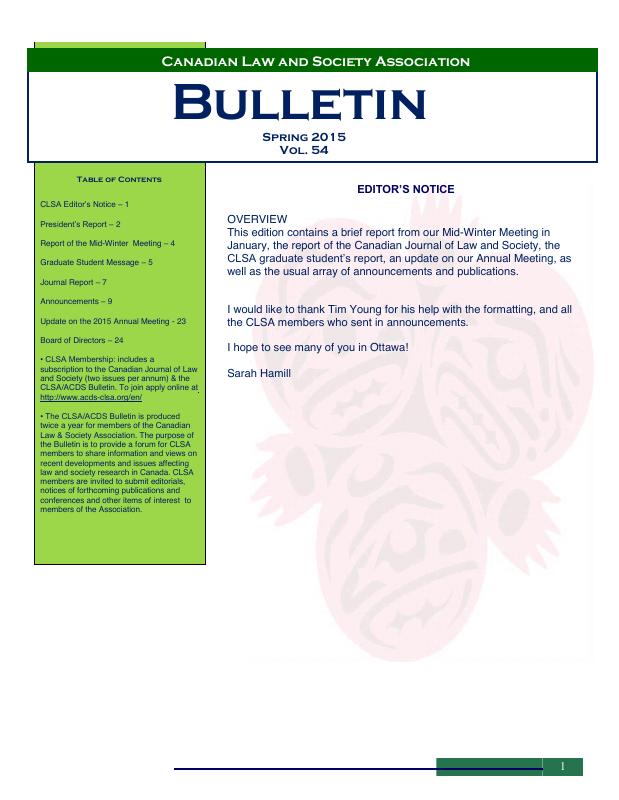
Canadian Law and Society Association Bulletin Spring 2015 Vol. 54 Table of Contents EDITOR’S NOTICE CLSA Editor’s Notice – 1 President’s Report – 2 OVERVIEW This edition contains a brief report from our Mid-Winter Meeting in Report of the Mid-Winter Meeting – 4 January, the report of the Canadian Journal of Law and Society, the Graduate Student Message – 5 CLSA graduate student’s report, an update on our Annual Meeting, as well as the usual array of announcements and publications. Journal Report – 7 Announcements – 9 I would like to thank Tim Young for his help with the formatting, and all Update on the 2015 Annual Meeting - 23 the CLSA members who sent in announcements. Board of Directors – 24 I hope to see many of you in Ottawa! • CLSA Membership: includes a subscription to the Canadian Journal of Law and Society (two issues per annum) & the Sarah Hamill CLSA/ACDS Bulletin. To join apply online at http://www.acds-clsa.org/en/ • The CLSA/ACDS Bulletin is produced twice a year for members of the Canadian Law & Society Association. The purpose of the Bulletin is to provide a forum for CLSA members to share information and views on recent developments and issues affecting law and society research in Canada. CLSA members are invited to submit editorials, notices of forthcoming publications and conferences and other items of interest to members of the Association. 1
Page 2
President’s Report Preparations are well underway for our annual conference in Ottawa on June 3-5. Lara Karaian is putting the finishing touches on the program, Jordan Palmer is seeing to the logistics, and everything is falling into place for another successful event. Once we return home from Ottawa, I would like to encourage all members to think outside our traditional January-June binary. The Association tends to come into view twice a year, but it need not be so. Think about organizing a local or regional initiative next year under the CLSA banner. Events closer to home would provide a way to share ideas and keep in touch for graduate students as well as any of us whose time and budget for travel are limited. Regional events would also help bring in new members, especially if we can get events going outside the Toronto-Ottawa-Montreal triangle. How about a mini-conference on the Prairies? Or a workshop in the Halifax area? The possibilities are many! In other developments, Jane McMillan and Maura Matesic are heading the CLSA Legacy Project, an exciting initiative that will preserve and make available the CLSA’s organizational history. Our archives are being digitized at York University, from where they will eventually be linked to our website (www.acds-clsa.org), providing a record of past conferences, prize winners, the history of the CLSA and the Canadian Journal of Law and Society, and other records. There are also plans for legacy creation – beginning as early as the Ottawa meeting. Details to follow. Our mentorship project is set to launch, which will provide graduate students, post-doctoral fellows, or any member with the benefits of another pair of eyes to go over grant applications, course outlines, and so on. Watch your inbox and the CLSA website for details. I hope to see you in great numbers in Ottawa in June! Eric Reiter CLSA President 2
Page 3
La Lettre du Président Les préparatifs de notre réunion annuelle à Ottawa le 3-5 juin sont bien avancés. Lara Karaian met la dernière main au programme, Jordan Palmer s'occupe de la logistique, et tout se met en place pour un événement à ne pas manquer. Après la réunion à Ottawa, je voudrais vous encourager de réfléchir en dehors de notre cadre habituel de deux réunions par année, janvier et juin. L'ACDS a tendance de n'apparaitre que deux fois par année, mais pourquoi? Songez à organiser une initiative locale ou régionale l'an prochain sous la bannière de l'ACDS. Des événements plus près donneront l'occasion aux étudiants ou aux autres avec des ressources limitées pour déplacement l'occasion de partager des idées et de rester en contact dans l'intervalle. Ce sorte de réunion attirerait également de nouveaux membres, et surtout des membres en dehors du triangle Toronto-Ottawa-Montréal. Il y a beaucoup de possibilités! Peut-être un mini-colloque dans les Prairies? Ou un atelier à Halifax? Pensez-y! Un autre développement est le projet héritage, pris en main par Jane McMillan et Maura Matesic. Ce projet préservera et fera disponible l'histoire organisationnelle de l'ACDS. Nos archives sont en train d'être numérisées à l'Université York, d'où elles seront éventuellement liées à notre site web (www.acds- clsa.org). Nous aurons donc une ressource sur notre passée : nos réunions, les lauréats de nos prix, l'histoire de l'ACDS et de la Revue canadienne droit et société, et cetera. Il y aussi des plans pour créer un peu d'histoire – commençant peut-être dès la réunion à Ottawa. Des détails suivront… Notre projet de mentorat est prêt à lancer, ce qui donnera aux étudiants, aux bousiers post-doctoral, ou à n'importe quel membre des « yeux supplémentaires » pour passer en revue des demandes de subvention, des plans de course, et ainsi de suite. Surveillez votre courrier électronique ou le site web de l'ACDS pour des détails. Au plaisir de vous voir en grand nombre à Ottawa en juin! Eric Reiter Président de l'ACDS 3
Page 4
Report of the Mid-Winter Meeting This year’s midwinter meeting was held at Concordia University in Montreal on the 17th and 18th of January, 2015. This year there were five panels dealing with topics ranging from Competing Normativies, and Rights, to the question of Representation, and the intersection of Criminal Law and Public Health. Presenters gave papers in both English and French. Thanks are owed to Alana Klein for putting the program together, Eric Reiter for his help with the practical details of the conference, and to the presenters and attendees. The following day the CLSA Board met and received reports from the President, the Treasurer, and CJLS. Lisa Wright and Sara Ross delivered a report on graduate student initiatives and the mentorship program. Lara Karaian provided an update about the CLSA Annual Meeting in June, 2015 in Ottawa, ON. 4
Page 5
Graduate Student Message Dear ACDS/CLSA Graduate Students, Warm weather is just around the corner, and so are an array of exciting upcoming events and opportunities for graduate students! 1. 2015 CLSA CONFERENCE a) CONGRESS Congress of the Humanities and Social Sciences 2015 will be taking place in Ottawa between May 30th to June 5th and is hosted by the University of Ottawa. For more information and to register, you can visit their website: http://congress2015.ca/. The 2015 annual CLSA conference will be taking place as part of the Congress gathering from June 3rd to the June 5th. This is a great place to expose yourself to new research, present your own research, and to make great connections within the academic community that interests you. b) CLSA/CALT GRADUATE STUDENT METHODS AND APPROACHES CAFÉ Of special interest to our graduate student members is the Graduate Student Methods and Approaches Café that we are holding jointly with the graduate student representatives for the Canadian Association of Law Teachers (CALT). This will take place the morning of June 3rd, 2015. During the arc of their graduate studies, a major challenge that law and society scholars face is how to gather all the “stuff” that will make up the body of their project and how to approach answering their carefully crafted research questions—whether the gathering is going to be through a qualitative or quantitative approach, whether ethnography is going to be used as a tool, or whether it is the choosing of the appropriate theoretical approach that must be chosen, and so on. Where does one begin? How does one choose? What is the next step? These are the kinds of questions that we hope you can begin to investigate during the course of this workshop. In the CLSA Methods and Approaches Café, each table will represent a particular method or approach and will be helmed by one or two experts prepared to answer your questions and discuss how to apply the method or approach to your project. Students will be able to enter and exit conversations as they wish, or just listen in on the advice of others. In addition to an excellent academic experience, the Graduate Student Methods and Approaches Café will be an opportunity to get to know other graduate students from across Canada and have some fun (what!) before the rest of the conference begins. FUN AND FUNDING If you have not already been overwhelmed by the fun you will have had at the Graduate Student Methods and Approaches Café, the CLSA and CALT will be holding their joint annual banquet the evening of June 3rd, 2015, location TBD, with Nathalie Des Rosiers as the keynote speaker, and the Canadian Journal of Law and Society will be holding a reception “Reflecting on 30 Years of the Canadian Journal of Law and Society” at the SAW Gallery on the evening of June 4th, 2015. We would also like to remind you that the ACDS/CLSA board is committed to supporting graduate students and making its meetings accessible to them. So if you are a graduate student presenting at the CLSA 2015 Annual Conference, and are interested in receiving funding towards your attendance, be sure to contact us (acdsgradclsa@gmail.com) in advance of the Annual Conference so that we can keep you informed. 5
Page 6
c) ELECTIONS Lisa’s term as graduate student representative is coming to an end this summer and, every year, the CLSA graduate student representatives hold elections for the outgoing representative. Each student serves a two-year term and is responsible for representing and advocating for graduate students at CLSA board meetings, communicating with graduate students, and organizing the graduate student workshops and socials for the annual meeting. Graduate students who are interested in this opportunity should send an email to acdsgradsclsa@gmail.com with your name, university affiliation, program of study, and a short statement explaining why you are interested in this position. Elections will be held June 5th at the Annual Board Meeting. 2. MENTORSHIP PILOT PROGRAM We are excited to announce that the ACDS/CLSA is looking to start a mentorship program in order to provide more support for graduate students. Through this program we hope to pair interested students and faculty who are not currently working together, and build stronger connections within our community amongst members who may not have had the chance to interact much in the past. Preliminary areas that we have identified as helpful to graduate students, and for which we have secured a small pool of mentors for our pilot program, are: - Advice/review/help regarding applications for grants from faculty who have experience evaluating grant applications - Advice/review regarding the peer review process when publishing academic work from faculty who have experience as journal article evaluators - Advice regarding the hiring process from faculty who have experience on hiring committees - Advice regarding admission to graduate programs from faculty to have experience as admissions coordinators or committee members At this point, we are in the nascent stages, and would like graduate students who are interested in participating in the pilot program to send us an email (acdsgradclsa@gmail.com) with some brief information for themselves as well as the particular areas, outlined above, for which they would be interested in mentorship. 3. FACEBOOK Finally, the ACDS/CLSA would like some more friends, and would like to know that you like us. So find us on Facebook: https://www.facebook.com/#!/ACDSCLSAGrads. Or you can always email us (acdsgradclsa@gmail.com) with your thoughts, questions, concerns, and so on. Warmly yours, Sara Ross and Lisa Wright 6
Page 7
Canadian Journal of Law and Society Editor’s Report The CJLS/RCDS has wonderful news to share! We were successful in our recent application to the Social Sciences and Humanities Research Council. We were ranked third out of 200 applications and will receive $88,850 over the next three years in order to continue publishing high quality articles. We are thrilled. An example of fine scholarship can be found in our current issue (see titles below) as well as in our upcoming Special Issue on transitional justice. Also, as you can see from the titles listed below, we have re-ignited the idea of (political) commentaries. We hope that these will inspire debate and be helpful for classroom discussions. Did you know that the CJLS/RCDS has been publishing for 30 years? We thought that this is an achievement worth celebrating. We will be raising a glass to 30 years of CJLS/RCDS with a reception during Congress (Ottawa, June 3-5). Please join us at Club SAW(67 Nicholas Street) at 5.30pm on June 4th. We look forward to seeing you all there. Please note that the current Managing Editor, Melanie Adrian, will be on sabbatical leave starting July 1, 2015. Dale Spencer (Carleton University - Law and Legal Studies) will be filling the position until July 1, 2016. Welcome aboard Dale! La RCDS/CJLS a d’excellentes nouvelles à vous annoncer! Notre demande de financement au Conseil de recherche en sciences sociales et humaines a été approuvé. Nous avons reçu le troisième rang après considération de 200 demandes et nous recevrons 88 850$ au cours des trois prochaines années, nous permettant de continuer de publier des articles de haute qualité. Nous en sommes ravis. Vous allez pouvoir découvrir le fruit de ces recherches innovatrices dans le présent numéro (voir la table des matières ci-dessous), ainsi que dans le prochain numéro spécial portant sur la justice transnationale. Vous noterez également que nous avons décidé de raviver l’idée de publier des commentaires (politiques). Nous espérons que ces derniers soient utiles pour animer les débats et servir de fonds à des discussions en classe. Saviez-vous que la RCDS/CJLS est publiée depuis maintenant 30 ans? C’est un accomplissement qui mérite d’être célébré. Nous lèverons notre verre pour fêter les 30 ans de la RCDS/CJLS lors d’une réception qui se déroulera pendant le Congrès. Venez vous joindre à nous au Club SAW (67 rue Nicholas) le 4 juin à 17h30. Au plaisir de vous y voir en grand nombre. Veuillez noter que la rédactrice gérante, Melanie Adrian, sera en congé sabbatique à compter du 1er juillet 2015. Dale Spencer (Université Carleton – études sociojuridiques) comblera le poste jusqu’au 1er juillet 2016. Bienvenue à bord Dale! 7
Page 8
Table of Contents for Current Issue: Commentary Christine Bruckert, “Protection of Communities and Exploited Persons Act: misogynist law making in action.” Sonia Lawrence, “Expert-tease: Advocacy, ideology and experience in Bedford and Bill C-36” Articles Ummni Khan, “ ‘Johns’ in the Spotlight: Anti-prostitution Efforts and the Surveillance of Clients” Tuulia Law, “Licensed or licentious? Examining regulatory discussions of stripping in Ontario.” Heli Askola, “Taking the Bait? Lessons from a ‘Hate Speech’ Prosecution.” Elke Winter & Marie-Michèle Sauvageau, “Devenir Canadien: analyse socio-historique de la naturalisation au Canada.” Trish Luker, “Performance Anxieties: Interpellation of the Refugee Subject in Law.” Lois Harder, “Does Sperm Have a Flag? On Biological Relationship and National Membership.” Nicole Marie Myers, “Who said anything about justice? Court culture and the courtroom workgroup.” Anita Lam & Lily Cho, “Under the Lucky Moose: Belatedness and Citizen’s Arrest in Canada.” Book Reviews Elizabeth Sheehy, ed, Sexual Assault in Canada: Law, Legal Practice and Women’s Activism (Ottawa: University of Ottawa Press, 2012) 819 pp. Reviewed by Lynne Hanson Carmella Murdocca To Right Historical Wrongs: Race, Gender and Sentencing in Canada (Vancouver: UBC Press, 2013) 280 pp. Reviewed by Gillian Balfour Lisa Guenther, Solitary Confinement: Social Death and its Afterlives (Minneapolis: University of Minnesota Press, 2013) 321 pp. Reviewed by Debra Parkes 8
Page 9
Announcements Conferences and Calls for papers Call for Proposals: Journal of Ethics in Mental Health Special Issue on "Legal Responses to Mental Health/Mental Disability: Courts, Special Courts and Inter-disciplinary Tribunals.” The Editors of this upcoming Special Issue of the Journal of Ethics in Mental Health invite submissions on the topic of "Legal Responses to Mental Health/Mental Disability: Courts, Special Courts and Inter-disciplinary Tribunals.” Potential subjects include (but are not limited to) Mental Health Courts and Community Courts; civil and criminal Mental Health Tribunals; Consent and Capacity Tribunals; and issues related to mental health/disability arising in non-specialist Courts (in the context of family or criminal law, for example). We will be accepting papers for publication in the special issue on a rolling basis, with a final deadline of October 31 2015. JEMH is published as an online Journal and the editors have decided to publish articles in the special issue on a rolling basis. This means that papers will be published in the online journal on acceptance (following a peer review process), ensuring timely publication. You may wish to check out the JEMH website at: http://www.jemh.ca/ For the special issue, the usual page limits do not apply. Please direct submissions and all other inquiries to Prof. Margaret Hall, Faculty of Law, Thompson Rivers University at:mahall@tru.ca INTERNATIONAL CONFERENCE “Family assets: Social practices and social regulation in the West during the nineteenth and twentieth centuries” Trois-Rivières, Quebec, Canada June 16-17, 2016 Jointly organized by the Centre interuniversitaire d'études québécoises (CIEQ) and the Canada Research Chair in the History of Civil Law in Quebec during the Contemporary Era Theme Over the nineteenth century, industrialization fundamentally changed the way families earned their livelihoods and sought, when the occasion arose, to transmit their resources and legacies. The decline of economies based on farmland and fisheries and a massive dependence on wage work weakened many households, while liberal ideology made individual will and personal property the foundations of socioeconomic relations. Henceforth, these relations would depend more directly on the exchange of money. With the development of capitalism, a variety of new methods of generating value emerged, and families found themselves interacting with more or less institutionalized markets for credit, insurance, finance, and everyday consumption. How was the monetization of social life experienced by households and family lines across the nineteenth and twentieth centuries? Looking at the experiences, practices and strategies of families living in a wide range of circumstances can lead to a better understanding of the role of money as a dominant form of social bond. It will be necessary to keep in mind families’ modes of material and symbolic reproduction, a process experienced under different conditions that varied according to time, place, and social status. Furthermore, what institutional practices presided, with varying degrees of intensity, over the regulation of the monetization of social life as experienced in the domestic sphere? 9
Page 10
While the family lies at the heart of this academic conference, participants are free to choose the analytical scope of their papers. The study of private life cannot be separated from the “social question” raised by the spread of wage labour in the nineteenth century (Castel, 1995) and the unequal distribution of national wealth (Piketty, 2013). Indeed, before the rise of the welfare state, the family was the focal point of the social reproduction of individuals, and today, through the resurgence of inheritance as a major source of wealth, the family still remains a vector of inequality. At the other end of the spectrum, family resources (salaries, real estate, capital...) create their own web of microsociological relationships, formal and informal, that evolve over time (Zelizer, 1994). Objectives The objectives of the conference are to promote discussion of the various processes and issues of the monetization of social life as they impact the family, to stimulate exchanges on strategies of analysis for various scales of time and place, and to understand the continuities and disruptions that have marked their history. Here are some examples of subjects that could be explored in more depth: The diversity of family experiences and practices in relation to assets and resources, with particular attention to questions of gender and class Interactions between the domestic economy and “modern” relationships to money, including consumption and credit in a capitalist economy Institutionalization and state regulation of family assets, especially from a legal and judicial perspective To submit a paper proposal: Proposals should address the theme of the conference from a historical perspective. They must include the author’s academic title, institutional affiliation and contact information (email, university address); the title and a brief summary of the paper (250 words); and a brief curriculum vitae. Papers may be presented in either English or French. Please note that the conference will lead to the publication of the submitted texts, subject to their favourable review. Deadline for submitting proposals is September 15, 2015, by email to: cieq@uqtr.ca Advisory Committee Hélène Belleau, INRS Urbanisation Culture Société, Quebec, Canada Claude Didry, IDHES-Cachan, École normale supérieure de Cachan, France Florent Le Bot, IDHES-Evry, Université d'Evry Val d'Essonne, France Livio Di Matteo, Lakehead University, Ontario, Canada Thierry Nootens, Université du Québec à Trois-Rivières, Quebec, Canada Sherry Olson, McGill University, Quebec, Canada Yvan Rousseau, Université du Québec à Trois-Rivières, Quebec, Canada 10
Page 11
COLLOQUE INTERNATIONAL « L’argent des familles : pratiques et régulations sociales en Occident aux XIXe et XXe siècles » Trois-Rivières, Québec, Canada 16 et 17 juin 2016 Organisé conjointement par le Centre interuniversitaire d'études québécoises (CIEQ) et la Chaire de recherche du Canada en histoire du droit civil au Québec à l'époque contemporaine Thématique Au cours du XIXe siècle, l’industrialisation transforme profondément la manière dont les familles voient à leur subsistance et tentent d'assurer, le cas échéant, la reproduction de ressources et patrimoines aux contours divers. Le recul des économies fondées sur le monde de la terre et la montée en force du salariat fragilisent bien des ménages alors que l'idéologie libérale, au même moment, fait de la volonté individuelle et de la propriété les fondements des rapports socioéconomiques. Ces rapports vont désormais dépendre plus étroitement du maniement de l'argent et des divers véhicules de création et fructification de la valeur qui se multiplient avec le développement du capitalisme. À ce titre, les familles interagissent de plus en plus avec différents marchés dont le degré d’institutionnalisation est variable : crédit, assurances, finance et consommation courante, pour ne nommer que ceux-là. De quelle manière le processus de monétarisation de la vie sociale a-t-il été vécu du point de vue des ménages et lignées familiales aux XIXe et XXe siècles? Il s’agira d’examiner l’expérience, les pratiques et les stratégies des familles, de toutes conditions, en regard de la place prise par l’argent en tant que forme dominante de lien social et en tenant compte de leur mouvement de reproduction matérielle et symbolique. Reproduction vécue dans des environnements marqués par des inégalités et fragilités différentes selon les époques, les lieux et les milieux. En outre, quelles pratiques institutionnelles ont présidé, avec une intensité variable, à la régulation de la monétarisation de la vie sociale telle que vécue dans la sphère domestique? Si les familles seront au cœur des échanges lors de cette rencontre scientifique, le choix des échelles d’observation est ouvert. La question sociale suscitée par la diffusion du salariat au XIXe siècle (Castel, 1995) de même que la problématique des iniquités en matière de répartition des richesses nationales (Piketty, 2013) sont inséparables de l’étude de la vie privée, puisque la famille est le point focal de la reproduction sociale des individus avant la montée de l’État providence et, simultanément, l’un des vecteurs des inégalités à l’époque contemporaine, au moyen du retour en force de l’héritage. À l’autre bout du spectre, les actifs familiaux (salaires, immeubles, capitaux, etc.) engendrent leur propre trame de rapports microsociologiques, rapports formels, informels et changeants dans la durée (Zelizer, 1994). Objectifs Les objectifs de ce colloque sont de permettre des réflexions croisées sur les différents processus et enjeux liés à la monétarisation de la vie sociale, du point de vue des familles, ainsi que sur les phénomènes de régulation sociale concomitants; de susciter des échanges à propos des différentes échelles spatiotemporelles à partir desquelles peuvent être abordés ces objets; de mieux comprendre les continuités et ruptures ayant marqué leur histoire. Voici, à titre d’exemples, quelques-unes des réalités susceptibles d’être approfondies: La diversité des expériences et pratiques familiales en matière d’avoirs et de ressources, en tenant compte notamment du genre et de la classe 11
Page 12
Les interactions entre l’économie domestique et les formes « modernes » de rapport à l’argent, incluant la consommation et le crédit en régime capitaliste L’institutionnalisation et la régulation étatique des différentes formes d'avoirs familiaux, en particulier sur le plan juridique et judiciaire Pour soumettre une proposition de communication Les propositions de communication doivent interroger la problématique du colloque et comporter une dimension historique. Elles doivent aussi inclure: titre académique, affiliation institutionnelle, coordonnées complètes (courriel, adresse universitaire), titre de la communication, résumé de 250 mots, court CV. Les communications pourront être présentées tant en anglais qu’en français. Veuillez noter que ce colloque donnera lieu à publication, sous réserve d’évaluation favorable des textes soumis. Date limite pour soumettre une proposition : le 15 septembre 2015. Faites parvenir votre proposition par courriel à l’adresse suivante : cieq@uqtr.ca Comité scientifique Hélène Belleau, INRS Urbanisation Culture Société, Québec, Canada Claude Didry, IDHES-Cachan, École normale supérieure de Cachan, France Florent Le Bot, IDHES-Evry, Université d'Evry Val d'Essonne, France Livio Di Matteo, Lakehead University, Ontario, Canada Thierry Nootens, Université du Québec à Trois-Rivières, Québec, Canada Sherry Olson, Université McGill, Québec, Canada Yvan Rousseau, Université du Québec à Trois-Rivières, Québec, Canada 12
Page 13
LES SOUVERAINETES INDIGENES ROYAUTES, PRINCIPAUTES, REPUBLIQUES ET EMPIRES AUTOCHTONES DANS LES MONDES ATLANTIQUES (AMERIQUE ET AFRIQUE, XVe-XIXe SIECLE) Le rapt Les 24, 25 et 26 mars 2016 à Nantes, ce colloque aura lieu au Château des ducs de Bretagne L’intérêt suscité par la question de la souveraineté indigène ne serait-il jamais autre chose que le goût de l’historien envers « la beauté du mort » pour emprunter cette expression à Michel de Certeau évoquant, en 1970, les travaux des hommes du XIXe siècle et ceux de ses contemporains sur la culture populaire et le folklore ? Il écrivait, en effet, que « la culture populaire suppose une opération qui ne s’avoue pas. Il a fallu qu’elle fût censurée pour être étudiée. Elle est devenue alors un objet d’intérêt parce que son danger était éliminé ». La souveraineté indigène perçue donc comme un danger en effet car elle est, in fine, un obstacle à la politique de conquête alors menée durant ces cinq siècles par les puissances européennes atlantiques (Provinces-Unies et Suède comprises) depuis la grande scène inaugurale du 12 octobre 1492 quand bannières au vent, Christophe Colomb et les Espagnols qui ont traversé la mer Océane débarquent théâtralement sur l’île de Guanahani, première île du continent américain, dont ils prennent possession au nom des souverains d’Espagne, qui les ont mandatés au mois de mars précédent. Les officiers présents, oubliant leurs rancœurs liées aux difficultés de la traversée, jurent allégeance à l’Amiral de la mer Océane, représentant des Rois Catholiques. La rencontre avec les peuples indigènes s’inscrit dans la volonté du Génois d’imposer la souveraineté espagnole, considérant que cette dernière supplantait une quelconque souveraineté susceptible d’exister en ces îles. Dès lors, les puissances européennes cherchent à justifier la souveraineté sur une terre par sa découverte ou son appropriation, qui se fait progressivement au cours des siècles suivant les premiers contacts en Amérique. Une menace dont l’élimination (ou « l’usurpation » pour reprendre l’expression du juriste Michel Morin en 1997) procède d’un double combat mené par les armes et par les plumes tant semble irrésistible la volonté de faire de ces terres étrangères des territoires vierges frappés du sceau du dénuement. Des terra nulliusprésentées si désertes que même la belle lucidité d’un Montaigne sera prise en défaut, reprenant, dans l’essai « Des cannibales » (Essais, I, 31), les topoï du temps sur la nudité américaine – largement diffusés au travers des éditions des Décades de Pierre Martyr d’Anghiera. Quelques années plus tard, l’iconologie de Cesare Ripa présente les quatre continents comme autant de variations autour d’une Souveraineté que l’on peut admirer dans son affirmation triomphante (l’Europe), déclinée ensuite dans des euphémisations progressives – l’Asie puis l’Afrique – jusqu’à son complet évidement avec l’Amérique. Dans la fameuse allégorie America, gravée dans les années 1580 par Theodor Galle d’après un dessin de Jan van der Straet, dans laquelle Amerigo Vespucci est montré comme réveillant l’Amérique dormante, ce dénuement est dramatiquement mis en scène dans le contraste entre l’Européen, debout et caractérisé par le mouvement que sa station interrompt seulement l’instant d’un souffle ou d’un étonnement, et l’Amérique, aussi pauvre et nue de vêtement que précédemment inerte. Toutefois la souveraineté indigène ne se réduit pas à cette propice absence et les explorateurs européens n’auront de cesse, pour la plupart d’entre eux, de rencontrer des « rois », de poursuivre la trace des royaumes indiens de Saguenay et Norembegue, d’atteindre les Sept Cités, de marcher à rebours sur les traces des rois mages pour gagner la mythique Ophir ou retrouver Seba quand ils ne buttent pas, un temps, sur de solides empires au Mexique et au Pérou dont ils peuvent moins nier la souveraineté qu’ils espèrent, précisément, la soumettre aux vrais rois, espagnols et chrétiens, ou de manière plus modeste, celle par exemple des Algonquins de l’Amérique française avec lesquels passe alliance Samuel de Champlain. Ou encore admirer de puissants rois amérindiens, dignes des Illustres antiques et des héros contemporains, comme Satouriona, « roi de Floride », ou le colosse Quoniambec figurés dans les Vrais portraits et Vies des hommes illustres de Thevet. Ou même faire 13
Page 14
de ces rois américains des mages bibliques comme dans une célèbre Adoration des mages, vers 1505, attribuée au Maître de Viseu, ou, à rebours les figures grimaçantes du souverain des Enfers…, images saisissantes alors d’une souveraineté indigène chahutée d’un bout à l’autre d’un large spectre allant de sa destruction sous des modalités diverses à sa préservation ou sa recomposition ambigüe en passant par son ignorance et la négligence de ses réalités. Dans le cas de l’Afrique c’est un autre rapport qui s’établit. Cet immense continent est présent dans l’imaginaire européen depuis l’Antiquité, pourtant les explorations portugaises du XVe siècle recomposent un nouvel objet et dessinent une logique différente où la place de la « souveraineté » telle qu’elle est entendue en Europe joue un rôle essentiel et peut susciter une configuration particulière associant droits traditionnels sur un espace et des populations et droit sur une activité comme en témoigne en 1486 la titulature de Jean II du Portugal. Dans un premier temps, elle peut ne pas être reconnue. Ce qui donne lieu aux premières rafles d’esclaves d’Afrique de l’Ouest racontées par Gomes Eanes de Zurara dans sa « Chronique de Guinée » (1453). Au fur et à mesure que les peuples rencontrés sont identifiés dans l’imaginaire de l’époque et que des distinctions s’établissent dans la lignée classique médiévale entre « Infidèles », « Maures » ou encore « Maures Noirs », l’émergence d’une souveraineté indigène devient possible et le roi du Saloum peut se faire appeler le « Père des Blancs ». Cette reconnaissance sert de barrage à l’accès des Européens à l’intérieur africain comme le montre l’exemple, tardif, d’un souverain du Galam qui refuse l’installation pérenne des Français dans les terres en question. La confrontation des réalités portugaises en termes de souveraineté, en terres américaines et africaines, rend compte également de la nécessité de comprendre les modulations de la souveraineté indigène au sein d’un même espace colonial. La Conquête, justifiée par l’entreprise d’évangélisation, a, semble-t-il, effacé toute forme de souveraineté indigène dans l’espace américain revendiqué par les empires ibériques aux Amériques. Si, dans le domaine de la foi, les rois d’Espagne imposent la conversion à leurs nouveaux sujets, ils s’inscrivent, sur le plan politique, en continuité avec les anciennes polités amérindiennes. Avec la construction coloniale des deux républiques au sein de la Monarchie catholique, celle des Espagnols et celle des Indiens, avec la reconnaissance de noblesses indigènes par les institutions monarchiques dès le XVIe siècle, et la reconnaissance d’une administration autonome des communautés indiennes par des caciques et principaux, c’est une forme de souveraineté relative, subalterne, qui est reconnue aux Indiens, comme élément à part entière d’une monarchie polycentrée. De fait, la Conquête est loin d’avoir éteint toute forme de souveraineté indigène, y compris à l’intérieur des empires européens, si l’on donne à ce concept, au rebours de sa conceptualisation bodinienne, un sens relatif et imparfait. De nombreux exemples témoignent de ces formes de gouvernements des Indiens par eux-mêmes à l’intérieur des empires chrétiens, comme la République de Tlaxcala, dont l’autonomie à l’intérieur de la Nouvelle-Espagne était justifiée par l’aide reçue par Cortès aux heures de la Conquête, Pátzcuaro, ou l’alliance avec les nations ou villages indiens en Amérique du Nord « française ». Des relations diplomatiques continues, aux marges des empires, attestent la reconnaissancede facto de polités indigènes, comme en témoigne encore l’institution du parlamento entre le capitaine général du Chili et les Indiens Araucans (Mapuche) tout au long de la période coloniale, ou les alliances commerciales ou militaires entre les Six-Nations iroquoises et les Britanniques. Ce n’est, d’ailleurs, qu’au cours du XIXe siècle que les dernières polités amérindiennes indépendantes furent conquises par les armes : Comanches, Apaches, Sioux des plaines ; Chiriguanos de l’Est bolivien ; Mapuches et Indiens de Patagonie dans ce qui deviendrait, à la fin du siècle, le Sud du Chili et de l’Argentine. Les empires européens, et les Etats indépendants qui leur ont succédé, et qui les ont souvent continués, ont ainsi construit un spectre complexe de relations avec les formes de gouvernements indigènes qu’ils autorisaient, reconnaissaient ou combattaient : co-construction impériale, sous le signe théorique d’une souveraineté européenne absolue dans ses prétentions mais aménagées dans ses pratiques comme en Nouvelle-France dans le cadre de l’alliance et de la protection ; transformation et incorporation des polités amérindiennes, avec lutte contre les Indiens des marges pour l’Espagne ; guerre et relations diplomatiques et commerciales pour la Grande-Bretagne ; incorporation à la citoyenneté pour les jeunes républiques hispano-américaines mais alliances, conflits et, au final, déportations ou ethnocides au sein des empires républicains en expansion au Nord et au Sud du continent, etc. 14
Page 15
Sur les plans du droit, de l’imaginaire politique, des représentations culturelles et des savoirs scientifiques, la discussion a été continue sur la définition, les limites et la valeur de ces souverainetés indigènes, qu’elles fussent relatives ou absolues. Cette réflexion de longue durée sur la nature des polités indigènes, la grandeur ou la barbarie des empires précolombiens, la dégénérescence ou la bonté naturelle des Indiens, donna lieu à la construction d’épistémologies et de savoirs dès le XVIe siècle. Si le débat sur les justes et injustes titres de la conquête fut l’un des éléments fondamentaux de la formation du droit moderne des gens, une forme naissante d’anthropologie historique naît avec les ouvrages qui évoquent les empires défunts des Aztèques ou des Incas (Inca Garcilaso de la Vega, Sahagún, Motolinía, etc.). Il faut souligner, avec Jorge Cañizares-Esguerra, l’importance de la controverse de l’Amérique, au XVIIIe siècle, pour l’épistémologie, ou l’une des épistémologies, des Lumières : le Nouveau Monde devait-il être connu à travers une histoire naturelle, ou l’histoire tout court ? Dans le second cas, la redécouverte des Antiquités américaines, et de la grandeur des empires précolombiens, devenait le support d’une réflexion anthropologique et historique sur les relations entre l’Europe au reste du monde. Pour les Européens, du Vieux ou du Nouveau Monde, la « Découverte » et la Conquête ont longtemps servi à penser le rapport à l’altérité anthropologique et politique : les souverainetés indigènes peuvent être comprises, ainsi, comme le lieu d’un travail symbolique où naissent des savoirs nouveaux dans les domaines du droit, de l’histoire, de la science politique, de l’anthropologie concernant le processus d’occidentalisation. Les Indiens, et leurs souverainetés vaincues, représentent, dans cette histoire, le spectre d’une altérité défaite, inoubliable, qui hante la conscience occidentale. Le colloque se propose dès lors de dresser un état des lieux du sujet pour rassembler autour de la souveraineté indigène des chercheurs en sciences humaines et sociales et en droit notamment, afin de saisir les constructions parallèles et associées de la souveraineté des deux côtés de l’Atlantique entre la fin des universaux médiévaux et leur régime de gouvernance au cours des XV e et XVIe siècles et les lendemains des expériences politiques des « Révolutions atlantiques » inaugurant de nouveaux rapports à l’Autorité dans la première moitié du XIX e siècle. Ce regard doit être considéré, en effet, moins comme inerte ou s’attachant à la seule description immunisante d’une extériorité exotique que partie prenante, de manière fondamentale, d’une construction singulière de la Souveraineté moderne européenne elle-même dont la mise en place est profondément associée aux questionnements provoqués ou renouvelés par ces nouveaux horizons du monde, géographiques, religieux et politiques. Dans cette ambition trois grandes thématiques se dessinent : celle d’abord de l’étude des souverainetés indigènes, parfaites et imparfaites selon les normes bodiniennes (1) ; celle ensuite de leur place dans la controverse du Nouveau monde et des antiquités américaines (2) ; celle enfin du miroir tendu par ces souverainetés autochtones aux pratiques souveraines européennes où le reflet révèle alors dans ces dernières moins des systèmes et des imaginaires drapés dans un glorieux absolu que des réalités elles-mêmes imparfaites d’abord et relatives ensuite à ces formes indigènes qu’elles pensaient rejeter dans leurs marges (3). Si l’on prend un peu de distance vis-à-vis de la conception bodinienne, ou philosophique de la souveraineté comme unité absolue, et que l’on pense cette notion à la fois comme relative et pas nécessairement déterminée par les marques qui la définissent usuellement dans les Etats, il devient possible de penser les différentes formes de droit au gouvernement que reconnurent, implicitement ou explicitement, les empires aux groupes amérindiens, ou comportant des Amérindiens tout au long d’une époque coloniale étirée jusqu’à la fin du XIXe siècle. La (re)construction ou la reconnaissance d’autorités indigènes au sein des empires ou les relations diplomatiques avec les polités indiennes décrivent ce spectre des souverainetés. Cette perspective implique une réflexion sur la nature de ces cités indiennes, prenant au sérieux la capacité de ces derniers à former des gouvernements bien ordonnés, même si non étatiques le plus souvent. Il s’agit aussi d’éviter le biais d’une ethnicisation ou d’une racialisation abusives, pour à la fois décrire la pluralité des types de gouvernements indigènes, le caractère souvent bigarré de leur composition, et les formes diverses de leur articulation aux empires. Des villages pluriethniques de réfugiés algonquiens décrits par le Middle 15
Page 16
Ground de Richard White aux Indios de comunidad des Andes espagnoles, des Six-Nations iroquoises à la République autonome de Tlaxcala, de l’apachería mexicaine à l’Empire comanche des grandes plaines (Pekka Hamalainen, 2009), ces polités, dotées d’une souveraineté parfaite ou non, reconnues par les empires ou les républiques, ou non, doivent être repérés comme des acteurs fondamentaux de la fabrique impériale, puis républicaine, et de la transformation de l’espace américain en territoires politiquement constitués. Les guerres ou les révoltes indiennes, et les négociations qui les accompagnent, diplomatiques ou non, constituent l’un des observatoires les plus intéressants pour comprendre ces souverainetés indiennes, du point de vue des deux partis en présence. Concernant le XIXe siècle, qui semble rejouer les scènes tragiques de la Conquête, deux processus mériteraient également une analyse fine. D’une part, l’association des Indiens au souverain populaire en Amérique latine, sous les espèces de la citoyenneté, avec les résultats mitigés que l’on connaît. D’autre part, l’absorption des dernières souverainetés parfaites indigènes dans les républiques américaines, aux Etats-Unis, en Argentine ou au Chili, sous les figures du removal jacksonien ou de la guerre sans quartier. Le deuxième thème concerne la reconstruction d’un passé indigène au cours du XVIII e siècle, visant à soutenir, notamment, la position pro-américaine dans le cadre de la controverse du Nouveau Monde (Gerbi, Cañizares-Esguerra), et l’éloge des souverainetés et des lois indiennes du passé. Le débat sur la capacité politique des indigènes – comme « hommes naturels », « bons sauvages » ou peuples stupides et paresseux, « dégénérés » depuis la Conquête – se trouve en arrière-plan ; il intéresse directement l’intégration des autochtones à la citoyenneté. Le troisième thème rappelle que les souverainetés européennes et les formes d’Etat qui les mettent en pratique ne sont pas déconnectées des expériences américaines et africaines de ces mêmes Etats au travers de la colonisation ultramarine et de la gouvernance impériale. La souveraineté se construit dans un processus social, religieux, philosophique et politique complexe dans lequel la dimension impériale et/ou coloniale est partie prenante des débats. S’il ne faut pas réduire la souveraineté indigène à un essentialisme sans histoire, l’avertissement vaut tout autant pour celle(s) des Européens qui n’arrivent pas en Afrique et en Amérique avec une Souveraineté comme un bagage dans les soutes de leurs navires. D’une manière certaine les souverainetés européennes se sont réalisées contre les souverainetés indigènes. Tout contre précisément. C’est-à-dire avec, aussi. Le colloque aura lieu les 24-26 mars 2016. Les propositions de communication sont à envoyer à l’adresse colloquesouverainetes2016@gmail.comsous la forme d’un résumé de 2000 caractères. Elles prendront soin de préciser quelles sources primaires sont mobilisées pour l’étude de cas. Elles seront accompagnées d’une courte notice bio-bibliographique. Elles doivent être adressées avant le 1er mai 2015. Les candidats seront informés de la décision du comité scientifique fin juin 2015. Ces propositions peuvent être rédigées en français, en anglais et en espagnol. Ces langues seront celles du colloque. Les frais de séjour à Nantes (dont quatre nuits d’hôtel) seront assurés par le comité d’organisation du colloque pour un auteur par contribution. Comité d’organisation Yann Lignereux, Université de Nantes, Centre de Recherches en Histoire Internationale et Atlantique. Luis Mora Rodríguez, Universidad del Costa Rica, Institut d’Etudes Avancées de Nantes. Grégory Wallerick, Université de Nantes, Centre de Recherches en Histoire Internationale et Atlantique. Clément Thibaud, Université de Nantes, Centre de Recherches en Histoire Internationale et Atlantique. 16
Page 17
Comité scientifique Antonio de Almeida Mendes, Université de Nantes, CRHIA. Nadine Béligand, Université Lyon II-LARHRA. Capucine Boidin, Université Paris III-Sorbonne Nouvelle, IHEAL. Ângela Domingues, Universidade Nova de Lisboa, CHAM-Açores. Marcela Echeverri, Yale University. Eduardo França Paiva, Universidade Federal de Minas Gerais, CEPAMM. Thomas Grillot, Centre Nationale de la Recherche Scientifique-EHESS (CENA). Gilles Havard, Centre Nationale de la Recherche Scientifique-EHESS (CENA). Michel Morin, Université de Montréal. Isabelle Surun, Université Lille III Charles-de-Gaulle, IRHIS - Institut d’Etudes Avancées de Nantes. Bertrand Van Ruymbeke, Université Paris VIII. INDIGENOUS SOVEREIGNTIES NATIVE MONARCHIES, PRINCIPALITIES, AND EMPIRES IN THE ATLANTIC WORLDS (AMERICA AND AFRICA, 15TH-19TH CENTURIES) For the historian, can the interest in indigenous sovereignty ever be anything other than desire for “the beauty of death,” to borrow Michel de Certeau’s phrase from 1970, referring to studies by nineteenth- century men and de Certeau’s contemporaries on popular culture and folklore? According to de Certeau, "popular culture presupposes a mechanism that cannot be admitted. It had to be censored in order to be studied. Thus, it can only become an object of interest because the danger [it represented] had been eliminated." Indeed, indigenous sovereignty was perceived as a danger because, ultimately, it was an obstacle to the Atlantic European States’ policy of Conquest (the United Provinces and Sweden included). These policies lasted over five centuries, from the great opening scene on 12 October 1492 when with banners flying, Christopher Columbus and the Spaniards who had crossed the Ocean Sea landed dramatically on the island of Guanahani, the first island of the American continent. They took possession of the island in the name of Spain’s sovereigns, who had appointed them the previous March. The officers present forgot the frustrations involved with the crossing and swore allegiance to the Admiral of the Ocean Sea, who represented the Catholic Monarchs. The meeting with indigenous peoples took place as part of Columbus’ will to impose Spanish sovereignty, considering that it superseded any sovereignty that may have existed in these islands. From that moment on, the European States sought to justify their sovereignty over these lands by discovery or appropriation, which was done gradually over the centuries following the first contacts in America. Indigenous sovereignty was also a threat whose elimination (or "usurpation" in the words of jurist Michel Morin in 1997) was to happen through combat using both arms and quills—such was the irresistible desire was to make these foreign lands into virgin territories, naked and empty. These terra nullius were presented as so deserted that even the beautifully lucid Michel de Montaigne fell into the trap when, in his essay "Of Cannibals" (Essays, I, 31), he took up the topoi of the time on nudity in the Americas – a topoi widely disseminated by the publication of Décades by Pierre Martyr d’Anghiera. A few years later, the iconology of Cesare Ripa depicted the four continents as variations around a Sovereign (Europe), admired in its triumphant aspect, then broken down into its progressive euphemizations – Asia then Africa – until its obvious completion with the Americas. In the famous allegory America, engraved in the 1580s by Theodor Galle based on a drawing by Jan van der Straet, Amerigo Vespucci is shown as waking sleeping America, whose poverty, nakedness, and passivity were dramatically staged in contrast to Europe, standing and characterized by movement only interrupted for take a breath or a moment of surprise. 17
Page 18
However, indigenous sovereignty was not limited to its fortuitous ‘absence,’ and most European explorers continued to encounter ‘kings’ as they followed the traces of the Indian kingdoms of Saguenay and Norembègue, trying to reach the Seven Cities of Gold, or walked in the opposite direction of the Magi to find the mythical Ophir, or to rediscover Sheba. For a time, they would run up against strong empires in Mexico and Peru. There, it was more difficult to simply negate the sovereignty that they had hoped to submit to the true Spanish and Christian kings, or more modestly, to follow the example of the Algonquins of French America who signed an alliance with Samuel de Champlain. Sometimes, explorers would admire powerful Amerindian kings worthy of the Greats of Antiquity, such as contemporary heroes Satouriona, Chief of Florida, and the giant Quoniambec, depicted in Thevet’s Vrais portraits et Vies des hommes illustres. They re-made these American kings into biblical Magi, as in a famous Adoration of the Magi from 1505 attributed to the Master of Viseu, or on the contrary, into the grimacing faces of the Ruler of the Underworld. These are striking images of indigenous sovereignty, jostled across a wide spectrum ranging from destruction in various ways, through ambiguous reconstruction, ignorance, or simple neglect of the realities of indigenous sovereignty, even up to preserving it. In the case of Africa, another kind of relationship was established. This immense continent had existed in the European imaginary since Antiquity. Yet, the Portuguese explorations of the fifteenth century recreated a new object and sketched out a different approach, in which the place of ‘sovereignty’ as it was understood in Europe played an essential role. In Africa, this gave rise to a particular configuration, combining traditional rights over an area and people with rights over commerce, as demonstrated by John II of Portugal’s titulature in 1486. First, sovereignty was not recognized, which enabled the first West African slave roundups as recounted by Gomes Eanes de Zurara in his "Chronicle of Guinea" (1453). Gradually, as the people encountered were identified in the imaginary of the time and as distinctions were established along traditional medieval lines between ‘infidels,’ ‘Moors,’ and ‘Black Moors,’ the emergence of an indigenous sovereignty became possible and the King of Saloum could be called the ‘Father of the Whites.’ This recognition then served as a barrier, preventing Europeans’ access to the interior of Africa as is shown by the example, somewhat late, of a ruler of Galam who refused to grant the French permanent settlement on the lands in question. The comparison with the Portuguese context, in terms of sovereignty in the Americas and Africa, also demonstrates the need to understand the variations in indigenous sovereignty within the same colonial space. Conquest, justified by evangelists’ missions, seems to have erased all forms of indigenous sovereignty from the Americas in the areas that were claimed by the Iberian Empires in the Americas. Although the kings of Spain required conversion from their new subjects, politically they situated themselves more within a continuity with the former Amerindian polities. With the colonial construction of two republics within the Catholic Monarchy, that of the Spaniards and of the Indians (with the recognition of indigenous nobility by monarchical institutions starting in the sixteenth century), and the recognition of Indian self-government headed by caciques and leaders, it was relative, subaltern sovereignty that was acknowledged for the Indians as a separate element within a polycentric monarchy. In fact, the Conquest was far from having eliminated all forms of indigenous sovereignty, even within the European empires, if we understand sovereignty as relative and imperfect contrary to its Bodinian sense. Several examples attest to these forms of Indian self-government within Christian empires, such as the Republic of Tlaxcala, whose autonomy within New Spain was justified by the aid Cortez received during the Conquest, Patzcuaro, and the alliance with Indian nations and villages in ‘French’ North America. Continuous diplomatic relations at the margins of Empires attest to the de facto recognition of native polities. This is further evidenced by the institution of the Parlamento between the Captain General of Chile and the Araucanian Indians (Mapuche) throughout the colonial period, and the commercial and military alliances between the Iroquois Six Nations and the British. Moreover, it was only in the nineteenth century that the last independent Amerindian polities were conquered by arms: the Comanches, Apaches, the Plains Sioux, the Chiriguanos of East Bolivia, and the Mapuches and Indians of Patagonia in what would become southern Chile and Argentina at the end of the century. 18
Page 19
The European Empires, and the independent States that succeeded them and often perpetuated them, were thus constructed on a complex spectrum of relations with indigenous forms of governments that they authorized, recognized, or fought. Empires were co-constructed, theoretically under a European sovereignty that claimed to be absolute, but in practice, was adapted. In New France, this adaptation meant a framework of alliance and protection; for Spain, a transformation and incorporation of Amerindian polities and fighting against the Indians on the margins; as war, diplomatic and trade relations for Great Britain; incorporation by citizenship for the young Spanish-American Republics; and as alliances, conflicts, and, ultimately, deportation and ethnocide among the Republican Empires expanding in both the north and south of the Americas. In terms of law, political imaginary, cultural representations, and scientific knowledge, there was continuous discussion about the definition, limits, and value of these indigenous sovereignties, whether they were relative or absolute. This longue durée reflection on the nature of indigenous polities, the greatness or barbarism of pre-Columbian empires, on Indians as degenerate or naturally good, gave rise to the construction of epistemologies and of knowledge from the sixteenth century. While the debate on the just and unjust rights of the Conquest was one of the fundamental elements in forming the modern law of nations, a nascent form of historical anthropology was also born with works that evoked the dead empires of the Aztecs or the Incas (Inca Garcilaso de la Vega, Sahagún, Motolinía, etc.). The importance of the controversy of the Americas in the eighteenth century, following Jorge Cañizares-Esguerra, must be emphasized as contributing to the epistemology, or one of the epistemologies, of the Enlightenment: should the New World be known through natural history or just simply history? In the latter case, the rediscovery of American Antiquities, and the grandeur of pre- Columbian empires, became the basis for anthropological and historical reflection on the relations between Europe and the rest of the world. For Europeans from both the Old and the New Worlds, the ‘Discovery’ and the Conquest have long served as a basis for thinking about the relationship to anthropological and political alterity. Indigenous sovereignties may be understood, therefore, as a symbolic space for research, in which new knowledge arises in law, history, political science, and anthropology about the process of Westernization. In this narrative, the Indians and their conquered sovereignties represent the specter of a conquered, unforgettable, other that haunts Western consciousness. This conference, therefore, seeks to draw up the current state of research on this subject, and to bring together researchers in the humanities and social sciences, and law in particular, on the subject of indigenous sovereignty. The goal is to understand the parallel and related constructions of sovereignty on both sides of the Atlantic, from the end of the Middle Ages and its regimes of governance during the fifteenth and sixteenth centuries, up to the aftermath of the political experiences of the ‘Atlantic Revolutions’ that ushered in new relationships to authority in the first half of the nineteenth century. The perspective adopted here should be seen less as static and focusing on a single, immunizing description of an exotic externality, and more as fundamentally involved in the particular construction of modern European sovereignty. The creation of that sovereignty was profoundly associated with issues that were raised or reopened by the world’s new geographic, religious, and political horizons. For this purpose, the conference focuses on three main themes: (1) the study of indigenous sovereignties, both perfect and imperfect according to Bodinian standards; (2) the place of these sovereignties in the controversy over the New World and American Antiquities; and finally, (3) the mirror that indigenous sovereignties held up to European sovereign practices. European Empires thought they had banished these indigenous forms of sovereignty to their margins. Yet in the mirror of their dialectical relationships, the Empires did not see the systems and imaginaries of an Absolute Ideal reflected back at them, but rather their own imperfections. We must step back from a Bodinian or philosophical conception that sees sovereignty as absolute unity, and instead think of sovereignty as both relative and not necessarily determined by the signs that usually define sovereignty in States. It then becomes possible to conceive of the various forms of right to government that Empires recognized, implicitly or explicitly, to Amerindian groups or those that included Native Americans, throughout the colonial era to the end of the nineteenth century. The (re)construction or recognition of indigenous polities within Empires and the diplomatic relations with Indian polities cover a spectrum of sovereignties. 19
Page 20
This perspective means we need to reflect on the nature of these Indian polities, taking Indians’ ability to form well-ordered governments seriously, even if most often these were not fully ‘States.’ This perspective also means avoiding the inaccurate bias of ethnicization or racialization in describing both the plurality of types of indigenous governments, the often motley nature of their composition, and various forms of their relationships with the Empires. From the multiethnic villages of Algonquian refugees described in Middle Ground by Richard White, to the Indios de comunidad of the Spanish Andes, or from the Iroquois Six Nations to the Autonomous Republic of Tlaxcala, from the Mexican Apachería to the Comanche Empire of the Great Plains (Pekka Hamalainen 2009)—whether these polities had perfect sovereignty or not, and whether or not they were recognized by empires or republics, they should be identified as fundamental actors in the making of Empires, then Republics, and in transforming American space into politically constituted territories. Indian wars and rebellions and the negotiations that accompanied them, whether diplomatic or not, are one of the most interesting observation points for understanding these Indian sovereignties, from the point of view of both parties involved. As for the nineteenth century, which seemed to replay the tragic scenes of the Conquest, two processes also deserve closer analysis: first, the association of Indians with popular sovereigns in Latin America under some form of citizenship, with the mixed results that are all too familiar; and second, absorbing the last, perfect indigenous sovereignties into the American Republics, in the United States, Argentina, and Chile, whether taking forms of a Jacksonian removal or wars that left no survivors. The second theme deals with the reconstruction of indigenous history in the eighteenth century, which sought to support the pro-American position in the context of the New World controversy (Gerbi, Cañizares-Esguerra), and thus praised Indian sovereignties and laws of the past. The debate on the political capacities of indigenous people – whether "natural men," "noble savages," or stupid and lazy people who had been "degenerate" since the Conquest – was in the background of this controversy and was directly related to the integration of indigenous peoples through citizenship. The third theme addresses the fact that European sovereignties, and the forms of Statehood that put those sovereignties into practice, were not disconnected from their American and African experiences due to long-distance overseas colonization and imperial governance. Sovereignty was constructed within a complex social, religious, philosophical, and political environment, in which the imperial and/or colonial dimension was an active part of the debates. While we must not reduce indigenous sovereignty to an essentialism without history, that same warning applies equally to European sovereignty, which did not arrive in Africa and America with Sovereignty as a neatly packed bag in the hold of their vessels. It is certain that European sovereignties came into being against indigenous sovereignty, entirely against them to be precise, and thus with indigenous sovereignties as well. The conference will take place from the 24th to the 26th of March 2016. Paper proposals should be sent as a summary of 2 000 characters to the address colloquesouverainetes2016@gmail.com. These abstracts should specify which primary sources will be used for the case study, and must include a short author bio and bibliography. The deadline for proposals is May 1, 2015. Applicants will be notified of the Scientific Committee’s decision at the end of June 2015. Proposals may be submitted in English, French or Spanish, which will be the languages of the conference. For accepted papers, lodging (four nights), and meals in Nantes will be paid for by the conference organizing committee for one author per paper. Organizing Committee Yann Lignereux, Université de Nantes, Centre de Recherches en Histoire Internationale et Atlantique. Luis Mora Rodríguez, Universidad del Costa Rica, Institut d’Etudes Avancées de Nantes. Grégory Wallerick, , Université de Nantes, Centre de Recherches en Histoire Internationale et Atlantique. Clément Thibaud, , Université de Nantes, Centre de Recherches en Histoire Internationale et Atlantique. 20
Page 21
Scientific Committee Antonio de Almeida Mendes, Université de Nantes, CRHIA. Nadine Béligand, Université Lyon II-LARHRA. Capucine Boidin, Université Paris III-Sorbonne Nouvelle, IHEAL. Ângela Domingues, Universidade Nova de Lisboa, CHAM-Açores. Marcela Echeverri, Yale University. Eduardo França Paiva, Universidade Federal de Minas Gerais, CEPAMM. Thomas Grillot, Centre Nationale de la Recherche Scientifique-EHESS (CENA). Gilles Havard, Centre Nationale de la Recherche Scientifique-EHESS (CENA). Michel Morin, Université de Montréal. Isabelle Surun, Université Lille III Charles-de-Gaulle, IRHIS - Institut d’Etudes Avancées de Nantes. Bertrand Van Ruymbeke, Université Paris VIII. Recent & Forthcoming Publications Books Boyd, Susan B., Dorothy Chunn, Fiona Kelly & Wanda Wiegers. Autonomous Motherhood: A Socio- Legal Study of Choice and Constraint (Toronto: University of Toronto Press, 2015). http://www.utppublishing.com/Autonomous-Motherhood-A-Socio-Legal-Study-of-Choice-and- Constraint.html Diab, Robert. The Harbinger Theory: How the Post 9/11 Emergency Became Permanent and the Case for Reform (New York: Oxford University Press, 2015): more information here: http://ukcatalogue.oup.com/product/9780190243227.do Epp-Buckingham, Janet. Fighting over God: A legal and political history of religious freedom in Canada, (Montreal: McGill-Queen’s University Press, 2014). http://www.mqup.ca/fighting-over-god-products-9780773543270.php Leckey, Robert. Bills of Rights in the Common Law (Cambridge: CUP, forthcoming) http://www.cambridge.org/ca/academic/subjects/law/constitutional-and-administrative-law/bills- rights-common-law?format=PB Articles and Book Chapters Herencia Carrasco, Salvador. “Public Interest Litigation in the Inter-American Court of Human Rights: The Protection of Indigenous Peoples and the Gap between Legal Victories and Social Change" (2015) Revue Québécoise de Droit International 199(as part of a special edition on "L'État de droit en Amérique Latine et au Canada" available at: http://www.sqdi.org/fr/revue-collection-vhsn201503.html ) Savarese, Josephine L. “Sadly . . . it appears the mother saw more of the police . . . than [she] did [her] children': Theorizing Soft Criminalization in the Child Welfare System, An Analysis of Re. S.F.” in J. Minaker & B. Hogeveen, Criminalized Mothers: Criminalizing Motherhood (Toronto: Demeter Press: Toronto, forthcoming) The article's critique of a child welfare intervention following a young girl's disappearance supports the calls for a national public inquiry into missing and murdered indigenous women. 21
Page 22
Snyder, Emily., Val Napoleon, & John Borrows, "Gender and Violence: Drawing on Indigenous Legal Resources." (2015) 48:2 UBC Law Review (forthcoming) Steele, Linda. “Disability, Abnormality and Criminal Law: Sterilisation as Lawful and Good Violence” (2014) 23:3 Griffith Law Review (forthcoming) \Weir, Lorraine. "'Oral Tradition' as Legal Fiction: The Challenge of Dechen Ts'edilhtan in Tsilhqot'in Nation v. British Columbia" International Journal for the Semiotics of Law (forthcoming in the special issue on "Signs In and Of Place: Indigenous Issues in the Semiotics of Law," ed. Kirsten Anker) Media/Shorter Articles Karsoho, Hadi. “The Supreme Court of Canada Ruling in Carter v. Canada: A New Era of End-of-Life Care for Canadians” BioéthiqueOnline available at: http://bioethiqueonline.ca/4/4 Lockhart, Emily. “How to confuse Nova Scotia youth about what counts as sexual violence” Halifax Media Co-op available at: http://halifax.mediacoop.ca/story/how-confuse-nova-scotia-youth-about- what-counts-se/33050 22
Page 23
2015 Canadian Law and Society Association Annual Meeting Conférence 2015 de l’Association Canadienne Droit et Société Preparation for our annual conference, to be held in Ottawa in conjunction with Congress 2015, is in full swing. The CLSA meeting will be June 3-5, 2015; we will also be repeating our successful cooperation with CALT, with joint activities planned for June 3rd. We have 45 panels scheduled and approximate 155 participants. Exciting highlights include: the Graduate Student’s Methods and Approaches Café; a plenary panel entitled Surveilling Criminalized Communities: Implications for Sex Workers, People Living with HIV, and Prisoners; and, a reception in celebration of 30 Years of the Canadian Journal of Law and Society. Banquet details will be finalized shortly. We are happy to announce that Nathalie Des Rosiers, Dean of the Faculty of Law at the University of Ottawa and former General Counsel for the Canadian Civil Liberties Association, will be our Keynote Speaker at this year’s dinner. The final program will be available on the CLSA’s website as well as on Congress’s main site, by April 24th. If you have not already done so, please register for the Annual Meeting via the Congress 2015 website: http://congress2015.ca/home 23
Page 24
Canadian Law & Society Association Board of Directors Officers/Executive Directors-At-Large Regional Representatives Eric Reiter Article 4.3 Michael Boudreau Vice-President (a)“The Board of Directors of the Atlantic Canada Department of History Association shall consist of the Criminology and Criminal Concordia University Officers described at article 4.1 Justice ereiter@alcor.concordia.ca (Officers), nine Directors-at-Large St Thomas University and two student Directors. mboudreau@stu.ca L. Jane McMillan (b) Directors at Large shall serve Past President three year terms, and three Directors- at- Ruby Dhand Department of Anthropology Large shall be replaced every year [when BC/Yukon Frances Xavier University their three year terms expire]. Faculty of Law ljmcmill@stfx.ca Student directors are elected for one Thompson Rivers University or two year terms. rdhand@tru.ca Ibrionke Odumosu-Ayanu Vice-President Directors Ken Leyton-Brown College of Law Prairies/NWT University of Saskatchewan Annie Bunting Department of History ibrionke.odumosu@usask.ca Law and Society Program University of Regina Lyndsay Campbell York University Ken.leyton-brown@uregina.ca Vice-President abunting@yorku.ca Law and Society, Faculty of Law Maura Matesic University of Calgary Ontario/Nunavut lyndsay@iii.ca Lori Chambers Social Sciences and Communications Studies Women’s Studies York University Lakehead University mmatesic@yorku.ca Dawn Moore lchambe2@lakeheadu.ca CJLS/RCDS Editor/Rédactrice Alana Klein Law and Legal Studies Lara Karaian Carleton University Quebec Criminology dawn_moore@carleton. Carleton University Faculty of Law ca lara_karaian@carleton.ca McGill University Alana.klein@mcgill.ca Benjamin Berger Allyson Lunny CJLS/RCDS Editor/Rédacteur Department of Social Science Student directors Osgoode Hall Law School York University York University alunny@yorku.ca Lisa Wright bberger@osgoode.yorku.ca Graduate Student Representative Natalie Oman Law and Legal Studies Carleton Melanie Adrian Legal Studies University CJLS/RCDS Managing Editor University of Ontario Institute of Lisa.Wright@carleton.ca Law and Legal Studies Technology Carleton University Natalie.oman@uoit.ca Sara Ross Melanie_Adrian@carleton.ca Graduate Student Representative Ravi Malhotra Osgoode Hall Law School Josephine Savarese Secretary Faculty of Law SaraRoss@osgoode.yorku.ca Department of Criminology & University of Ottawa Criminal Justice St Thomas ravi.malhotra@uottawa.ca Bulletin Editor/Website Manager University Sarah Hamill savarese@stu.ca Nicole O’Byrne Faculty of Law Faculty of Law University of Alberta University of New Brunswick sehamill@ualberta.ca nobyrne@unb.ca Rashmee Singh Sociology and Legal Studies Contact Information University of Waterloo r78singh@uwaterloo.ca Check our Website for the latest news! See us at: Emily Snyder http://www.acds-clsa.org Faculty of Law University of Victoria esynder@uvic.ca 24