Reading note · CLSA / ACDS
Bulletin — Winter 2013 brings together the Association’s activities and scholarly notices in one dated issue. Read the page headings to distinguish reports on completed work from announcements of planned events. Names and offices reflect the issue, not necessarily the current board.
How to use this issue
Choose one theme or author. Search their name below, record the page, then note whether the item is a report, a call, a prize announcement or a publication reference. Follow the named publication or organising institution for subsequent developments.
Reading note template
Issue: Bulletin — Winter 2013. Page: __. Item or author: __. Type of item: __. What the source states: __. What needs checking elsewhere: __. This separates the document’s evidence from your interpretation.
28 pages of text
Source-language text, including both languages where the original is bilingual. Page numbering follows the obtained document.
Page 1
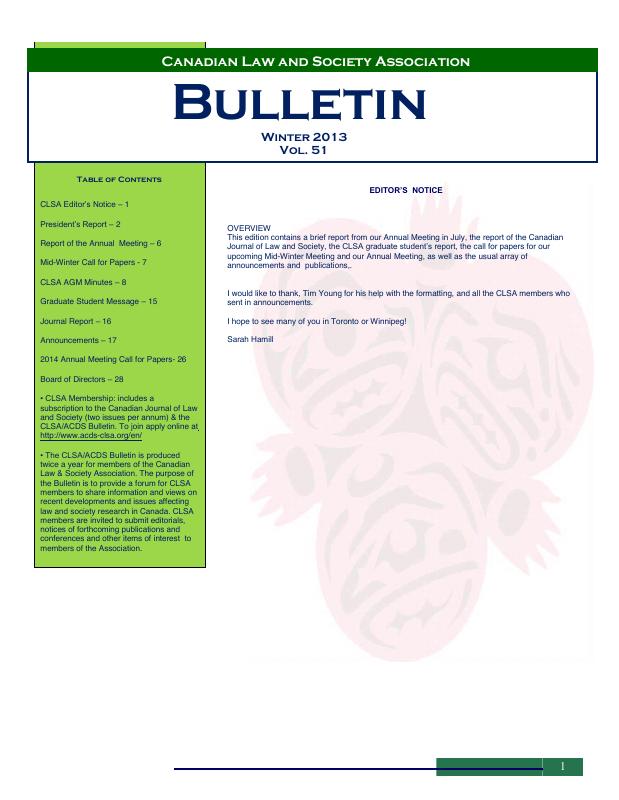
Canadian Law and Society Association Bulletin Winter 2013 Vol. 51 Table of Contents EDITOR’S NOTICE CLSA Editor’s Notice – 1 President’s Report – 2 OVERVIEW This edition contains a brief report from our Annual Meeting in July, the report of the Canadian Report of the Annual Meeting – 6 Journal of Law and Society, the CLSA graduate student’s report, the call for papers for our upcoming Mid-Winter Meeting and our Annual Meeting, as well as the usual array of Mid-Winter Call for Papers - 7 announcements and publications,. CLSA AGM Minutes – 8 I would like to thank, Tim Young for his help with the formatting, and all the CLSA members who Graduate Student Message – 15 sent in announcements. Journal Report – 16 I hope to see many of you in Toronto or Winnipeg! Announcements – 17 Sarah Hamill 2014 Annual Meeting Call for Papers- 26 Board of Directors – 28 • CLSA Membership: includes a subscription to the Canadian Journal of Law and Society (two issues per annum) & the CLSA/ACDS Bulletin. To join apply online at http://www.acds-clsa.org/en/ • The CLSA/ACDS Bulletin is produced twice a year for members of the Canadian Law & Society Association. The purpose of the Bulletin is to provide a forum for CLSA members to share information and views on recent developments and issues affecting law and society research in Canada. CLSA members are invited to submit editorials, notices of forthcoming publications and conferences and other items of interest to members of the Association. 1
Page 2
President’s Report Dear Colleagues, This is an autumn rife with legal and political storms generating many unanticipated opportunities for sociolegal discourse. From disputed a Supreme Court appointment to regressive victim’s rights bills, from violent confrontations on the front lines of Idle No More to the emergence of the Indigenous Nationhood Movement and from the Safe Streets and Communities Act to the deluge of scandals that impact every level of government, this is a rich season for theory and research. We are so blessed. Looking Forward The CLSA/ACDS activities planned for 2014 promise opportunities for further discussion of sociolegal research, theory, methods and practice. Please join us for a day of round tables, research updates and collegiality at the annual mid-winter meeting at the Centre for Criminology and Sociolegal Studies, University of th. Toronto Saturday January 11 Please contact Maura Matesic by mid December mmatesic@yorku.ca to secure th your place on the roster. The Board meeting will follow on Sunday January 12 . Come celebrate the Centennial year of Robson Hall, Faculty of Law, University of Manitoba by attending our annual conference June 6- June 8, 2014 in Winnipeg. “Law’s Encounters: Co-existing and Contradictory Norms and Systems” will be a joint meeting with the Canadian Association of Law Teachers CALT-ACPD. In addition to the key notes, plenaries, papers, panels, roundtables and author meets readers sessions, there will be an interdisciplinary workshop devoted to the legacy of E.T Kingsley with a mix of speakers from the fields of history, law and disability studies and the annual graduate student workshop. Please e-mail your conference proposals of between 250 words to 300 words, including 2-4 keywords, institutional affiliation and contact details to Maura Matesic at mmatesic@yorku.ca by January 15, 2014. Looking Back In July 2013, “Law on the Edge,” a joint meeting with the Law and Society Association of Australia & New Zealand was hosted by the University of British Columbia Faculty of Law at their beautiful new Allard Hall. The conference began with a terrific Graduate Student program skillfully organized by CLSA/ACDS graduate student representatives Tim Bryan and Daena Crosby. The workshop content was designed by and for the students. The sessions were facilitated by various faculty members from both CLSA and LSAANZ, many thanks to everyone who participated. From the opening plenary welcoming delegates to Musqueam territory featuring Glen Coulthard, Bruce Granville Miller, Aaron Wilson and Douglas Harris, to the plenary on migration and multiculturalism featuring Catherine Dauvergne, Shaunnagh Dorsett and Sherene Razack, from the keynote address by Leah Bassell, to the plenary on law, space and boundaries starring Nicholas Blomley, Davina Cooper, Lee Godden and Valmine Toki, to the exceptional banquet address by John Borrows and the special ceremonial presentation by the Git Hayetsk dancers, the conference was a tremendous, intellectually rich event, carefully choreographed by the brilliant Emma Cunliffe and her conference team at UBC. Many thanks to the international coordinating committee and special thanks to LSAANZ’s Nan Seuffert and Deirdre Howard-Wagner and to Emma Cunliffe and Benjamin Berger of the CLSA for their indefatigable contributions. This conference was funded in part by the SSHRC Connection Grants Program and through generous donations from Osgoode Hall Law School, York University and UBC Faculty of Law and the institutional affiliations of our collective members. The annual meeting is the time for elections and executive appointments to the CLSA-ACDS Board of Directors. This year we welcome Ibironke Odumodu-Ayanu (University of Saskatchewan) as Vice-President and Lara Karaian (Carleton University), Allyson Lunny (York University) and Natalie Oman (University of Ontario Institute of Technology) as members at large. Joining the Board as the Quebec Regional Representative is Alana Klein (McGill) and Lisa Wright (Carleton University) as the Graduate Student Representative. Melanie Adrian (Carleton University) is the new Managing Editor of the Canadian Journal of Law and Society and the new Editorial Assistant is Robyn Pepin (Carleton). At our annual board meeting we said goodbye to Vice-President Benjamin Berger (Osgoode Hall Law School, York University) and CJLS Managing Editor Dawn Moore (Department of Law) Carleton University. Both Dawn and Ben made significant contributions as outstanding citizens to the Association over many years of dedicated service. We are very grateful for all that they brought to us and wish them all the best in their new pursuits. We also said “see you soon” to Graduate Student Representative Daena Crosby who is completing her PhD studies at the University of Alberta. 2
Page 3
While in Vancouver we celebrated the intellectual achievements of interdisciplinary sociolegal scholars through our annual book and article prizes. The selection committees were challenged by the wonderful quality and range of scholarship submitted for consideration. The book prizes are chosen from submissions of Canadian authors writing in Law and Society selected by publishers for a given year. The CLSA/ACDS book prize was awarded to R. Blake Brown, Arming and Disarming: a History of Gun Control in Canada. Honourable mentions went to Shelley Gavigan, for Hunger, Horses, and Government Men: Criminal Law on the Aboriginal Plains, 1870-1905, and David Milward, for Aboriginal Justice and the Charter: Realizing a Culturally Sensitive Interpretation of Legal Rights. The article prizes are selected from the Canadian Journal of Law and Society publications of a given year. The English language article prize was awarded to Sarah Marsden's piece titled "The New Precariousness: Temporary Migrants and the Law in Canada" 27(2) CJLS 209-229. The Honourable mention went to Sarah E. Hamill's piece in the same issue titled "Making the Law Work: Alberta's Liquor Act and the Control of Medicinal Liquor from 1916 to 1924" 27(2) CJLS 249-265. The French language article prize was awarded to Richard Dubé: "La théorie de dissuasion remise en question" 27 (1) CJLS 1-29. The inaugural Graduate Student Essay Prize was bestowed to Danielle McKenzie for her paper "Feeling the Effects of Canada's Child-Care Policy." Congratulations to all award recipients! Moving Forward Cambridge University Press now publishes the Canadian Journal of Law and Society. Through Cambridge Journals we will raise the CJLS's international profile and maintain its Canadian spirit. Many thanks to the editorial team and to Mariana Valverde (University of Toronto) for guiding us through this exciting transition and generating such a wonderful forum for interdisciplinary sociolegal studies engagements. We look forward to seeing you in Toronto in January and in Winnipeg in June. Please note that my term as President ends in June 2014. This is a position that is directly elected by the membership and we are seeking nominations. We welcome your participation, please activate your membership, and encourage your students, members of your local judiciary and fellow colleagues to get involved in the CLSA/ACDS. Please visit our website www.acds-clsa.org. Sincerely, L. Jane McMillan President, CLSA/ACDS 3
Page 4
La Lettre du Président Automne 2013 Chers collègues, Nous sommes témoins d’un automne remplis de scandales légales and politiques, générant plusieurs opportunités pour le discours socio-légale. D’un nomination au Cours Suprême contesté à la charte des droits des victimes régressif, du confrontations violant sur la ligne de front de Idle No More au Indigenous Nationhood Movement émergeant, et du loi sur la sécurité des rues et des communautés au déluges des scandales qui affectent tous les niveaux du gouvernement, c’est une saison riche pour la théorie and la recherche. Nous sommes chanceux. À l’avenir Les activités de l’ACDS pour l’année 2014 promettent encore plus d’opportunités pour échanger nos idées autour de la recherche socio-légale, les théories, les méthodes, et l’application. Joignons-nous pour une journée de tables rondes et conversations collégiales autour de la recherche à la conférence de la mi-hiver au Centre for Criminology and Sociolegal Studies, l’Université de Toronto, samedi le 11 janvier. Veuillez contacter Maura Matesic, d’ici le mi-décembre mmatesic@yorku.ca. La réunion du conseil aura lieu dimanche le 12 janvier. Viens célébrer le centenaire de Robson Hall, Faculté de droit, Université de Winnipeg, à notre conférence annuelle. ‘Rencontrer le droit : systèmes and normes coexistants et contradictoires’ est une réunion conjointe avec l’Association Canadienne des Professeurs de Droit CALT-ACPD. En plus des présentations, sessions, tables rondes, ateliers de recherche, et sessions d’auteurs rencontrant lecteurs, il y aura un atelier interdisciplinaire dédié aux contributions de E.T Kingsley, avec des présentations des domaines d’histoire, légal, et disability studies. Veuillez envoyer vos propositions de 250 à 300 mots, incluant 2 à 4 mots clés, affiliation institutionnelle, et coordonnées à Maura Matesic, mmatesic@yorku.ca, d’ici le 15 janvier 2014. Revenir sur le passé ‘Law on the Edge,’ notre conférence annuelle conjointe avec Law and Society Association of Australia and New Zealand à eu lieu en juillet à l’Université de Colombie-Britannique au superbe Allard Hall. La conférence à commencer avec un programme pour les étudiants de deuxième et troisième cycle, organisé par les représentatifs étudiants de l’ACDS, Tim Bryan et Daena Crosby. Le contenu de l’atelier était créé par et pour les étudiants. Les sessions étaient facilité par divers membres du l’ACDS et LSAANZ. Merci à tous pour votre participation. Du première plénière, avec Glen Coulthard, Bruce Granville Miller, Aaron Wilson et Douglas Harris, qui nous ont souhaiter la bienvenue au territoire des Musqueam, à la session sur le migration et le multiculturalisme, incluant des présentations par Catherine Dauvergne, Shaunnagh Dorsett et Sherene Razack, du discourse liminaire par Leah Bassell, à la plénière sur le droit, le place, et les frontiers, présenté par Nicholas Blomley, Davina Cooper, Lee Godden et Valmine Toki, à la présentation au banquet par John Borrows et la présentation spéciale à la cérémonie donnée par les danseurs Git Hayetsk, la conférence annuelle était un événement spectaculaire et riche intellectuellement, organisée avec soin par Emma Cunliffe et l’équipe à UBC. Remerciements au comité international et un merci spécial à Nan Seuffert et Deirdre Howard-Wagner de LSAANZ et à Emma Cunliffe et Benjamin Berger de l’ACDS pour leurs contributions infatigables. La conférence était fondée partiellement par le programme Subventions Connexion du SSHRC, et avec des dons généreux de Osgoode Hall Law School, Université de York, et la Faculté de droit de UBC, et les institutions de nos membres collectifs. La rencontre annuelle est aussi le temps pour les élections et les nominations exécutifs pour le Conseil d’Administration de L’ACDS. Nous souhaitons la bienvenue à Ibironke Odumodu-Ayanu (Université de Saskatchewan), notre vice-présidente et Lara Karaian (Université Carleton), Allyson Lunny (Université York) et Natalie Oman (Université de Ontario Institut de Technologie), nos membres éloignés. Joignons le Conseil est Alana Klein (McGill), comme représentatif régionale pour le Quebec, et Lisa Wright (Université Carleton), la nouvelle représentatif étudiante. Melanie Adrian (Université Carleton) est la nouvelle directeur de la publication pour la Revue Canadienne Droit et Société et Robyn Pepin (Carleton) est la nouvelle assistante d’édition. 4
Page 5
A la rencontre annuelle, nous avons dit au revoir à notre vice-président, Benjamin Berger (Osgoode Hall Law School, York) et l’extraordinaire directeur de la publication, Dawn Moore (Département du Droit, Carleton). Des citoyens remarquables de l’Association, Dawn et Ben ont faites des contributions importantes pendant leurs années en service de l’ACDS. Nous sommes extrêmement reconnaissants et leurs souhaitent bonne chance. Nous avons aussi dit ‘à bientôt’ à Daena Crosby, la représentatif étudiante, qui complète ses études doctorales à l’Université de l’Alberta. Pendant notre séjour à Vancouver, nous avons célébrer les accomplissements intellectuelles des érudits socio-légales avec le Prix du livre et le Prix du meilleur ouvrage socio-juridique canadien. Avec la qualité et les divers intérêts des soumissions, c’était une tache éprouvante pour le comité de sélection. Le Prix du livre est choisi parmi les soumissions d’auteurs canadiens écrivant dans la catégorie de société et droit, selon la maison de publication. R. Blake Brown était accordé le Prix du livre, Arming and Disarming : A History of Gun Control in Canada. Shelley Gavigan, Hunger, Horses, and Government Men : Criminal Law on the Aboriginal Plains, 1870-1905, et David Milward, Aboriginal Justice and the Charter : Realizing a Culturally Sensitive Interpretation of Legal Rights, ont mérités les mentions d’honneurs. Le Prix du meilleur ouvrage socio-juridique canadien est sélectionné de la Revue Canadienne Droit et Société annuelle. Le prix pour la publication anglaise était Sarah Marsden, ‘The New Precariousness : Temporary Migrants and the Law in Canada’ 27(2) CLJS 209-229. Sarah E. Hamill, ‘Making the Law Work : Alberta’s Liquor Act and the Control of Medicinal Liquor from 1916-1924’ 27(2) CLJS 249-265, à reçu la mention d’honneur. Richard Dubé, ‘La théorie de dissuasion remise en question’ 27(1) CLJS 1-29, est le gagnant du Prix pour la publication française. Danielle Mackenzie, ‘Feeling the Effects of Canada’s Child-Care Policy’ est la gagnante du première Graduate Student Essay Prize. Félicitations a tous! En avance Cambridge University Press est maintenant le publieur de la Revue Canadienne Droit et Société. Avec Cambridge Journals nous allons rehausser le profil du RCDS mais au même temps maintenir l’esprit canadien. Remerciements à l’équipe rédactionnelle et Mariana Valverde (Université de Toronto) pour guidons nous à travers cette transition excitante et pour générer un forum interdisciplinaire pour l’engagement socio-légale. Nous avons hâte de vous voir à Toronto en janvier et à Winnipeg en juin. Notez bien que mon terme comme présidente finisse en juin 2014. Le poste de président est élu directement par nos membres and nous demandons vos nominations. S’il vous plait activer votre adhésion et demander aux étudiants, membres du système judiciaire local, et vos collègues d’engager avec l’ACDS. Visitez notre site web www.acds-clsa.org. Sincères salutations, L. Jane McMillan Présidente, CLSA/ACDS 5
Page 6
Report of the Annual Meeting Law on the Edge was the 2013 joint meeting of the Canadian Law & Society Association and the Law & Society Association of Australia & New Zealand. The conference was held in Vancouver at UBC’s Allard Hall building from 1-4 July 2013. It was an international, interdisciplinary conference that brought together law and society scholars from around the world. Participants came from across the humanities and social sciences, and also included lawyers, policy workers, and community members who shared an interest in the topics of the conference. The title Law on the Edge reflected the central theme of the conference: the shared experience of living "on the edge" of major centers of power in the North America, Asia and Europe. In addition to over 100 panels incorporating more than 400 papers, the conference had a full suite of keynote speakers, plenary panels, field trips and Indigenous programming focusing on the conference themes of Indegeneity and immigration. Leah Bassell (University of Leicester) delivered her keynote address, “Paradoxes of Protection: Gender at the Borders,” on July 2, 2013 while John Borrows (University of Minnesota) delivered his keynote address, “Ningiiwitaa-inaakonige: Walking Around the Edges of Indigenous Law,” at the Conference Banquet. The Git Hayetsk dancers also performed at the banquet. In 2014 we meet with the Canadian Association of Law Teachers in Winnipeg, June 6-8, 2014. 6
Page 7
Mid-Winter Meeting Call for Papers Chère membres, Le comité de ACDS vous invite à soumettre vos communications pour ceux et celle qui désire présenter ou suggestions thématiques pour les round table discussions de reports en progrès au conférence semi-annuelle qui aura lieu au Centre for Criminology and Socio-legal studies, l'Université de Toronto les 11 et 12 janvier 2014. La conférence semi-annuelle est une rencontre informelle qui vous offre une opportunité de faire connaissance d'autre membres du Société. Avant le 15 décembre veuillez contactez Maura Matesic (mmatesic@yorku.ca) afin de confirmer votre présence. Veuillez aussi envoyer vos communications si vous voulez présenter au conférence à Maura Matesic (mmatesic@yorku.ca) avant le 15 décembre. Toute communications acceptées dérouleront le samedi 11 janvier 2012 et l'assemblée du conseil d'administration se tiendra le dimanche 12 janvier 2014. Les membres du conseil d'administration sont priés d'y assister puisqu'il s'agit de la principale rencontre de l'année. Dear Members, This is a general interest call for abstracts for those wishing to present papers or propose suggestions for thematic round table discussions of work in progress at the CLSA’s Annual Mid- Winter Meeting January 11 –12 at the Centre for Criminology and Socio-legal Studies, University of Toronto. The Mid-Winter meeting is an informal gathering and is a great way to connect and get involved with the CLSA. Please confirm your attendance by December 15 to Maura Matesic (mmatesic@yorku.ca ). Maura is also handling the presentation program, so if you are interested in presenting please send a brief proposal to Maura Matesic ( mmatesic@yorku.ca ) by December 15. All accepted proposals will be scheduled on January 11, the board meeting will be on January 12. Board members are asked to attend as this is the main board meeting of the year. 7
Page 8
Minutes of the CLSA Annual General Meeting 3 July 2013 ACDS/CLSA Annual General Meeting Wednesday July 3, 2013 12:45- 2:00 Room 104 University of British Columbia Faculty of Law at Allard Hall Minutes Attendees L. Jane McMillan, Benjamin Berger, Lyndsay Campbell, Ibirinke Odumosu-Ayana, Lise Gotell, Sarah Hamill, Natalie Oman, Lori Chambers, Rachel Aris, Amanda Glasbeek, Dawn Moore, Debra Parkes, Lisa Wright, Lulu Thomas-Hawthorne, Allyson Lunny, Ruby Dhand, Margaret Hall, Mariana Valverde, Mayana Slobodian,Andrew Wakefield, Ravi Malhotra, David Milward, Richard Jochelson, Maura Matesic, Michael Mopas, Josephine Savarese, Richard Weisman,Tim Bryan, David Szablowski, Renisa Mawani, Ben Issit 1. Approval of 2012 AGM minutes Lise moved/Ben seconded 2. President’s Report L. Jane McMillan gave the President’s report. One of the main accomplishments over the year has been the creation of the new CLSA website. The President recognized Eric Reiter and Sarah Hamill for their hard work on this. CLSA membership has increased in the past year. One of the challenges as we move forward will be to make better use of the regional networks. Congratulations were offered on the highly successful Law on the Edge Conference. It generated fruitful collaborations and resulted in the creation of more formal links between CLSA and LSANZ. Ben Berger and Emma Cunliffe were recognized for their tremendous role in planning a very successful conference and thanks to UBC Faculty of Law at Allard Hall for hosting the conference. 3. Election of Directors This was the second year of the new elections procedure, managed this year by Ben Berger and Lyndsay Campbell. On top of the slate of candidates prepared in advance, nominations were sought from the floor. There were none. In some cases, the positions were contested and an election took place. The ballots were administered. Those who stood for election were later notified of the results. The Board of the CLSA is listed at: http://www.acds-clsa.org/?q=en/node/16. 8
Page 9
4. Journal Report Dawn Moore was pleased to give her last CJLS report as Managing Editor. The Journal team has been thrilled with the transition to Cambridge Journals and with plans for raising the international profile of the Journal. The Canadian spirit of the Journal will be maintained (for example, by a policy on reviewing Canadian books), combined with a move to a more robust international presence. There is an upcoming 2014 special issue is on “Decolonization and Law.” The Journal will be starting a yearly special edition competition. To this point, decisions about special issues have been ad hoc. The Journal will be issuing a call for proposals in the Fall, with a decision in January. This year’s call can be found at http://www.acds-clsa.org/?q=in-the- news/Call%20for%20Special%20Issue%20Proposals. Dawn expressed her thanks to Lisa Wright who has acted as the editorial assistant for the past two years. Finances are in good shape, with a successful SSHRC application that provides three years of funding. The Journal is likely to have a positive balance of $20,000 by 2014. University of Toronto Journals still owe us money. Editor Mariana Valverde emphasized that it is important for the Journal to have reserves, especially enough to publish at least one issue. There are some financial risks on the horizon, including moves towards open access. At present, the Journal is a revenue generator. Dawn proposed the creation of an ad hoc finance committee with representation from the Journal and from the CLSA. The role of the Ad Hoc Finance Committee would be to address the financial relationship/sharing of revenue between the CLSA and the Journal. Moved Amanda Glasbeek/Seconded Natalie Oman Eric Reiter suggested that it would be best to have some Executive involvement in the committee. An Ad Hoc Committee was formed including: Melanie Adrian, L. Jane McMillan and Mike Mopas. Dawn reminded members that the Journal makes its money through downloads. It’s a great idea to assign and have students download CJLS articles. Members thanked Dawn for her incredible work as Managing Editor of the CJLS and welcomed Melanie Adrian as the new Managing Editor. 5. Financial Report Michael Mopas gave a Treasurer’s report. The report is attached to the minutes. On June 20, 2013, total funds on hand were $37,580.22 In 2012, the total revenue was $18,940.03 less expenses of $11,185.26, resulting in a surplus of $7,199.01. The healthy financial picture for 2012 was due to strong membership numbers, decreased website costs, increased ad revenue and good financial management of the 2012 conference. For 2013, revenue projections are $17,500, with expenses of $12,450. The biggest expense is the new website. Support for the Graduate Student Workshop has been a challenge since SSHRC cancelled its Aid in Attendance Grant. We need to think about new ways to fund grad student travel. This year we got a SSHRC Conference Grant that provided $8000 of support for graduate student travel. The CJLS provided $3000. 6. Membership Report Eric Reiter gave a membership report. Membership numbers are healthy, though the exact number is not yet clear. Issues: o With new website, process should be simpler. o Targeted emails to get people to renew. o We should be doing a survey of membership to see what we can do better in order to attract members. 9
Page 10
7. Book Prize and Article Prize The President thanked members of the Book Prize Committee and Article Prize Committee. Prizes will be given out at the banquet. Shortlisted books have been profiled at Law on the Edge via “author meets reader” sessions. 8. Graduate student essay prize & ballots for naming prize There was a discussion about the new Graduate Student Essay Prize, awarded for the first time in 2013. The winner’s essay is to be published in the CJLS. A ballot was administered to choose a name for the Essay Prize. 9. Committees (Prize committees, Communications) There was a discussion about using the bulletin as the mechanism of communicating to the membership. Sarah Hamill was recognized for her hard work managing the bulletin and the website. 10. Graduate Student Report Thanks to Tim Bryan and Daena Crosby Graduate Student Members of the Board, especially for their work on the Graduate Student Workshop, held June 30, 2013. Tim Bryan gave the graduate student report. The workshop was very successful, but a challenge to organize because of the need to coordinate with LSANZ. The morning was devoted discussions of “Methodology and the Research Process,” while in the afternoon, there were break-out groups. Thanks to Ben Berger for his assistance with the workshop and to Osgoode Hall Law School, York University for their financial support. Lisa Wright will be taking over from Daena Crosby. Thanks to Daena for her service to the CLSA. 11. Conference report and future meetings Ben Berger delivered the conference report. Law on the Edge was a huge success, with significant international participation, especially from Australia, New Zealand and the UK. The collaboration with LSANZ was enriching and was a pleasure. Emma Cunliffe of the University of British Columbia was acknowledged for her tremendous role in organizing the conference at the local level. Ibironke Odumusu-Ayanu will be taking over from Ben Berger as Vice President with responsibility for conferences, as Ben is concluding his term. The 2014 Annual Conference will be held in Winnipeg, at the same time as the CALT conference. Prior collaborations with CALT have been successful with greater turnout than at some CLSA meetings held at Congress. The dates are June 6-8, 2014. Maura Matesic has agreed to be the Program Chair for the 2014 Conference. Ravi Malhotra discussed the possibility of holding a half-day (minimum) panel devoted to interdisciplinary work on disability. There is SSHRC funding for this workshop. It could be held at the 2015 conference in Winnipeg, so long as it does not conflict with LSA. Coordination with CALT is essential in planning future conferences. The 2015 conference will be held at Congress at University of Ottawa. CALT is also meeting at Congress 2015. 10
Page 11
There was a discussion of the possibility of a future joint meeting with the LSA. Ben Berger emphasized that LSA plans up to seven years in advance. 12. Other business None 13. Adjournment CLSA/ACDS Financial Report Prepared by Michael Mopas, CLSA Treasurer CLSA Annual General Meeting Vancouver, BC July 3, 2013 1. Current Balances The balances of the CLSA accounts are as follows: Scotia Bank account, non-personal (as of June 17, 2013-07-02): $5,010.61 Scotia Bank account, corporate (as of December 30, 2011): $32,569.61 Total CLSA funds on hand: $37,580.22 The total funds on hand reported at the 2013 CLSA Mid-Winter Meeting was $39,464.11. The difference is - $1,883.89. 2. Overview of 2012 Revenue The table below represents the money received by the CLSA from January 1 to December 31, 2012. Revenue Type Amount Memberships $13,086.25 SSHRC – Aid and Attendance Fund $4,450.00 CFHSS – Aid to Interdisciplinary Sessions $250.00 Advertising $900.00 Banquet $360.00 Total revenue for this period $18,940.03 11
Page 12
3. Overview of 2012 Expenditures The table below represents the money spent by the CLSA from January 1 to December 31, 2012. Expenditure Type Amount E-Commerce fees $954.15 Bank fees $298.90 Web hosting (for 6 months) $315.00 Web maintenance (e.g., miscellaneous changes to site) $113.00 Congress awards banquet $450.45 Book prize and miscellaneous conference costs (annual meeting) $197.28 Student travel (mid-winter meeting) $1,219.84 Student travel grants $4,757.42 Midwinter conference (catering costs shared with U of O) $500.00 Executive committee dinner at midwinter conference $191.68 CFHSS Congress fees $44.29 Bookkeeping $2282.60 Translation services $161.59 CLSA rep travel to CFHSS meeting $254.82 Total expenditures for this period $11,741.02 4. Overview of 2013 Revenue The table below represents the money received by the CLSA from January 1 to June 30, 2013. Revenue Type Amount Memberships $4,266.57 Total revenue for this period $4,266.57 5. Overview of 2013 Expenditures The table below represents the money spent by the CLSA from January 1 to June 30, 2013. Expenditure Type Amount E-Commerce fees $434.95 Bank fees $119.70 CHFSS membership $1606.56 Student travel (mid-winter meeting) $598.66 Midwinter social $137.55 12
Page 13
New website project $8,130.34 Web hosting (balance of contract with Rebel Trail) $157.50 Total expenditures for this period $11,185.26 6. Treasurer’s Assessment of our Current Financial Situation The total revenue received by the Association in 2012 was $18,940.03. The total expenditures incurred by the Association during this period was $11,741.02. This resulted in a surplus of $7,199.01. This surplus can be attributed to: 1) healthy membership numbers; 2) the increase in advertising revenue; 3) fewer costly upgrades to the website than in previous years; and 4) better management and oversight of annual conference expenses. In 2012, the Association was able to generate $900 in revenue from selling advertising space in our conference program. The Association should continue this practice. The Association should consider asking for volunteers (perhaps from the conference organizing committee?) who could solicit businesses and organizations to purchase advertising space in our programs. To ensure that we stay within our conference budget, as we did this year, efforts must be made to ensure greater dialogue between the local organizers and the Treasurer and/or the Executive during the planning stages of this event. 7. 2013 Budget OPERATING REVENUE Association membership $16,000 Donations/sponsorship $500.00 Advertising revenue $1,000.00 TOTAL $17,500.00 OPERATING EXPENSES CFHSS membership $1,600.00 E-Commerce fees $800.00 Bank fees $300.00 Web hosting $750.00 Book prize and miscellaneous conference costs (annual meeting) $500.00 Student travel (mid-winter meeting) $600.00 Student travel grants $5,000.00 Midwinter conference catering $300.00 Bookkeeping $2,000.00 Translation services $300.00 CLSA rep travel to CFHSS meeting $300.00 TOTAL $12,450.00 13
Page 14
PROJECT EXPENSE Website migration $8,000.00 The CLSA faces a budget shortfall of -$2,950.00. This is due to the costs associated with switching web hosting providers and creating a new website. 8. Graduate Student Workshop and Student Travel Funding In 2012, the Association once again received $4,450 from SSHRC to support student travel. Thirteen graduate students applied for and received travel funding to attend the 2012 Annual Meeting in Waterloo, ON. However, it was recently announced that SSHRC has cancelled its ‘Aid and Attendance to Scholarly Association’. As a result, the CLSA will need to seek other sources of funding in order to provide travel assistance to our graduate students and to put on the grad student workshop. In 2013, the Association received funding from SSHRC to put on this year’s conference. The Association has allocated $8,000 of this money to fund graduate student travel to the conference. The Canadian Journal of Law and Society also generously donated $3,000 for graduate student travel funding. This money will be divided amongst the total number of successful applicants. A total of 19 graduate students have applied for a travel grant. These students will be contacted in the next few days about their applications. 9. Bookkeeping The Treasurer has contacted Ashton and Associates to undertake the bookkeeping for 2012. The balance sheets will be presented at the next Mid-Winter Meeting. The balance sheets can also be posted on the Association’s website. 14
Page 15
Graduate Student Message Greetings graduate students! Thanks to everyone who attended the 2013 Law on the Edge conference, a joint meeting between the CLSA/ACDS and LSAANZ. Because of your hard work this year’s conference was a great success! This year, the graduate student workshop comprised an entire day of sessions at the beginning of the conference. With the joint intellectual resources of CLSA/ACDS and LSAANZ, and the generous financial support of Osgoode Hall Law School, workshop sessions covered methodology, academic writing and publishing, teaching, balancing academic life, and landing the academic job. Thank you to all those who attended the workshop and to all presenters who participated. We would also like to thank Benjamin Berger for his coordination of the graduate student workshop committee. Following the conference, we surveyed CLSA/ACDS graduate student members on their experiences at the conference and more generally as members of CLSA/ACDS. The responses were very positive; graduate students enjoy the benefits of being a CLSA/ACDS member, their experience at the Law on the Edge conference, and the graduate student workshop. In particular, respondents mentioned that they enjoyed the conference atmosphere, the variety of panels and they made very useful suggestions for next year’s graduate student workshop! Thank you to all those who responded to our survey, and please contact us with other suggestions you may have regarding your CLSA/ACDS membership and conference experiences. The 2014 CLSA annual meeting will be jointly hosted with the Canadian Association of Law Teachers th th from July 6 - 8 , 2014 in Winnipeg Manitoba. The call for papers is available at: http://www.acds- clsa.org/?q=en/content/clsa-2014-annual-meeting-call-papers . Every year, the CLSA graduate student representatives hold elections for the outgoing representative. Each student serves a two-year term and is responsible for representing and advocating for graduate students at CLSA board meetings, communicating with graduate students, and organizing the graduate student workshops and socials for the annual meeting. We would like to thank Daena Crosby, the outgoing graduate student representative, for her work and dedicated service to the CLSA. Lisa Wright replaces Daena and will serve as graduate student representative until 2015. Please send either of us any comments or suggestions you may have for workshops, socials and other ways we can build the CLSA graduate student community. Finally, we would like to extend an invitation for you to attend this year’s CLSA Mid-winter meeting at the Centre for Criminology and Socio-legal Studies, University of Toronto from January 11-12, 2013. This is an invaluable opportunity for you to present “works-in-progress” and receive helpful feedback from CLSA scholars. We hope to see you in Toronto! Please email your abstracts to Maura Matesic mmatesic@yorku.ca by 15 December 2013. We look forward to seeing you during the year! Best, Tim and Lisa 15
Page 16
Canadian Journal of Law and Society Editor’s Report English: The CJLS/RCDS welcomes Melanie Adrian (Law - Carleton) as the new Managing Editor of the Journal. Robyn Pepin (Ph.D. student in Legal Studies – Carleton) is the new Editorial Assistant. The journal wishes to thank Dawn Moore and departing Editorial Board Members Elizabeth Jelin, Ngaire Naffine and Christiane Wilke for all of their contributions. As well as many exciting articles, with a growing number originating from scholars around the world, the journal is also preparing a special issue on law and decolonization that will have a large proportion of Canadian content but also include international perspectives. French: La RCDS aimerait souhaiter la bienvenue à Melanie Adrian (Faculté de droit - Carleton) en tant que nouvelle directrice de la rédaction. Robyn Pepin (étudiante au doctorat en Études juridiques - Carleton) est la nouvelle adjointe à la rédaction. La Revue aimerait remercier Dawn Moore ainsi que les membres sortants du comité de rédaction, Elizabeth Jelin, Ngaire Naffine et Christiane Wilke, pour leurs contributions. En plus de préparer des articles intéressants, dont un nombre grandissant proviennent de chercheurs du monde entier, la Revue prépare actuellement un numéro spécial sur le droit et la décolonisation. Bien qu’une partie importante du contenu soit canadien, ce numéro inclura aussi des perspectives internationales. CJLS/RCDS online : http://journals.cambridge.org/action/displayJournal?jid=CLS 16
Page 17
Announcements Conferences and Calls for papers Canadian Journal of Human Rights (CJHR) Deadline for Submissions: Dec 30th, 2013 The Canadian Journal of Human Rights (CJHR), the only academic journal of its kind in Canada, is now accepting submissions for its next volume. The CJHR is published by the Robson Hall Faculty of Law at the University of Manitoba; however, it is not a typical law journal. The journal is both a national and international forum for scholars to share and debate ideas in human rights and humanitarian law and policy. It is the only journal in Canada that deals exclusively with human rights scholarship. As developments in the area of human rights are not limited to legal events and analyses, the CJHR has an interdisciplinary focus and will publish quality papers that deal with human rights issues in a broader socio-legal arena. There is no requirement that submissions have a strict legal focus. The CJHR welcomes submissions from scholars from diverse backgrounds of academic engagement. Manuscripts may be submitted in English or French. Please see our web site at www.cjhr.ca for specific manuscript requirements and further information. Kindly send submissions via e-mail as attachments in Word to: Dr. Donn Short, Editor-in-Chief Canadian Journal of Human Rights editor_cjhr@umanitoba.ca Authors should include full contact information (name, institution, mailing address, telephone) in the body of the e-mail. Deadline for submissions is December 30th, 2013. 17
Page 18
CHAMP PÉNAL/PENAL FIELD Appel à contributions/Call for papers champpenal.revues.org The State of Abolitionism Today A special issue edited by Nicolas Carrier and Justin Piché Numerous analysts of the penal field have criticized the intensification of punishment experienced in most liberal democracies in the western world. Dubbed the ‘punitive turn’ by some, contemporary penal policies and practices are contrasted to those of a supposed less punitive past characterized by an ethic of care for the criminalized. Recent discussions on the topic have led some scholars, notably in Anglophone debates, to call for a ‘public criminology’ or the advancement of more robust ‘public’ critiques of penal intensification with the goal of making penal politics more effective, useful, rational and humane. What is the place of abolitionist thought and action in this context? What arguments and actors support such work? In what ways is abolitionism relevant, if at all? This special issue of Champ pénal/Penal Field sets out to assess the state of abolitionism today. The many targets of abolitionism Analysts of the penal field tend to identify three targets of abolitionism: the prison and the industrial complex in which it operates, the penal system, and the diffusion of carceral controls in society more generally. Abolitionist thought and action also focuses on specific issues such as the criminalization of certain drugs, sex work, migration and political dissent against the State. Contributions to this special issue can address any of the multiple issues addressed in abolitionist work and could also explore the implications of the presence of multiple targets for activism, research and intellectual work. Drivers of and motives for action This special issue aims to showcase diverse perspectives on how ‘justice’ is conceptualized and experienced, and how these inform contemporary abolitionist work. Why abolitionism? Because imprisonment, being subjected to carceral control, and punishment is unjust? In what ways? Is it sufficient to document the effects of institutionalized responses to problematized situations as many have done in regards to the prison? Is it necessary that facts inform our conception of justice? Is this possible and/or desirable? Are the drivers of and motives for taking an abolitionist stance stable in time and space, anchored in long-established traditions of thinking and acting, or is renewal underway? Strategies and alternatives What alternative ways of conceptualizing and responding to criminalized conflicts and harms characterize abolitionist work today? On what grounds do we oppose a penal system that claims to be in the business of justice? What lessons can be learned from past abolitionist efforts? How does abolitionism position itself vis-à-vis less radical approaches such as penal minimalism? How do abolitionists respond to the critique that there will always be a ‘dangerous few’ who need to be controlled and imprisoned? Does engaging in the ‘de-ontologization’ of dangerousness suffice? What are the similarities and differences between abolitionism, restorative justice, transformative justice and social justice? Does abolitionism imply anarchism, or can it be envisioned within State sovereignty? How is a world without punishment imagined or practiced? Are the kinds of social relations required to involve those most impacted when addressing conflicts and harms promoted by abolitionists possible in a globalized context characterized by social distance? What is an abolitionist response to ‘war crimes’ and ‘crimes against humanity’? Is abolitionism, like criminology, a domestically driven endeavour? In the context of a global lockdown and expanding surveillance in western democracies, abolitionist arguments have been characterized as utopian – is this the case? And if so, is this a problem? * Bilingualism Proposed contributions can be submitted in English or in French. To reach as broad of a readership as possible, we are striving towards a bilingual collection and authors whose works are accepted for publication are encouraged, but not obligated, to translate their papers. Submission guidelines The word count for papers is between 8,000 and 15,000 words. The articles must also conform (!) with the submission guidelines of the journal, which can be found at http://champpenal.revues.org/7625 Article submissions An abstract outlining your proposed contribution must be submitted no later than March 1, 2014. The submission deadline for completed papers is September 1, 2014. In both cases, please send your correspondence to the following addresses: nicolas_carrier@carleton.ca justin.piche@uottawa.ca Another invitation … We invite those interested in contributing to this special issue to present a preliminary version of their papers at the Fourth Conference – Critical Perspectives: Criminology and Social Justice to be held June 11 and 12, 2014 at Carleton University or at the Fifteenth International Conference on Penal Abolition to be held June 13 to 15, 2014 at the University of Ottawa. Both universities are located on Algonquin Territory / in Ottawa, Ontario, Canada. 18
Page 19
For more information, please visit http://www.actionicopa.org or write to Justin or Nicolas. Nicolas Carrier Justin Piché Institute of Criminology & Criminal Justice Department of Criminology Carleton University University of Ottawa CANADA CANADA nicolas_carrier@carleton.ca justin.piche@uottawa.ca CHAMP PÉNAL/PENAL FIELD Appel à contributions/Call for papers champpenal.revues.org Actualité de l’abolitionnisme Dossier coordonné par Nicolas Carrier et Justin Piché L’intensification pénale qui caractérise la plupart des démocraties libérales occidentales a été critiquée par de nombreux analystes du champ pénal, souvent dans le cadre de discussions saisissant la pénalité contemporaine avec le vocable de ‘virage punitif’, posant dès lors un passé ‘non punitif’ de la pénalité, notamment caractérisé par un souci de ‘prendre soin’ des personnes criminalisées. Les injonctions à pratiquer une ‘criminologie publique’ et à produire une critique ‘publique’ de l’intensification pénale se multiplient, peut-être plus particulièrement dans les écrits anglophones. Alors que la masse des interventions contre l’intensification pénale produite par cette ‘criminologie publique’ se concentre sur le projet d’injecter du savoir criminologique dans les politiques pénales afin de les rendre plus efficaces, plus utiles, plus rationnelles et même, dira-t-on, plus humaines, d’autres interventions poursuivent le projet radical de l’abolitionnisme. Quelle est la place des discours, pratiques et praxis abolitionnistes dans la société contemporaine? Quelles logiques et quels acteurs les supportent? Peut-on les dire influents? Ce dossier de Champ pénal/Penal Field veut proposer un état des lieux sur l’abolitionnisme. Pluralité des luttes Pour les analystes du champ pénal, il est désormais usuel de distinguer trois cibles générales de l’abolitionnisme : la prison et le complex industriel dont elle fait partie, le carcéral, le pénal. Il est également commun de qualifier d’abolitionnistes des discours, pratiques et praxis dont la focale se fait sur la pénalisation de conduites ou conditions spécifiques, telles les infractions liées à certaines drogues, au travail du sexe, à l’immigration, ou aux activités politiques contre l’État. Les contributions attendues pourront porter sur des manifestations plurielles de l’abolitionnisme dans le champ pénal, et possiblement explorer les enjeux que cette diversité pose pour la militance, la recherche empirique et le travail intellectuel. Moteurs et motifs Ce dossier a pour ambition de réunir des contributions permettant de jeter un regard d’ensemble sur les conceptions de la justice, les expériences et les constats empiriques qui nourrissent les perspectives abolitionnistes contemporaines. Pourquoi l’abolitionnisme? Parce que l’emprisonnement, l’incarcération, la pénalisation sont injustes? En quoi le sont-elles? Peut-on ici se satisfaire de brandir des faits sur les effets des réponses institutionnalisées aux ‘situations problèmes’, comme plusieurs l’ont fait à l’égard de la prison? Le factuel peut-il ou doit-il informer notre conception de la justice? Quels sont les limites d’une pensée abolitionniste conséquentialiste? Les moteurs et motifs abolitionnistes sont-ils stables dans l’espace et le temps et déjà bien ancrées, ou se renouvellent-ils? Modalités et alternatives Quels programmes sont mis de l’avant par les abolitionnistes, tant sur le plan des stratégies de luttes que sur celui des ‘mesures de rechange’? Comment s’oppose-t-on à un système qui affirme produire de la justice? Quelles conceptions du changement social animent ces programmes? Quelles leçons peut-on tirer des efforts abolitionnistes passés? Comment se positionne-t-on par rapport à des programmes moins radicaux, tel que celui du minimalisme pénal? Comment l’abolitionnisme fait-il face à une critique insistant sur le besoin de contrôler une minorité de personnes dangereuses (les dangerous few)? Peut-on ici se satisfaire de la typique ‘désontologisation’ de la notion de dangerosité? Quels rapports se tissent entre abolitionnisme, justice réparatrice, justice transformative et justice sociale? L’abolitionnisme est-il pensable dans le cadre du maintien de la souveraineté des ‘États de droit’, ou ne fait-il sens que dans le cadre de collectifs/collectivités anarchistes? Comment imagine-t-on ou pratique-t-on un espace social sans peine? Les programmes abolitionnistes ont typiquement mis de l’avant une vision de la socialité ancrée dans la proximité; cette vision est-elle toujours viable? Quels programmes peut-on imaginer pour répondre à ce que l’on saisit actuellement sous le vocable de crime de guerre? De crime contre l’humanité? L’abolitionnisme est-il, comme la criminologie dans son ensemble, une 19
Page 20
pratique à vocation essentiellement domestique? Dans le contexte d’une intensification généralisée du recours au pénal et à la surveillance dans les démocraties libérales, les propositions des abolitionnistes sont peut-être plus que jamais aisément qualifiées d’idéalistes; le sont-elles? Et le cas échéant, est-ce un problème? * Bilinguisme Les propositions de contribution peuvent être soumises en anglais ou en français. Ce dossier a pour ambition d’être bilingue : les auteur(e)s dont les articles sont acceptés sont invités à produire ou faire produire une version traduite des articles. Normes de présentation La taille attendue pour un article se situe entre 8 000 et 15 000 mots. Les articles doivent se conformer (!) aux règles de présentation de la revue, que l’on peut consulter à l’adresse suivante : http://champpenal.revues.org/13 Comment soumettre les articles er Un résumé de la proposition de contribution doit être soumis au plus tard le 1 mars 2014. er La proposition de contribution doit être soumise au plus tard le 1 septembre 2014. Dans les deux cas, faire parvenir les textes aux deux adresses suivantes : nicolas_carrier@carleton.ca justin.piche@uottawa.ca Une invitation de plus ... e Nous invitons les personnes intéressées à venir présenter une version préliminaire de leurs articles dans le cadre de la 4 conférence Perspectives critiques : criminologie et justice sociale, qui se tiendra à Carleton University les 11 et 12 juin 2014, e et dans le cadre de la 15 Conférence internationale sur l’abolition de la peine (ICOPA 15), qui se tiendra du 13 au 15 juin 2014 à l’Université d’Ottawa. Les deux universités sont situées sur le territoire Algonquin / Ottawa, Ontario, Canada. Pour plus de renseignements, on peut consulter la page web suivante : http://www.actionicopa.org ou écrire à Justin ou Nicolas. Nicolas Carrier Justin Piché Institute of Criminology & Criminal Justice Département de criminologie Carleton University Université d’Ottawa CANADA CANADA nicolas_carrier@carleton.ca justin.piche@uottawa.ca 20
Page 21
The Fifth Annual Meeting of the Association for Law, Property, & Society The Association for Law, Property, & Society (ALPS) is a scholarly organization for those engaged in scholarship on all aspects of property law and policy including real, personal, intellectual, intangible, cultural, personal, and other forms of property. Its annual meeting brings together scholars from many disciplines to discuss their work and to foster dialogue among those working in property law, policy, and theory. The 5th Annual Meeting of ALPS will be held in Vancouver at the University of British Columbia’s Faculty of Law at Allard Hall, May 2-3, 2014. We welcome proposals for papers or panels in any area of property law & society scholarship. Potential topics include: • Aboriginal rights & title • Eminent domain & regulatory takings • Histories of property • Housing/urban development/planning • Inequalities of property • Intellectual Property • Land/environment/resources • Property & civil rights • Property law & economics • Property & poverty • Property transfers & risk • Teaching property law • Theories of property Submissions may be of individual papers or of panels. Panel proposals may include a collection of paper presentations, roundtables, or book panels. Submit proposals to alps2014@law.ubc.ca by 15 January 2014. Conference participation will be confirmed by February 15, 2014. The standard length of each session will be 90 minutes and we expect sessions to include time for questions and discussion from the audience as well as presentation. Commentators are optional, but if included the papers need to be shortened to allow for audience questions and discussion. If submitting a panel, submit individual paper abstracts as well as a panel abstract. Abstracts should be no more than 250 words. Confirmed Speakers The conference planning committee is excited to have arranged a leading group of speakers including: • Joe Singer (Harvard) • Andre van der Walt (Stellenbosch) Visit the conference website for updates and more information: http://www.alps.syr.edu/ 21
Page 22
Job Postings Assistant Professor – Cities and Innovation Munk School of Global Affairs, University of Toronto Closing date: January 10, 2014 The Munk School of Global Affairs at the University of Toronto invites applications for a tenure-stream appointment at the rank of Assistant Professor in the field of Comparative Political Economy of Cities and Innovation. The appointment will begin on July 1, 2014. Applicants must have a Ph.D. in a field related to Global Affairs. Applicants must have innovative research programs and teaching interests with a broad understanding of the comparative political economy of growth and innovation. The School is especially interested in those candidates whose work relates to how cities and other sub-national units develop innovation-based growth policies, and their implications for growth and equity. The candidate ideally would have demonstrated ability to lead fieldwork globally, and possess in-depth knowledge on the innovation and growth process of more than one region. Familiarity with, and research interests in, the distributive consequences of innovation are encouraged as well. Applicants must have excellent theoretical knowledge of the core literature in their disciplines as well as superior research and teaching abilities. The successful candidate will be fully appointed in the professional Master of Global Affairs (MGA) program at the Munk School, and will be expected to contribute to the core teaching needs of the program. The Masters of Global Affairs degree at the Munk School is an exciting, new professional graduate degree designed to equip students with knowledge and skills for careers in government and international institutions, the private sector, and NGOs. Salary will be commensurate with qualifications and experience. All qualified candidates are invited to apply online at: http://uoft.me/academicopportunities Job# 1301625. Applications should include a cover letter, curriculum vitae, teaching dossier (including a statement of teaching philosophy), a statement outlining current and future research interests, and a writing sample. If you have questions about this position, please contact munkschool.director@utoronto.ca. All application materials should be submitted online. The U of T application system can accommodate up to five attachments (10MB) per candidate profile. Please combine attachments into one or two files in PDF/MS Word format. Submission guidelines can be found at: http://uoft.me/how-to-apply Applicants should also ask at least three referees to send letters, at least one of which should comment on the candidate’s teaching, directly to the department via email to the attention of Professor Janice Stein, Director, Munk School of Global Affairs at the University of Toronto, at munkschool.director@utoronto.ca by the closing date, January 10, 2014. For more information about the Munk School of Global Affairs please visit us at: www.munkschool.utoronto.ca . The University of Toronto is strongly committed to diversity within its community and especially welcomes applications from visible minority group members, women, Aboriginal persons, persons with disabilities, members of sexual minority groups, and others who may contribute to the further diversification of ideas. All qualified candidates are encouraged to apply; however, Canadians and permanent residents will be given priority. The University of Toronto offers the opportunity to teach, conduct research and live in one of the most diverse cities in the world. 22
Page 23
Canada Research Chair in Indigenous Environmental Justice (Tier 2) Osgoode Hall Law School and the Faculty of Environmental Studies at York University seek to recruit and nominate a Canada Research Chair in Indigenous Environmental Justice (Tier 2). The successful candidate will be cross-appointed between the two Faculties. In making this appointment, we are seeking to further enrich the two Faculties’ strengths in the study of environmental justice, and Indigenous law and governance, and to deepen our appreciation of the interconnections between these fields of study. The Faculties embrace a broad definition of “environment”, and are open to a plurality of understandings of, and approaches to, the study of Indigenous environmental justice. Osgoode Hall Law School, Canada's largest English-language law school, is committed to setting the standard for excellence in legal education and legal scholarship. Our innovative teaching program fosters a strong foundation in legal reasoning, diverse perspectives on law, and an understanding of law's transformative role in promoting a just society. Osgoode produces original and significant legal scholarship and prepares its graduates for leadership and service within the profession and beyond. Further information about Osgoode Hall Law School can be found at http://www.osgoode.yorku.ca/about/index.html. FES is a unique interdisciplinary Faculty that adopts a broad definition of environment including natural, built and social environments. The Faculty has a strong social and environmental justice orientation, and values applied and action- oriented research. More information about the Faculty of Environmental Studies is available at www.fes.yorku.ca The successful candidate will have an active research agenda demonstrating: • A critical, interdisciplinary approach; • Community-engaged , participatory or action-research methods, including a knowledge of and commitment to Indigenous ways of knowing, and the implementation of research principles and protocols that achieve inclusive community participation under conditions that strive for mutual respect and equity; and, • Intellectual leadership in the study of Indigenous environments, in/justice, Indigenous law and governance, and/or the study of resistance by Indigenous communities to environmental assaults on their territories. The successful candidate will be expected to demonstrate a practice of, and commitment to, establishing genuine and meaningful connections with Indigenous communities; leadership in Indigenous communities or organizations; and/or successful experience engaging in mutually productive research partnerships with Indigenous communities in Canada or elsewhere. According to the terms of the CRC program, Tier 2 nominees should: • Be excellent emerging world-class researchers who have demonstrated particular research creativity; • Have demonstrated the potential to become an internationally recognized leader and to achieve international excellence in their fields in the next five to ten years; • Be proposing an original, innovative research program of high quality; and • As a chair holder, have the potential to attract excellent trainees, students and future researchers. The successful candidate will be required to work with the Faculties and the Office of the Vice-President Research and Innovation to prepare the formal CRC nomination. The Chair is subject to approval by the CRC program review process. Eligibility criteria and CRC program information can be found at the following website: http://www.chairs-chaires.gc.ca Applicants should be Assistant or Associate Professors, or possess the necessary qualifications to be appointed at these levels. Absent exceptional circumstances, the successful candidate is expected to have a Ph.D. in law or legal studies, environmental studies, political science, geography, or another relevant discipline; and the candidate is expected to have received her/his highest degree no more than ten years prior to nomination for the Chair. The Chair will help strengthen the existing relationship between the two faculties which is already evidenced through cross-listed courses, faculty research collaborations, co-sponsored events, and the joint MES/JD degree program. 23
Page 24
Both Osgoode and FES are committed to experiential learning. The two faculties are also committed to ensuring that the successful candidate’s contributions to teaching at the University will possess the necessary flexibility to allow for meaningful engagement in the candidate’s home community and/or community of study. This will involve the exploration of opportunities to engage in experiential learning and teaching initiatives, including intensive teaching terms or exchange programs. Candidates should demonstrate excellence and/or the potential of excellence in teaching and the dissemination of their research activities. In making this appointment, Osgoode and FES are seeking to make progress towards creating a more supportive learning environment for Indigenous students. Preference will be shown for candidates who demonstrate the potential to support and mentor Indigenous students from both faculties. This position, subject to final budgetary approval, will commence July 1, 2014. Interested individuals should send an application that includes a c.v., cover letter, graduate and/or law transcripts, three letters of reference, copies of relevant publications, and a statement of teaching philosophy (including a note about how the candidate would envision making teaching contributions to both faculties) to be received as soon as possible, and in any event no later than Friday, December 13, 2013 to: Nicole Salama, Secretary of the Faculty Recruitment Committee, Osgoode Hall Law School, York University, 4700 Keele Street, Toronto, Ontario, M3J 1P3, e-mail: facultyrecruitment@osgoode.yorku.ca. Please note that electronic applications are strongly preferred, and hard copies will not be returned. Candidates are also required to submit a statement demonstrating that they meet the criteria to be appointed as a Tier 2 CRC. Applicants are invited to contact Professor Dayna Scott, Chair of the CRC Subcommittee of the Faculty Recruitment Committee at dscott@osgoode.yorku.ca. Osgoode Hall Law School and FES are committed to equality and diversity. The Law School has an Employment Equity Plan, which aims to ensure that our faculty is reflective of the four designated societal groups identified in the federal Employment Equity Act: women, visible minorities, Aboriginal persons, and persons with disabilities. We welcome applications from members of these groups and encourage candidates to self-identify in their initial applications. All qualified candidates are encouraged to apply; however, in accordance with HRSDC regulations, Canadian citizens and permanent residents will be given priority. 24
Page 25
CLSA in the News Thomas Burelli An article on my research has been published on the website of Acfas (Association Francophone pour la promotion du savoir : "Les chercheurs : incorrigibles flibustiers de la connaissance?" The article will be published in the newspaper "Le soleil" between the 3rd of November and the 1st of December. Lara Karaian was interviewed by the CBC for an article on sexting: “How teens view sexting: Why young people sext and why consent is a key issue for them” CBC News (National), Aug. 24, 2013. http://www.cbc.ca/news/canada/how-teens-view- sexting-1.1375103 Recent & Forthcoming Publications Books Baker, G Blaine. & Donald Fyson, eds, Essays in the History of Canadian Law: Quebec and the Canadas (Toronto: University of Toronto Press, 2013) More information: http://www.utppublishing.com/Essays-in-the-History-of-Canadian-Law-Vol.-Xl-The-Canadas.html Lam, Anita. Making Crime Television: Producing Entertaining Representations of Crime (New York: Routledge, 2014) More information: http://www.routledge.com/books/details/9780415632881/ Weisman, Richard. Showing Remorse: Law and the Social Control of Emotion (Ashgate, 2014) More information: http://www.ashgate.com/isbn/9780754673989 Articles and Book Chapters Burelli, Thomas. « Collaboration entre scientifiques et communautés autochtones et locales : Le patrimoine culturel immatériel autochtone face aux logiques de développement et de valorisation de l’innovation» Innovation et Droit, L.G.D.J., 135-154. http://www.lgdj.fr/colloques-etudes-rapports/233809617/innovation-droit Courtemanche, Oliver L. « La configuration juridique et sociale des revendications foncières autochtones : exploration du système interaméricain des droits de l’homme », (2014) Droit et société (à venir). Deckha, Maneesha. “Welfarist and Imperial: the Contributions of Anti-Cruelty Legislation to Civilizational Discourse” (20130 65:3 American Quarterly 515 Karaian, Lara. ““Policing ‘Sexting’: Responsibilization, Respectability and Sexual Subjectivity in Child Protection/Crime Prevention Responses to Teenagers’ Digital Sexual Expression” (2013) Theoretical Criminology (Forthcoming. On- line first, September 27, 2013 DOI: 10.1177/1362480613504331). Savarese, JL. “Warming Up the “Chilling Effect”: A Comment on the Motive Clause Discussions in R v Khawaja (2010) and R v Khawaja (2012)” (2012) 30:2 Winsdor YB Access Just 119 Schulz, Jennifer L. “Fairly Legal: A Canadian Perspective on the Creation of a Primetime Mediator” in Asimow, Brown & Papke, eds, Law and Popular Culture: International Perspectives (Cambridge Scholars Press 2014) (forthcoming). Ugochukwu, Basil. “Unpacking the Universal: African Human Rights Philosophy in Chinua Achebe’s Things Fall Apart” in Oche Onazi, ed, African Legal Theory and Contemporary Problems: Critical Essays (Dordrecht: Springer, 2013). Book website: http://www.springer.com/law/book/978-94-007-7536-7?otherVersion=978-94-007-7537-4 Ziff, Bruce. “The Great Onyx Cave Cases – A Micro-History” (2013) 40:1 Northern Kentucky Law Review 1 25
Page 26
2014 Canadian Law and Society Association Annual Meeting Conférence 2014 de l’Association Canadienne Droit et Société Association Canadienne Droit et Société, Conférence annuelle 2014 6 au 8 juin 2014 Faculté de droit, Université du Manitoba Rencontrer le droit : Systèmes et normes coexistants et contradictoires Le droit est dynamique. Les transformations du droit prennent place à l’intérieur d’une société mais peuvent aussi opérer à travers les sociétés. Les changements sont influencés par la course prise par la société et, au même temps, la société est transformée par les préceptes du droit. Au cours des interactions qui prennent place dans la société, le droit s’exprime en plusieurs formes. Ses formes peuvent êtres complémentaires ou contradictoires. L’intérêt de la Conférence annuelle 2014 est les divers rencontres du droit en navigant les interactions de la société. Cela comporte une exploration des normes légaux et socio-légaux coexistants en plus des contradictions inhérentes au cours de ces interactions. Nous cherchons des présentations, sessions, et d’autres groupes qui explorent les rencontres du droit aux périphéries mais aussi au centre. Notre thème explore plusieurs domaines de la pensée socio-légale incluant : - Allégeances disciplinaires du savoir socio-légal - Les lois et traditions indigènes et systèmes légaux alternatifs - Les interactions entre les normes sociaux, le droit, et d’autres formes d’expression légale - Les droits/normes internationaux et le droit domestique - Les fondements historiques des complexités des interactions légaux - Les rencontres légaux émergentes - Les rencontres du droit avec le sexe, les handicaps, la race, la santé, l’âge, la criminalisation - Les crises – guerre, terrorisme, financières, etc. – et le développement spontané du droit étant donné les normes préexistantes - Les interactions entre le droit et la différence Nous invitons des propositions concernant ces domaines ou d’autres qui explorent les coexistences et contradictions existants alors des rencontres entre le droit et les peuples, les communautés, et la société en générale. Les propositions peuvent inclure, mais ne sont pas limités à : - Présentations - Sessions - Ateliers pour les étudiants de deuxième ou troisième cycle - Tables rondes - Ateliers de recherche - Sessions d’auteurs rencontrant lecteurs Nous invitions aussi des expressions d’intérêts pour présider une session. Veuillez envoyer vos propositions de 250 à 300 mots, incluant 2 à 4 mots clés, affiliation institutionnelle, et coordonnées à Maura Matesic, mmatesic@yorku.ca, d’ici le 15 janvier 2014. Une reconnaissance de reçu de votre proposition sera envoyée. 26
Page 27
Canadian Law and Society Association, Annual Meeting 2014 June 6-8, 2014 Faculty of Law, University of Manitoba Law’s Encounters: Co-existing and Contradictory Norms and Systems Law is dynamic. Over the course of time, law changes within and across societies. These changes are influenced by the course that society takes and in turn, society changes based on the dictates of law. In the process of societal interactions, law becomes expressed in multiple forms. Some of these forms are complementary, others are contradictory. The focus of the Canadian Law and Society’s Annual Meeting in 2014 is law’s multiple encounters in navigating interactions in society. It involves an exploration of co-existing legal and socio-legal norms as well as the contradictions inherent in some of these encounters. We are interested in papers, panels and other groups that explore law’s encounters at the margins as well as the center. Our broad theme explores several areas of socio-legal thought and scholarship including: - Disciplinary allegiances in socio-legal scholarship - Indigenous laws and traditions and other legal systems - Interactions between social norms, statute and other forms of legal expression - International law/norms and domestic law - Historical foundations of law’s multi-faceted encounters - New and emerging socio-legal encounters - Law’s encounters with gender, disability, race, health, age, criminalization etc. - Crises – war, terrorism, financial crises and others – and spontaneous development of laws in light of pre-existing norms - Law’s encounters with difference We invite proposals in these areas and others that explore the broad theme of the co-existences and contradictions inherent in law’s encounters with peoples, communities and broader society. Proposals may include but are not limited to: - Papers - Panels - Graduate student workshops - Roundtables - Research workshops - Author meets readers sessions We also invite expressions of interest for chairing panels. Please e-mail proposals of between 250 words to 300 words, including 2-4 keywords, institutional affiliation and contact details to Maura Matesic at mmatesic@yorku.ca by January 15, 2014. We will acknowledge receipt of your proposal. 27
Page 28
Canadian Law & Society Association Board of Directors Officers/Executive Directors-At-Large Regional Representatives L. Jane McMillan Article 4.3 Michael Boudreau President (a)“The Board of Directors of the Atlantic Canada Department of Anthropology Association shall consist of the Criminology and Criminal Frances Xavier University Officers described at article 4.1 Justice ljmcmill@stfx.ca (Officers), nine Directors-at-Large St Thomas University and two student Directors. mboudreau@stu.ca Richard Weisman (b) Directors at Large shall serve Past President three year terms, and three Directors- at- Ruby Dhand Law & Society Large shall be replaced every year [when BC/Yukon Program, York their three year terms expire]. Faculty of Law University Student directors are elected for one Thompson Rivers University rweisman@yorku.ca or two year terms. rdhand@tru.ca Ibrionke Odumosu-Ayanu Directors Ken Leyton-Brown College of Law Prairies/NWT University of Saskatchewan ibrionke.odumosu@usask.ca Annie Bunting Department of History Law and Society Program University of Regina Eric Reiter York University Ken.leyton-brown@uregina.ca Vice-President abunting@yorku.ca Department of History Maura Matesic Concordia University Lyndsay Campbell Ontario/Nunavut ereiter@alcor.concordia.ca Law and Society, Faculty of Law Social Sciences and Communications Studies University of Calgary York University Michael Mopas lyndsay@iii.ca mmatesic@yorku.ca Treasurer Department of Sociology and Lori Chambers Alana Klein Anthropology Carleton University Women’s Studies Lakehead University Quebec michael_mopas@carleton.ca lchambe2@lakeheadu.ca Faculty of Law Mariana Valverde McGill University CJLS/RCDS Editor/Rédactrice Lara Karaian Alana.klein@mcgill.ca Centre of Criminology Criminology Student directors University of Toronto Carleton University m.valverde@utoronto.ca lara_karaian@carleton.ca Lisa Wright Graduate Student Representative Melanie Adrian Allyson Lunny Law and Legal Studies Carleton CJLS/RCDS Managing Editor Department of Social Science University Law and Legal Studies York University Lisa.Wright@carleton.ca Carleton University alunny@yorku.ca Melanie_Adrian@carleton.ca Tim Bryan Natalie Oman Graduate Student Representative Lise Gotell Legal Studies Law and Society Program Secretary University of Ontario Institute of York University Women’s Studies Technology tbryan@yorku.ca University of Alberta Natalie.oman@uoit.ca lisegotell@ualberta.ca Bulletin Editor/Website Manager Josephine Savarese Robert Diab Sarah Hamill Secretary Faculty of Law Thompson Rivers University Faculty of Law Department of Criminology & Criminal Justice St Thomas rdiab@tru.ca University of Alberta University sehamill@ualberta.ca savarese@stu.ca Contact Information Check our Website for the latest news! See us at: http://www.acds-clsa.org 28