Reading note · CLSA / ACDS
Bulletin — Winter 2012 brings together the Association’s activities and scholarly notices in one dated issue. Read the page headings to distinguish reports on completed work from announcements of planned events. Names and offices reflect the issue, not necessarily the current board.
How to use this issue
Choose one theme or author. Search their name below, record the page, then note whether the item is a report, a call, a prize announcement or a publication reference. Follow the named publication or organising institution for subsequent developments.
Reading note template
Issue: Bulletin — Winter 2012. Page: __. Item or author: __. Type of item: __. What the source states: __. What needs checking elsewhere: __. This separates the document’s evidence from your interpretation.
26 pages of text
Source-language text, including both languages where the original is bilingual. Page numbering follows the obtained document.
Page 1
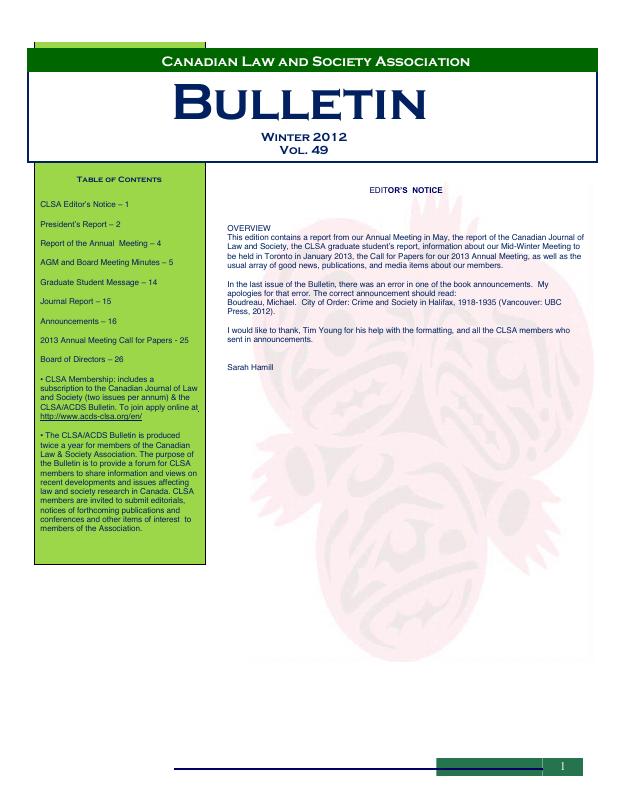
Canadian Law and Society Association Bulletin Winter 2012 Vol. 49 Table of Contents EDITOR’S NOTICE CLSA Editor’s Notice – 1 President’s Report – 2 OVERVIEW This edition contains a report from our Annual Meeting in May, the report of the Canadian Journal of Report of the Annual Meeting – 4 Law and Society, the CLSA graduate student’s report, information about our Mid-Winter Meeting to be held in Toronto in January 2013, the Call for Papers for our 2013 Annual Meeting, as well as the AGM and Board Meeting Minutes – 5 usual array of good news, publications, and media items about our members. Graduate Student Message – 14 In the last issue of the Bulletin, there was an error in one of the book announcements. My apologies for that error. The correct announcement should read: Journal Report – 15 Boudreau, Michael. City of Order: Crime and Society in Halifax, 1918-1935 (Vancouver: UBC Press, 2012). Announcements – 16 I would like to thank, Tim Young for his help with the formatting, and all the CLSA members who 2013 Annual Meeting Call for Papers - 25 sent in announcements. Board of Directors – 26 Sarah Hamill • CLSA Membership: includes a subscription to the Canadian Journal of Law and Society (two issues per annum) & the CLSA/ACDS Bulletin. To join apply online at http://www.acds-clsa.org/en/ • The CLSA/ACDS Bulletin is produced twice a year for members of the Canadian Law & Society Association. The purpose of the Bulletin is to provide a forum for CLSA members to share information and views on recent developments and issues affecting law and society research in Canada. CLSA members are invited to submit editorials, notices of forthcoming publications and conferences and other items of interest to members of the Association. 1
Page 2
President’s Report Dear CLSA, it is a great pleasure and honour to write to you as President of the Association. I look forward to working with you to enhance law and society scholarship across the country and to expand our engagement with each other and our research practices. To begin I wish to express my gratitude and many thanks to Richard Weisman for his great leadership and guidance as past President of the CLSA and to Kimberley White for her outstanding membership work as Vice-President. Our annual meeting was held with Congress at Waterloo/Wilfrid Laurier Universities in May 2012. Lyndsay Campbell gave generously of her time and energy to create a wonderful series of panels and paper sessions. Sarah Hamill and Dayna Crosby put together a fantastic graduate student program. Dr. Philip Girard gave an excellent plenary session entitled “The Many Legalities of Northern North American 1500-1749: A Reconnaissance.” Nikolai Kovalev, the local arrangements coordinator, was responsible for organizing the fun filled banquet. At the banquet the annual article and book prizes were announced. Congratulations to the book prize winner, Laura DeVries for Conflict in Caledonia, UBC Press, 2011 and to Lesley Erickson who received the honourable mention for Westward Bound: Sex, Violence, The Law, and the Making of a Settler Society, UBC Press, 2011. The article prize was awarded to Emily Grabham, Senior Lecturer, Kent Law School, University of Kent for "Doing Things with Time: Flexibility, Adaptability, and Elasticity in UK Equality Cases” in Volume 26: 3 2011. The breadth and depth of the publications of our CLSA membership is very impressive. Please use our website to keep us informed of your achievements in research. We held elections at the Annual General Meeting and welcome Eric Reiter of Carleton University as Vice President, Ruby Dhand (BC/Yukon), Ken Leyton-Brown (Prairies/NWT), Maura Matestic (Ontario/Nunavut) Michael Boudreau (Atlantic) and Ronald Niezen (Quebec) as our new regional representatives, and Annie Bunting, Lyndsay Campbell, Lori Chambers as new members-at-large and Tim Bryan is the new graduate student representative. Thanks to all of you who attended and participated in the conference and the business meetings. We encourage your participation at the mid-winter meeting January 25 and 26, 2013 at the University of Toronto. Please plan to attend the “Law on the Edge” joint conference with the Australia and New Zealand Law and Society Associations July 1-4, 2013 at the Allard Hall Law School, University of British Columbia, Vancouver. This conference has something for everyone and an outstanding roster of speakers and events. Wishing you all the very best in your in your law and society practice. Please come and share your experiences with us in Vancouver. Jane McMillan 2
Page 3
La Lettre du Président Cher CLSA, c'est un grand plaisir et un honneur de m'adresser à vous en tant que présidente de l'Association. Je suis impatiente de travailler avec vous pour renforcer notre engagement avec l'autre et nos pratiques de recherche dans le domaine de droit et société. Premièrement, je tiens à exprimer ma gratitude et un grand merci à Richard Weisman pour son grand leadership en tant que président sortant de l'ACDS. Notre assemblée générale annuelle a eu lieu avec le Congrès aux Wilfrid Laurier/Waterloo le mai 2012. Lyndsay Campbell a donné généreusement de son temps et d'énergie pour créer une magnifique série de tables rondes et des séances de papier. Sarah Hamill et Dayna Crosby à mise sur pied un programme d'études supérieures fantastique. Dr Philippe Girard a donné une excellente séance plénière intitulée “The Many Legalities of Northern North American 1500-1749: A Reconnaissance.” Nikolaï Kovalev, le coordonnateur des arrangements locaux, était chargé d'organiser le banquet magnifique. Lors du banquet annuel le prix d'article et le prix littéraire ont été annoncés. Félicitations au gagnante du prix littéraire, Laura DeVries, pour “Conflict in Calendonia”, UBC Press, 2011, et à Lesley Erickson qui a reçu la mention honorable pour “Westward Bound: Sex, Violence, the Law and the Making of a Settler Society “UBC Press, 2011 . La gagnante du prix d’article était Emily Grabham, chargée de cours, Kent Law School, Université de Kent pour "Doing Things with Time: Flexibility, Adaptation, and Elasticity in UK Equality Cases" dans le Volume 26:3 2011 L'ampleur et la profondeur du recherche de nos membres CLSA est très impressionnante. Veuillez utiliser notre site web pour nous tenir informés de vos réalisations dans la recherche. Nous avons organisé des élections à l'assemblée générale annuelle et je souhaite la bienvenue à Eric Reiter de l'Université Carleton à titre de vice-président, Ruby Dhand (BC / Yukon), Ken Leyton-Brown (Prairies / TN- O), Maura Matestic (Ontario / Nunavut) Michael Boudreau (Atlantique) et Ronald Niezen (Québec), nos nouveaux représentants régionaux, et Annie Bunting, Lyndsay Campbell, Lori Chambers en tant que nouveaux membres et à Tim Bryan, comme réprésentant des étudiants . Merci à tous ceux d'entre vous qui ont assisté et participé à la conférence et les réunions d'affaires. Nous vous encourageons à participer à la réunion de la mi-hiver les 25 et 26 janvier 2013, à l'Université de Toronto. S'il vous plaît prévoyez assister à la «Law on the Edge" conférence conjointe avec les associations de droit et société du Nouvelle-Zélande et a’Australie, les 1-4 juillet 2013, à l'Allard Hall Law School, Université de la Colombie-Britannique, à Vancouver. Cette conférence a pour tous les goûts et une selection exceptionnelle de conférences et d'activités. Je vous souhaite la meilleure dans votre recherche. S'il vous plaît venez partager avec nous à Vancouver. Jane McMillan 3
Page 4
Report of the Annual Meeting The CLSA had a successful meeting in Waterloo with Congress from 27-29 May. The theme of Congress was “Crossroads: Scholarship for an Uncertain World.” We had 30 regular panels on a wide variety of topics, ranging from disability rights to the Enbridge pipeline to prisons. We screened a video, “This is Us: Voices from the Street,” and we had three grad student career panels. We promoted a special presentation by Mary Eberts and a panel marking the 30th anniversary of the Charter, chaired by Nathalie Des Rosiers. We joined with the Canadian Historical Association to offer a panel in the form of a game: attendees of “Constitution-Making Through Digital History Games: The Quebec Conference, 1864” took on the roles of John A. Macdonald, Charles Tupper, Leonard Tilley and others. Our thought-provoking plenary address by Philip Girard, “The Many Legalities of Northern North America 1500-1749: A Reconnaissance,” was very well received. In 2013 we meet with the Law and Society Association of Australia and New Zealand in Vancouver over the July long weekend. We are hoping for a large turn-out at what promises to be an extremely rewarding conference. Lyndsay Campbell, Faculty of Law, University of Calgary. 4
Page 5
Minutes of the CLSA Annual General Meeting 28 May 2012 1. Approval of the Agenda Moved: Lyndsay Campbell Seconded: Annie Bunting 2. Approval of 2011 AGM Minutes Moved: Seconded: Maura Matesic Seconded: Lyndsay Campbell 3. President’s Report Moved: Seconded: Maura Matesic Seconded: Lyndsay Campbell One of the goals for the board for the 2011-2012 year was to implement certain recommendations from the Futures Committee. In particular, the board worked to further open the election process and to encourage broader participation from the members. At the mid-winter meeting held on January 28, 2012 at the University of Ottawa, the issue of board elections was discussed. Based on the Futures Committee recommendations, the nominations committee worked to achieve openness and transparency as the guiding principles. The response of the membership was positive. A nominations committee was created to facilitate the nomination process in advance of the AGM. The Committee then sent out a general call to the membership for nominations (including self-nominations) for these positions, setting a deadline of the end of April. 2 Once the slate was finalized, the committee circulated the slate to the nominees and asked for bios/statements of around 200 words each. Those statements were compiled into a document and circulated, along with the list of nominees for the various positions, to the general membership, with a reminder of the date of the upcoming election. The President offered his thanks to the nominating committee members - Jane McMillan, Ibironke Odumosu, and Benjamin Berger. The information sheet prepared by the Nominations Committee outlining the candidate biographies was provided at the AGM. One significant development was the establishment of 5 regional representative positions, which was a recommendation of the Futures Committee. The importance of having an active board and an active membership was noted. The longevity of organizations is not carved out in stone, making organizations subject to disappearance. The President stressed the need to ensure the preservation of the CLSA as a vital resource for those who are involved in socio-legal scholarship. The President announced that the elections opened at the end of the board meeting. Ballots were distributed and the process was explained. Voters were to clearly mark their ballots, deposit them in the voting box and were asked to sign out on the sheet provided. The President expressed his wish that all the candidates running for the board could be elected. CLSA policies and the Constitution determined that three positions were available for Members At Large as well as one representative from the regions. The candidates were acknowledged as valued members of the Association who had contributed as socio-legal scholars. Thanks were expressed to those who agreed to run for the board. A motion was made to acclaim the candidates where there was only one nomination. Moved: Seconded: Maura Matesic Seconded: Lyndsay Campbell 5
Page 6
Results: President L. Jane McMillan, By Acclamation BC/ Yukon Regional Representative Ruby Dhand – By Acclamation Prairies/ NWT Regional Representative Ken Leyton-Brown - By Acclamation Ontario/ Nunavut Maura Matesic - By Acclamation Quebec Ronald Niezen - By Acclamation Atlantic Canada Michael Boudreau Directors-at-Large Annie Bunting Lyndsay Campbell Lori Chambers 4. Journal Report The journal editors provided a written report that highlighted that the journal is receiving high numbers of manuscript submissions. They are satisfied with the number and quality of the submissions. There is a deficit that was attributed to two one- time only events. After the move to Cambridge, the journal will be publishing two regular issues and one special issue yearly. The first issue with Cambridge will be released in 2013. 5. Financial Report Michael Mopas reviewed the financial report. Several highlights are included below: The CLSA is in a reasonable position in regard to revenue. The membership is healthy and is contributing to a viable financial position. The CLSA is facing a deficit of almost $7000, mainly due to: two payments made to CFHSS in 2011; atypical costs associated with website; and a deficit at the 2011 Annual Meeting. The membership was informed of the revocation of CLSA’s charitable status, which became known through a search of the Canada Revenue Agency's public list of charities online (revocation date – April 30, 2011). The notice online states that the CLSA must pay a revocation tax. The board has decided not to seek the re-establishment of the charitable status given the costs. The website expenses have been identified as too high and the board is looking into less costly options. Further details are included in the report attached [not included in Bulletin]. 6. Conference Report- Lyndsay Campbell, Nikolai Kovelev The planning for Congress 2012 went smoothly. There were just under 100 delegates. The President acknowledged and thanked Lyndsay Campbell for her effort on Congress 2012. It was a success based on the variety of presenters and panels. Nikolai Kovalev's contributions as Local Arrangements Coordinator were also acknowledged. 6
Page 7
One highlight was a combined session between the Canadian Historical Association and the Canadian Law and Society Association, May 28, 2012, from 1:30 to 4:45. The organizers ran a short version of the course, "Making the Canadian Constitution". It was organized with Dr. James Muir, Assistant Professor, Department of History & Classics, Faculty of Law, University of Alberta. There were also two Congress sponsored panels with socio-legal perspectives, including the following: M a r y E b e r t s , C o ng r e ss B i g T h in k in g le c t u re , Professor as citizen, Monday, May 28, 2012 - 9:30am - 11:10am In her Big Thinking lecture at Congress 2012, Mary Eberts suggested that certain questions on balancing social justice advocacy and professional goals hit hardest for junior academics who are dependent on the good opinion of colleagues for tenure and promotion, and on finding favour with funders. Mary Eberts is currently the Ariel F. Sallows Chair in Human Rights at the University of Saskatchewan. Equity Issues May 28, 13:30 to 15:00 | Mathematics and Computer Building (UW), room 4021 Equity Panel - Dignity, equality, freedom: the charter 30 years on Carissima Mathen, Nathalie Des Rosiers, Doug Elliott, Ryder Gilliland Co-sponsored by the Canadian Civil Liberties Association (CCLA) How has the Canadian Charter of Rights and Freedoms impacted human rights discourse and democratic participation in Canada? This panel of distinguished lawyers, including Doug Elliott, Marlys Edwardh and Ryder Gilliland, chaired by Nathalie Des Rosiers (Ottawa), reflected upon the experiences of Aboriginal people, women, racialized minorities and LGBT people in order explore the Charter’s impact on rights and freedoms, social inclusion and democratic participation. Congratulations were extended to the CLSA Congress organizers on these successes in particular. A dinner was held at Marbles Restaurant, 8 William St. E., Waterloo. The President and organization thanked Lyndsay Campbell and Nikolai Kovalev for their efforts in regard to Congress 2012. It was a success based on the variety of presenters and panels. 7. Membership Drive A written report was filed by Kimberley White. In the past 2 years memberships have gone from 108 to 200 which is a healthy increase. Efforts need to continue to stabilize the memberships. The membership breakdown just prior to Congress was as follows: Emeritus: 2 Individual: 103 Student: 95 Total: 200 The President and the membership expressed their appreciation to Kimberley White. 8. Book Prize and Article Prizes- Jane McMillan The work of selecting winners was completed in the Winter and early Spring by the selection committees. There were 15 submissions for the book prize. The committees for the book and article prize were impressed with the submissions. The prizes were awarded at the 2012 Annual Meeting Awards Banquet. 7
Page 8
9. Committees- involvement of membership The importance of having an active board and an active membership was noted. The longevity of organizations is not carved out in stone, making organizations subject to disappearance. The President stressed the need to ensure the preservation of the CLSA as a vital resource for those who are involved in socio-legal scholarship. As an organization, we occupy an important intellectual space, especially given our focus beyond black letter law to interdisciplinary scholarship. Members who want to become more involved were encouraged to make themselves known because there is work to complete. 10. Future Annual meetings- 2013 CLSA – LSAANZ Joint Meeting, Vancouver 2013 The Canadian Law & Society Association is joining with the Law and Society Association of Australia and New Zealand for its 2013 conference, to be held at the UBC Faculty of Law in Vancouver on 1 - 4 July 2013. The theme of the conference is "Law On The Edge", with a number of sub-themes that focus on law in times of crisis, tragedy and uncertainty; indigeneity, pluralism and difference; law on the geo-political edge; connections, departures, mobilities; and new legal spaces on the edge. The conference will include several keynote speakers and a plenary panel of distinguished law and society scholars. It is intended to spark conversations about the shared but somewhat different histories and legal cultures of Canada, New Zealand and Australia, and we are looking forward to building on the vibrant connections that already exist between law and society researchers in these three countries. We will keep CLSA members informed as the conference planning continues. 11. Other Business Article and Book Prize Winners – Announced at the Dinner Dr. Lori Chambers, Dr. Michael Boudreau and Dr. Carmella Murdocca formed the book prize committee. The book prize was awarded to Laura DeVries – Conflict in Caledonia, UBC Press, 2011. An honorable mention went to Lesley Erickson- Westward Bound: Sex, Violence, The Law, and the Making of a Settler Society, UBC Press, 2011. Annie Bunting and Lise Gotell served as the article prize committee. For the CLSA 2011 English Article Prize recipient, they selected: "Doing Things with Time: Flexibility, Adaptability, and Elasticity in UK Equality Cases” in : 26: 3 (2011) by Dr Emily Grabham, Senior Lecturer, Kent Law School, University of Kent. An honorable mention went to “A Company with Sovereignty and Subjects of its Own? The Case of the Hudson’s Bay Company, 167-1763” in 26:1(2011) by Edward Cavanagh. Congratulations to the winners and thank you to the Committee members. 12. Adjournment Mover: Annie Bunting Seconder: Sarah Hamill The meeting was adjourned. 8
Page 9
Minutes of the Board Meeting, 21 August 2012 CLSA Board of Directors Meeting Conducted via Conference call 9:00 am Pacific 1:00 pm Atlantic Present: Chairperson L. Jane McMillan, Benjamin Berger; Tim Bryan, Annie Bunting, Lyndsay Campbell, Lori Chambers, Dayna Crosby, Ruby Dhand, Lise Gotell, Sarah Hamill, Ken Leyton-Brown, Maura Matesic, Michael Mopas, Ibironke Odumosu-Ayanu, Eric Reiter, Josephine L Savarese (Secretary), David Szablowski, Richard Weisman. Regrets: Michael Boudreau, Ronald Niezen. Agenda Items 1. Review of minutes of meeting 29 May 2012 The minutes were approved as circulated. Motion to approve: Lyndsay Seconder: Richard 2. President’s report Jane thanked those on the call for taking the time to join the meeting. She also particularly welcomed new members. The candidacy of Eric Reiter for the position of vice-president was approved by an email vote. The importance of having an active board was stressed. Jane thanked the board members for their commitment, time and energy to the process of organizational management. As a board, we can collectively identify and address key issues relating to the CLSA. 3. Governance and Nominations Committee report Benjamin Berger presented the report to the board. He welcomed everyone who was new to the board or to new positions. Background: The central goal of the report was to obtain board input on recommendations made by the Nominations Committee in a report filed on May 24, 2012. The nominating committee members were L. Jane McMillan, Ibironke Odumosu, and Benjamin Berger. Based on the Futures Committee recommendations, the nominations committee worked to achieve openness and transparency as the guiding principles for CLSA board elections. A nominations committee facilitated the nomination process prior to the AGM which resulted in an election for board positions. Five regional positions were created based on a recommendation from the Futures Committee. Input was sought on four governance related recommendations. Certain practices have been subject to historical convention yet have not been solidified as formal board practices. Recommendations 2 (allowing for the appointment of five regional representatives) and 3 (permitting the necessary by-law changes to allow for the appointment of persons to the board where their expertise is necessary) from the report were uncontested. The board confirmed the powers to appoint. The discussion centred on recommendations 1 and 4. Recommendation 1: 9
Page 10
The Nominations Committee pointed out the lack clarity around the length of terms for board appointments. The Nominations Committee recommended the following: Point 1. That the board confirm that members at large positions are 3 years with all executive positions starting as fresh 2 year terms. Point 2. Board confirmations that regional representatives hold 2 year terms with half of the newly elected regional representatives holding 3 year terms to allow staggering avoiding too much initial turnover. Discussion and Decision Point 1 was affirmed by the board. Point 2: Following a vote, the board confirmed that the normal term for regional representatives would be 3 years. In the initial year, some would be asked to volunteer for a two year term to effect the staggering. Ben agreed to email the regional representatives following the board meeting to solicit volunteers for the shorter term. Recommendation 4: The Nominations Committee identified the need for clarity on the term of office for board members who replace a vacancy when a board member leaves the board prior to his or her term expiration. It was recommended that the position remain vacant until the next election. At the next election, the vacant position would be filled for the remainder of the term that would have accrued to the vacated member. Discussion and Decision Following a vote, it was determined that persons who join the board as replacements will serve out the remainder of the original term rather than beginning a fresh term. Appointed Members Due to the decision taken by the board to permit board appointments to fulfill special responsibilities, Sarah Hamill was appointed to the board as the newsletter editor and the website content manager. Sarah was acknowledged for her active role in the organization as a member and as a past board member. Motion to Approve the Decisions: Annie Seconder: Lyndsay 4. Treasurer’s report Graduate Student Reimbursement – Congress 2012 There was a delay in graduate student reimbursements due to an administrative oversight by SSHRC staff. Mike Mopas will forward the cheques to the graduate students given that the money was on its way. There will be graduate student funding for the Mid-Winter meeting. Membership Fees It was noted that the fees were low in comparison to other associations and were important as a source of funds. The topic of staggered fees was raised as a point of discussion for a later date. The website should include a donation “button” so that members can contribute to the organization, particularly towards graduate student expenses. Fee Changes The 2013 fees for CLSA membership was increased to $ 100.00 for regular members. The graduate student fees were retained at the current rate due to the importance of a strong graduate student contingency. Annie/ Lori The fees for the upcoming meeting in Vancouver 2013 will be set by the Joint Committee who is working with the partner organizations. The fees for Congress 2012 were acknowledged to be at the lower end and this will be a consideration for the joint committee. 10
Page 11
Motion to Approve: Annie Seconder: Lori 5. Journal report Marianna Valverde provided the journal report as an update to the official report provided during the Waterloo meetings. There were no particulars concerns to report. The journal receives many manuscripts which are tracked through an automated manuscript management system. Carleton University supports the journal and the managing editor needs to be placed there. Input from board members is welcome in the form of comments, questions and submissions. The journal has been presented with numerous requests to publish special issues focusing on topics of interest. Given the high demand, efforts are underway to formalize the process for special issues requests. Two special issues were in the works. The special issues extend the visibility of the journal due to wider marketing and allow for concentration on timely issues such as security and surveillance post 9/11, gender and the law. The journal is moving to Cambridge in 2013 and will be publishing three times per year on a regular basis. The tentative plan is for two regular and one special issue per year. The move to Cambridge is viewed positively because it makes the journal more visible in EU circles and it allows international scholars a venue to comment on law and society issues. The report for June will be provided by email. It will include a French language editor special report on the student protest in Quebec, a topic of considerable interest. 6. Newsletter Sarah Hamill will be the newsletter editor for the upcoming year. At the board meeting in August, she was appointed interim director. She received positive feedback from past issues and will continue with the practice of regular newsletters to inform members of CLSA news. 7. Web site Sarah Hamill will serve as the web site content manager. The website continues to be an administrative problem and to be cost inefficient. Sarah is prohibited from making certain changes as these are handled by the website manager for a fee. The CLSA currently has a temporary contract with Rebel Trail. Alternative options are being considered. Estimates for website management services were solicited from two companies. Primordial Soup indicated that there would be a start- up cost of $8000 and Exacto gave an estimate of $8600. The board was concerned about the start -up costs yet also doubtful about Rebel Trail’s ability to provide the service required. Given the financial implications of a change, the membership will be kept fully informed. A Website Management Review Committee was established with Jane, Eric and Sarah as the members. Mike Mopas will be consulted as required. A report will be filed at the Mid-Winter meeting. The committee will research the options so that an informed decision can be made. The website is an important vehicle for organizational information sharing. There will be no further short term contracts with Rebel Trail given the problems experienced with website management. Electronic voting for future board elections was raised as a topic for discussion at a later date. 11
Page 12
8. Mid-winter meeting The CLSA Mid-winter retreat will be held at the Centre for Criminology and Socio- Legal Studies, University of Toronto, January 25-26, 2013. Friday will be the day for paper presentations and discussion with a board meeting on the Saturday. Paper and panel proposals should be emailed to the program chair, Maura Matesic, mmatesic@yorku.ca by 15 December 2012. Ben also volunteered to assist with the other board members providing support, as required. 9. Graduate student report Tim Bryan and Dayna Crosby provided a report. Reactions to Congress 2012 All presenters and grad students were impressed with the structure and organization of the CLSA meetings held during Congress 2012 at Waterloo, Ontario. Concerns were raised about the number of meeting attendees who came and left resulting in small audiences for the presentations. Tim and Dayna are considering ways to market the benefits of fuller involvement during meetings even while it was recognized that similar problems may not arise at the Vancouver meetings. The close proximity of Waterloo to Toronto resulted in low participation given that some attendees returned home following their own presentation. There is interest in more effective communication with graduate students to ensure that they are aware of the benefits of CLSA membership including the fact that interdisciplinary research is encouraged meaning that researchers from a range of disciplines can become involved. The Hawaii meetings were cited as a good example of a strong on-line presence that could be modeled. Online Marketing and Networking Tim and Dayna are considering a blog as a way to attract and inform graduate students. 10. 2013 Conference Update CLSA – LSAANZ Joint Meeting, Vancouver 2013 The Canadian Law & Society Association is joining with the Law and Society Association of Australia and New Zealand for its 2013 conference, to be held at the UBC Faculty of Law in Vancouver on 1 - 4 July 2013. The theme of the conference is "Law On The Edge", with a number of sub-themes that focus on law in times of crisis, tragedy and uncertainty; indigeneity, pluralism and difference; law on the geo-political edge; connections, departures, mobilities; and new legal spaces on the edge. The conference will include several keynote speakers and a plenary panel of distinguished law and society scholars. It is intended to spark conversations about the shared but somewhat different histories and legal cultures of Canada, New Zealand and Australia, and we are looking forward to building on the vibrant connections that already exist between law and society researchers in these three countries. The 2013 Local Organizer is Emma Cunliffe, Law, University of British Columbia. The conference planning and preparation is underway and is going smoothly. On the program side, the progress was reported to be positive. There will be a series of special lectures and events that promise to be invigorating and to provoke discussion. General Information: Ben Berger is representing the CLSA on the planning committee. Jane assisted with a SSHRC application which is pending. Contact people from NZ and Australia have been given the names of Tim and Dayna so that networking between graduate students can occur. Holding Meetings During Congress It was noted that issues arise when CLSA meetings are held during the Congress period including costs, location and low enrollment. Future meetings will prioritize collaboration with CALT with joint CALT/CLSA meetings presented as the optimum. 12
Page 13
11. Prize committees The CLSA awards a book and an article prize on an annual basis. Dr. Ken Leyton-Brown agreed to serve as the chair of the Prize Committee. Lise Gotell and Annie Bunting agreed to serve as the Article committee. Members of the Book Prize Committee will be solicited by Ken. There was discussion about the establishment of a new prize for the highest quality graduate paper received through a competition. 12. World Consortium of Legal Studies Annie bunting gave the report. Marianna Valverde is also involved. The Canadian Law and Society Association is a member of the World Consortium of Law and Society. The Consortium plans to serve as an international coalition of scholars working in law and society and of institutions undertaking research and teaching. The Consortium will use the website architecture to organize meetings. They looked to the CLSA website as an example of how to create an online presence. This aspect of the organization is in the development phase and does not offer much to the CLSA graduate students as a model for online recruitment and information sharing. An executive committee has been established with regional representation. There will be more than one American representative. The LSA was initially resistant to the WCLS due to concerns about duplication of efforts. Some of the doubts on the need for another law and society organization have been resolved and the LSA is currently participating in the WCLS. Member organizations are being asked to contribute financially. CLSA should anticipate a request to access our membership list. 13. Other business There was a brief discussion on the website and whether any remedial action could be taken short of changing the website company. It was determined that a change was the only course of action available. The board returned to the issue of the CLSA prize offerings at the end of the meeting. During the discussion, this idea was described as “great”, “wonderful” and a career “boost”. It was decided that a new prize would be established for a graduate student paper. Graduate students enrolled in Canadian universities will be eligible to participate and the winning paper will be published in the CJLS. The members of the CJLS editorial board will serve as the CLSA Graduate Student Paper Prize adjudicators. Motion: Richard Seconder: Lyndsay The meeting was adjourned. 13
Page 14
Graduate Student Message Greetings graduate students! Thanks to everyone who attended the 2012 CLSA Annual Conference held in Waterloo, ON. Your hard work and commitment to the CLSA made this year’s conference a success! With the continued financial and intellectual support of the CLSA faculty members, the graduate student workshops this year provided graduate students with helpful insights into the graduate student experience, offered useful tips for surviving and thriving in the academy, and engaged students to think about pedagogy and practical tools for teaching and learning with undergraduate students. Thanks to those graduate students who attended and to Richard Weisman, Bryan Hogeveen, Justin Piché, Anita Lam, Joanne Minaker, and James Muir for making these sessions possible. We would also like to thank Lyndsay and Nikolai for all of their work to organize the conference. Every year, the CLSA graduate student representatives hold elections for the outgoing representative. Each student serves a two-year term as responsible for representing and advocating for graduate students at CLSA board meetings, communicating with graduate students, and organizing the graduate student workshops and socials for the annual meeting. We would like to thank Sarah Hamill, the outgoing graduate student representative, for her work and dedicated service to the CLSA. My name is Tim Bryan and I am your 2012- 2014 graduate student representative. I am a PhD student in Socio-Legal Studies at York University. As your current graduate student representatives, Dayna and I are excited about the upcoming year and would like to encourage you to get involved with the CLSA. Please send either of us any comments or suggestions you may have for workshops, socials and other ways we can build the CLSA graduate student community. We want to extend an invitation for you to attend this year’s CLSA Mid-winter meeting at the Centre for Criminology and Sociolegal Studies, University of Toronto from January 25-26, 2013. This is an invaluable opportunity for you to present “works-in-progress” and receive helpful feedback from CLSA scholars. We hope to see you in Toronto! Please email your abstracts to Maura Matesic mmatesic@yorku.ca by 15 December 2012. Also, the 2013 CLSA annual meeting will be jointly hosted with the Law and Society Association of Australia and New Zealand at the University of British Columbia in Vancouver from 1 - 4 July 2013. Please email your proposals to lawontheedge@law.ubc.ca by 10 December 2012. More information can be found at http://www.law.ubc.ca/events/law_on_the_edge/ We look forward to seeing you during the year! Tim Bryan ( tbryan@yorku.ca ) and Dayna Crosby ( dcrosby@yorku.ca ) CLSA Graduate Student Representatives 14
Page 15
Canadian Journal of Law and Society Editor’s Report The CJLS/RCDS is preparing to publish two exciting international issues, one on surveillance after 9/11 and the other on gender equality in the European Union. The table of contents for these issues can be found below. La RCDS/CJLS publiera bientôt deux numéros internationaux intéressants. Le premier numéro examine la surveillance suite aux évènements du 11 septembre 2001. Le second numéro traite de l'égalité entre les sexes au sein de l'Union européenne. Vous trouverez ci-dessous la table des matières de ces deux numéros. The Legacy: Intensified Surveillance in the Aftermath of 9/11 Guest Editors: Kevin D. Haggerty and Ariane Ellerbrok I. Torin Monahan and Priscilla M. Regan – Zones of Opacity: Data Fusion in Post-9/11 Security Organizations II. Yasmeen Abu-Laban and Abigail Bakan – After 9/11: Canada, the Israel/Palestine Conflict and the Surveillance of Public Discourse III. Brenda McPhail, Christopher Parsons, Karen Louise Smith, Joseph Ferenbok and Andrew Clement – Identifying Canadians at the Border: ePassports and the 9/11 legacy IV. Kevin Walby and Seantel Anaïs – Communications Security Establishment Canada (CSEC), Structures of Secrecy, and Ministerial Authorization after September 11 V. Lisa Austin – Getting Past Privacy? Surveillance, the Charter, and the Rule of Law VI. Sunny Hughes – U.S. Domestic Surveillance after 9/11: An analysis of the chilling effect on First Amendment rights in cases filed against the Terrorist Surveillance Program Gender Equality, Legal Mobilization and Feminism in a Multi-Level European System Guest Editors: Dia Anagnostou and Susan Millns I. Dia Anagnostou – Gender Constitutional Reform and Feminist Mobilization in Greece and the EU: From formal to substantive equality? II. Anna Śledzińska-Simon and Adam Bodnar – Gender Equality from Beneath: Electoral Gender Quotas in Poland III. Susan Millns and Charlotte Skeet – Gender Equality and Legal Mobilization in the United Kingdom: Using Rights for Lobbying, Litigation, Defence and Attack IV. Gesine Fuchs – Strategic Litigation for Gender Equality in the Workplace and Legal Opportunity Structures in four European Countries V. Rachel Cichowski – Legal Mobilization, Transnational Activism and Gender Equality in the EU 15
Page 16
Announcements Events and Happenings CLSA – ACDS Mid-Winter Meeting 2013, Toronto, On This is a general interest call for abstracts for those wishing to present papers or propose suggestions for thematic round table discussions of work in progress at the CLSA’s Annual Mid- Winter Meeting January 25 – 26 at the Centre for Criminology and Socio-legal Studies, University of Toronto. The Mid-Winter meeting is an informal gathering and is a great way to connect and get involved with the CLSA. Please confirm your attendance by December 15 to Maura Matesic ( mmatesic@yorku.ca ). Maura is also handling the presentation program, so if you are interested in presenting please send a brief proposal to Maura Matesic ( mmatesic@yorku.ca ) by December 15. All accepted proposals will be scheduled on January 25, the board meeting will be on January 26. Board members are asked to attend as this is the main board meeting of the year. *** Le comité de ACDS vous invite à soumettre vos communications pour ceux et celle qui désire présenter ou suggestions thématiques pour les round table discussions de reports en progrès au conférence semi-annuelle qui aura lieu au Centre for Criminology and Socio-legal studies, l'Université de Toronto les 25 et 26 janvier 2012. La conférence semi-annuelle est une rencontre informelle qui vous offre une opportunité de faire connaissance d'autre membres du Société. Avant le 15 décembre veuillez contactez Maura Matesic (mmatesic@yorku.ca) afin de confirmer votre présence. Veuillez aussi envoyer vos communications si vous voulez présenter au conférence à Maura Matesic (mmatesic@yorku.ca) avant le 15 décembre. Toute communications acceptées dérouleront le vendredi 25 janvier 2012 et l'assemblée du conseil d'administration se tiendra le samedi 26 janvier 2012. Les membres du conseil d'administration sont priés d'y assister puisqu'il s'agit de la principale rencontre de l'année. Calls for Papers and Conference Announcements ENCOUNTERS IN CANADA: CONTRASTING INDIGENOUS AND IMMIGRANT PERSPECTIVES YORK UNIVERSITY, KEELE CAMPUS, TORONTO, CANADA MAY 15–17, 2013 CALL FOR PAPERS Indigenous peoples are the original caretakers of Canada, but their encounters with settlers have been marred by assimilation and territorial dispossession over hundreds of years. The result has been significant alienation between Indigenous peoples and Canadian governments. Conversely, immigrants to Canada, which for the purposes of this conference include early colonists, recent immigrants, refugees and displaced persons, have often viewed the country as a haven or land of opportunity. However, many are sorely unaware of Indigenous history, rights and contributions to Canada’s development. No people or community can speak for another; individual and group knowledge is intrinsic and internal. However, in keeping with the ideal of “mutual sharing” emphasized in the Royal Commission on Aboriginal Peoples, respect and trust can be fostered through shared difference. While the specific experiences of Indigenous peoples, immigrant communities, refugees and Canadian-born citizens are very different on many levels, connections can be developed through dialogue and reciprocity. Indigenous peoples as well as immigrant and refugee communities experience discrimination, racism, stigmatization and marginalization. These encounters represent a wider systemic problem in Canadian political, legal, sociocultural and historical contexts. Efforts to overcome exclusion can be built through increased awareness and knowledge-building, with support from allies. 16
Page 17
This conference aims to fill this gap in knowledge and will bring together leaders from government and the judiciary, legal scholars, academics and practitioners to formulate practical solutions. The primary objective is to build bridges – cultural, political, intellectual and social connections – between those who share the lands of what is now Canada. The underlying rationale of the conference stems from the fact that Canada is now shared by Indigenous peoples, descendants of early settlers and more recent immigrant and refugee communities. These communities encounter Canada in very different ways based on racial identity, ancestral heritage, cultural background, community belonging, language and spiritual practice. Bridging the chasm that exists between Indigenous peoples and all newcomers, whether early or contemporary immigrants or refugees, is urgently needed in order to end discrimination and achieve equitable quality of life for all who live in this country. To this end, the objective is to understand how Indigenous peoples and various immigrant groups experience their lives in Canada. How are the challenges they face different? Are there shared goals and experiences upon which to build future alliances to achieve improved quality of life in Canada? Conference papers are expected to be published subsequently in an edited volume, and acceptable topics will relate to the following broad themes: (1) “Colonialism versus Consent”: Indigenous peoples have been and continue to be negatively impacted by colonialism. They did not consent to assimilation or territorial dispossession. Early settlers and contemporary immigrants and refugees generally have chosen to make Canada their home; this choice was not imposed on them. In the context of colonialism and consent, what have been the contrasting experiences of Indigenous peoples versus settler/immigrant/refugee communities? (2) “Exclusion and Identity”: Indigenous peoples have faced centuries of exclusion and assimilation on their own lands. Early settlers did not face these forms of discrimination, but new immigrants and refugees often experience life on the perimeters of Canadian society. How are these experiences of race and identity different or similar? Are there similarities in how Indigenous peoples and immigrant communities maintain or revitalize their cultures and languages? Could encounters with exclusion and discrimination become points of “shared difference” between Indigenous peoples and immigrant communities? If so, is there the potential for building alliances? (3) “Place and Displacement”: The role of “place” is a vital component of identity. Spiritual and cultural attachment to the land is a predominant component of most Indigenous identities. Similarly, displacement and attachment to home significantly impact life experience, sense of security and the physical and mental well-being of immigrants and refugees who come to Canada. Are there similarities between the territorial dispossession experienced by Indigenous peoples in Canada and refugee communities? What are the impacts of forced migration, especially for those communities who seek to revitalize, recreate or reinvent their identities after losing a sense of “place”? How is “place” experienced by immigrant groups who voluntarily or actively choose to reside in Canada? (4) “Nationalism and Alienation”: Any form of exclusion or discrimination is apt to result in alienation. While experienced differently and in different contexts, Indigenous peoples and immigrant/refugee communities are often alienated from the Canadian mainstream. This perpetuates disadvantage, erects barriers between communities and highlights the differences between “others”. How should the myriad of different national identities be respected in Canada? How should the original contributions of Indigenous peoples be recognized? (5) “Recognition and Respect”: Recognition of difference – historical, cultural, political and social – is a vital sign of respect for a people or nation. Many who live in Canada are unaware of the distinctive histories and contributions of Indigenous peoples. Many are also unaware of the cultures and values of immigrant and refugee communities. What should be done to promote awareness and appreciation of the different groups that share what is now Canada? What might recognition of difference look like in legal, political and cultural contexts, and how would recognition differ for Indigenous peoples versus immigrant/refugee communities in practice? How should the differing cultural practices, histories and identities of Indigenous peoples be promoted and respected? In contrast, what should Canadians learn about immigrant and refugee communities? 17
Page 18
(6) “Relationship-Building and Community Engagement”: Indigenous peoples face an alarming array of dire problems, akin to third-world conditions in an otherwise prosperous country. Immigrant and refugee communities also often contend with poorer quality of life than the “average” Canadian. How are these experiences different? What needs to be done to remedy these problems? Is relationship-building and reconciliation the answer for Indigenous peoples, and if so, what should approaches look like? Can and should alliances be forged between Indigenous peoples and settler/immigrant communities, both early and recent? How and in what contexts (i.e. legal, political, cultural, social) should all communities be actively involved in the creation of their futures? Interested participants are requested to submit abstracts as soon as possible, and no later than December 1, 2012, after which time they will be reviewed by the Conference Program Committee. Proposals for paper presentations and/or panels are welcomed from academics, practitioners and advanced graduate students from across Canada and internationally. Submissions should include a title, an abstract of no more than 250-350 words demonstrating the relevance of the topic to the conference themes as well as brief biographical and contact information along with institutional affiliation (100 words) for each presenter. The conference is actively sourcing funding to support travel and accommodation. If successful, we will be able to provide modest support to selected participants based on financial need. If applying for travel support, please email a brief one-page budget outlining financial need for travel and accommodation to Michele Millard at mmillard@yorku.ca. Abstract submissions should be submitted online here. Any technical questions about the website or online submission process should be directed to Michele Millard, Centre Coordinator and Conference Administrator, Centre for Refugee Studies at York University (mmillard@yorku.ca). All other questions concerning the conference should be directed to the principal academic organizer, Dr. Jennifer Dalton, Assistant Professor, School of Public Policy & Administration, Faculty of Liberal Arts & Professional Studies, and Centre for Refugee Studies Scholar (jedalton@yorku.ca). Interested participants may also contact the members of the Conference Organizing Committee: Dr. David McNab, Associate Professor of Indigenous Thought and Canadian Studies, Departments of Equity Studies/Humanities, Faculty of Liberal Arts & Professional Studies (dtmcnab@yorku.ca); Dr. James Simeon, Acting Director, Centre for Refugee Studies, and Associate Professor, School of Public Policy and Administration, Faculty of Liberal Arts & Professional Studies (jcsimeon@yorku.ca); Dr. H. Tom Wilson, Professor, Faculties of Graduate Studies, Law and Liberal Arts & Professional Studies, and Senior Fellow of McLaughlin College (htwilson@osgoode.yorku.ca). Co-Sponsored By the School of Public Policy and Administration and the Centre for Refugee Studies. *** 6th Congress of Polish Canadianists “The Peaceable Kingdom? Cultural and language communities in Canada and the rule of law" 5-7 April 2013 organised by Adam Mickiewicz University in Poznań, Poland Call for papers th It is with pleasure that we invite you to participate in the 6 Congress of Polish Canadianists, which will take place between 5th and 7th of April 2013 in Poznań, Poland. Congress presentations will focus on the often disturbed or destabilized relations among linguistic, literary and cultural communities of Canada in the context of the political and legal framework within which they exist. We hope to draw scholars from a variety of disciplines within the Canadian Studies and beyond who want to reflect on the emergence of multidisciplinary links among the political, the social and the cultural within Canada. Results of initial research into those areas carried over the last ten years indicate that, whether one takes a socio-political, cultural or literary perspective, it is no longer possible to ignore tensions between differing views regarding the nature of the above mentioned links and interdependencies. Canada, though apparently faithful to the principles of multidisciplinarity and multiculturalism, still has to face and deal with intense conflicts that go beyond the limits of academic discourse. How can one define or think about relationships between cultural and linguistic communities of Canada and the rule of law in relation to this complex interaction between dialogue and the apparent exclusion and silencing? 18
Page 19
The organizers invite you to consider the specificity of the three major kinds of tensions occurring in contemporary Canadian society, i.e. negotiations-negations-antagonisms, from the point of view of the law, economy, politics, sociology, culture, literature, linguistics and translation studies. Potential proposals may include, but are not limited, to the following topics: jurisprudence in the context of official bilingualism and multilingual practice; is it in the service of the humanist ideal that aims to create a common culture? or, does it serve instead to strengthen the cultural divisions by highlighting breakdowns of communication and broken links between groups that constitute the multicultural context?; official languages of Canada and official translation; the impact of the official bilingualism on the policy and practice of translation the impact of the relations between cultural and linguistic communities in Canada and the rule of law on national identity; the role of the English language in everyday life in comparison to its legal status (ideological framework); publication laws and the dissemination of Canadian minority literatures; the impact of legal translation on literary themes and devices promotion policy of the official languages; official bilingualism and the rule of law; legal and political developments in relation to language issues language laws: federal and provincial; linguistic diversity and the economic integration of Canadian provinces ; redefinition of the relations between the two official languages and minority languages; the impact of the change of the legal status of a given language on the restructuring of the linguistic and economic markets; the impact of provincial and regional specificity on legislation related to cultural and linguistic issues; literary and critical reflection on the Canadian “pastoral ideal” and pastoral tradition in support of/against Northrop Frye's claims of its centrality for the concept of Canada as “a Peaceable Kingdom” idealistic impulses in Canadian social and literary tradition versus social and cultural practice links between Canadian literary markets and legal regulations/cultural policies of the Canadian government today and in the past; anglophone and francophone literatures in Canada: historical and contemporary interdependencies, dialogues, conflicts; how are these facilitated or not by the legal framework? banned and challenged books: censorship in Canada today and in the past; majority and minority Canadian literatures (ethnic, racial, class, gender); legal, political and literary responses to othering, excluding, stigmatizing of individuals and communities; gender and sexuality within the multicultural framework; First Nations literatures and cultures in the “Peaceable Kingdom.” 19
Page 20
The deadline for paper or panel proposals is Friday, 30 November 2012. Enquiries and proposals in English or French to: Dagmara Drewniak and Małgorzata Pałaniuk (conference secretaries) Email: pacs.2013@gmail.com Email abstract(s) of 200-300 words and brief CV (please do not exceed one side of A4) which must include your title, institutional affiliation, email and mailing address by 30 November 2012. Submissions will be acknowledged by email. Conference organisers: Agnieszka Rzepa Alicja Żuchelkowska Invitation au 6ème Congrès des Canadianistes Polonais : "Le Royaume paisible? Relations entre les communautés culturelles et linguistiques du Canada et l'application de la loi" Les 5, 6 et 7 avril 2013 organisé par l'Université Adam Mickiewicz Poznań, Pologne Appel à contributions Nous avons le plaisir de vous inviter à contribuer au 6ème Congrès des Canadianistes Polonais qui se déroulera les 5, 6 et 7 avril 2013. Le thème de prédilection de ce congrès est le caractère, souvent boulversé ou déséquilibré, des relations entre les communautés linguistiques, littéraires et culturelles envers les structures et établissements d'envergure politique et juridique ou envers elles-mêmes, étant donné que les études canadiennes consacrent depuis une dizaine d'années une attention particulière à l'égard de l'émergence pluridisciplinaire des rapports politiques, sociaux et culturels au sein de l'État canadien. Il en résulte que la réflexion scientifique sur lesdits problèmes ne peut plus ignorer les tensions entre les points de vue divergents en ce qui concerne la nature de ce rapports, envisagés tout aussi bien sous l'angle sociopolitique que linguistique ou littéraire , tensions qui revêtent les trois formes principales: négociations - négations - antagonismes. De même, une question se pose, à savoir: comment peut-on penser les relations entre les communautés culturelles et linguistiques du Canada et l'application de la loi par rapport à cette interaction complexe entre le dialogue et l'exclusion apparente? Apparemment fidèle à la vertu de la pluridisciplinarité et du pluriculturalisme, le Canada n'est pourtant pas étrangère à toute sorte de conflits intenses qui dépassent même les limites du discours scientifique. Les organisateurs vous invitent à la réflexion au sujet de la spécificité de ces trois principales interactions relationnelles se manifestant dans la société canadienne contemporaine, interactions revêtant différents parcours- juridiques, économiques, politiques, littéraires, linguistiques, traductologiques, sociaux et culturels- que nous nous proposons d'explorer durant le congrès. Ainsi, ce congrès se propose de poursuivre la discussion à propos de la problématique des rapports relatifs aux phénomènes socio- juridiques, ceci en prenant en compte, entre autres, les acquis théoriques et méthodologiques que les études canadiennes ont enregistrés au cours des vingt dernières années. Nous invitons les chercheurs et chercheuses représentant des disciplines différentes à soumettre des propositions de communications qui aborderont, sans pourtant s'y limiter, les problèmes suivants : la jurisprudence dans des contextes de multilinguisme officiel est-elle au service de l'idéal humaniste qui vise à créer une culture commune? Sinon, sert-elle plutôt à renforcer les divisions culturelles en soulignant les rencontres manquées entre les groupes sociolinguistiques qui constituent ces contextes?; langue institutionnelle au Canada par rapport à traduction officielle ; traduction institutionnelle de l'État canadien ; effets du multilinguisme officiel sur les politiques de traduction et sa pratique ; effets des relations entre les communautés culturelles et linguistiques du Canada et l'application de la loi sur l'identité nationale ; rapports de force dont jouit la langue anglaise au Canada dans la vie quotidienne comparativement à son statut légal (cadre idéologique) ; 20
Page 21
application de la loi éditoriale et la diffusion des littératures canadiennes minoritaires ; politique de promotion des langues nationales ; bilinguisme officiel et application de la loi ; jurisprudence en matière linguistique ; diversité linguistique vs intégration économique des provinces canadiennes ; actions sur les langues dans le cadre des États provinciaux ; redéfinition des relations entre langues dominantes et langues dominées ; changement de statut juridique d'une langue donnée et son impact sur la recomposition du marché linguistique et économique ; aménagement(s) juridique(s) et politique(s) des questions linguistiques ; apport des particularités provinciales et régionales dans le domaine de la loi; réflexion critique et littéraire sur l' “idéal pastoral” canadien et la tradition pastorale appuyant/contestant les revendications de Northrop Frye concernant son concept du Canada centralisé perçu comme “Royaume Paisible”; penchants idéalistes au sein de la société canadienne; tradition sociale et littéraire vs la pratique du quotidien; liaisons entre les marchés littéraires canadiens et les réglementations juridiques/politiques culturelles de l'État canadien autrefois et de nos jours; littérature d'expression anglaise et française au Canada; interdépendances historiques et contemporaines, dialogues, conflits, et leur prise en charge politico-juridique éventuelle; oeuvres interdites ou contestées; censure au Canada autrefois et de nos jours; majorités et minorités canadiennes (ethniques, linguistiques, sexuelles, politiques, sociales); réactions politiques, juridiques et littéraires envers l'Autre, l'exclusion et la stigmatisation des individus et des communautés; prise en charge des études sur les enjeux de la sexualité dans le cadre multiculturel; littératures et cultures des Premières Nations au sein du Royaume Paisible. Les résumés de communications, d'une longueur d'environ 200-300 mots, accompagnés d'une courte notice biographique (prière de ne pas dépasser une page), sont à envoyer aux organisatrices jusqu'au 30 novembre 2012. Les résumés sont à envoyer à: Dagmara Drewniak ou Małgorzata Pałaniuk (secrétaires du Congrès) à l'adresse suivante: pacs.2013@gmail.com Les auteurs seront informés de l'acceptation de leurs propositions par mail. Organisatrices du Congrès: Agnieszka Rzepa Alicja Żuchelkowska 21
Page 22
Human Trafficking: What’s Going On? – Panel Discussion Friday November 30, 2012 7 to 9pm Ryerson University - 55 Dundas Street West - Ted Rogers School of Management – Cara Commons (7th floor) Please join us for an exciting public panel considering the international and Canadian trends in “human trafficking”. The panelists ask: Why has human trafficking become a legal and policy priority in Canada, and with what effects? How have international dialogues shaped Canadian public policy? Why does migration for the purposes of engaging in sexual labour capture the public imagination, while other forms of labour-related migration disappear from discussions of criminal exploitation? Melissa Ditmore (Sex Workers Project - New York City) Annalee Lepp (Global Alliance Against Trafficking in Women and the University of Victoria) Nandita Sharma (University of Hawai’i - Manoa) Harsha Walia (Anticolonial migrant justice activist and author – Vancouver) This is a FREE event, held in a wheelchair accessible space. For more information see http://www.facebook.com/events/297512677020410/ Co-sponsored by: Law Research Centre (Ryerson University) & Centre for Feminist Research (York University) Generously supported by: Social Sciences and Humanities Research Council of Canada Department of Criminal Justice and Criminology, Ryerson University Office of the Dean of Arts, Ryerson University Office of the Vice President, Research and Innovation, Ryerson University Ryerson Student Union Graduate Program in Socio-Legal Studies, York University Graduate Program in Gender, Feminist and Women's Studies, York University Department of Social Science, York University REFLECTIVE LAW 18TH ANNUAL UBC INTERDISCIPLINARY LEGAL STUDIES GRADUATE STUDENT CONFERENCE MAY 6-7, 2013 CALL FOR PAPERS Graduate students in all disciplines are invited to participate in the 18th annual UBC interdisciplinary legal studies graduate student conference. The Conference will be held at the University of British Columbia on May 6-7, 2013. The Conference provides a collaborative and supportive atmosphere for graduate students to present ideas, and develop interdisciplinary and inter-university networks, in a stimulating and fun environment. Conference theme: The theme of the 2013 conference is ‘Reflective Law’. The Conference is intended to promote critical reflection on law and its role in our changing world. Participants are encouraged to reflect on the law as a means for dealing with historical, contemporary and future problems, including topics such as: criminal law as reflective of cultural values; international law in a multicultural world; reflections on environmental regulation and sustainability; the impact of technology and a globalised planet; law as mirroring societal values; the relevance of legal institutions in contemporary society; corporate laws as reflective of underlying theoretical approaches; innovative conceptions of the practice of law; laws reflecting colonialism, indigenous values, majoritarianism or minority rights; reflections on immigration policies; ideals reflected in human rights charters; or in any other way that authors understand the theme. We strongly encourage creativity in the interpretation of the theme. Submission guidelines: Proposals are invited from students pursuing graduate degrees in law and disciplines that intersect with law (including economics, political science, anthropology, history, sociology, gender studies, psychology, cultural studies and philosophy). Proposals should include the title of the paper, a 250 word abstract, and the student’s full institutional affiliation, email address and phone number. Presenters should be current graduate students or have recently completed graduate studies (exceptional proposals from 3rd year LL.B./J.D./B.A. students may be accepted). Proposals must be submitted via email to submissions.lawgradcon@gmail.comby January 21, 2013. Conference registration and fees will be payable by March 18, 2013. Detailed information will be posted regularly on the Conference website:www.law.ubc.ca/events/2013/may/18th_conf.html. Questions may be directed to conference organizers at lawgradcon@gmail.com. 22
Page 23
The Faculty of Law at the University of Alberta is Proud to Announce its Centenary Conference: The Future of Law School 26-28 September 2013 Telus Centre for Professional Development, North Campus In 2012-13, the Faculty of Law at the University of Alberta is celebrating its centenary. A remarkable hundred years of service to the profession and the public it has been. Our graduates have served the profession provincially, nationally and internationally; they have become academic lawyers in a host of law schools throughout the common law world; and they have staffed the judicial branch both here in Canada (The Right Honourable Beverly McLachlin, Chief Justice of the Supreme Court of Canada, is one of ours) and abroad. Our Centenary Year will culminate with the two and a half day Conference, The Future of Law School, that will take place from Thursday evening 26 September through to the end of day Saturday 28 September 2013. This Conference is ideally timed to solicit a wide professional, judicial, academic and public response and to have a lasting legacy. Witness the 2007 Carnegie Report Educating Lawyers which issued strong criticism of professional legal education and which has had a profound and continuing impact throughout the common law world; the 2009 Federation of Law Societies of Canada's Report on the Common Law Degree in Canada; and the installation of the 2020 Consultation Panel by the UK Centre of Legal Education: the Law School and the Profession it supplies are being criticized from without and contested from within as never before and their futures are now, as never before, very much up for grabs. Indeed, it wouldn't be hyperbole to state that this unprecedented contest has risen to the status of a cultural war, within the law school and the profession and among the wider public, over the future of law school, of lawyers, and with that, of the law itself. This Conference is dead set on contributing loudly and meaningfully to this cultural battle. It will bring together leading legal thinkers — Canadian and international, and academic, professional and judicial — to state the case against the present and for the future, before members of the common law legal community and before the public at large. The Future of Law School will be structured around the following four themes: Foundations: Theories of Contemporary Professional Legal Education Circumstances: Law Schools, Regulators, and the Market for Legal Services Challenges: Reflecting Changes in the Practice of Law Practices: Innovating the Content and Delivery of Legal Education The Conference's legacy will reside primarily in kindling a passionate public and professional debate concerning what's wrong and what must be righted in professional legal education and with that, the profession of law. This legacy will take shape, in part, and linger in time, through the publication by the University of Alberta Press of an edited collection of Conference papers, presentations, debates, and decisions. For more information check the Conference website at: http://lawschool.ualberta.ca/en/centenary/conference.aspx 23
Page 24
The Good News Dr. Lara Karaian of Carleton University’s Institute of Criminology and Criminal Justice is the recipient of two year SSHRC Insight Development Grant ($73,292) for her project, “Managing Risky Subjects: Teenage Girls, Digital Technology and Canadian Anti-Sexting Public Education Campaigns”. Recent & Forthcoming Publications Books McCoy, Ted. Hard Time: Reforming the Penitentiary in Nineteenth-Century Canada (Edmonton: Athabasca University Press, 2012). http://www.aupress.ca/index.php/books/120209 The Osgoode Society would like to announce the following publications: Gavigan, Shelley. Hunger, Horses and Government Men: Criminal Law on the Aboriginal Plains, 1870-1905 (Vancouver: UBC Press, 2012) Tucker, Eric., Bruce Ziff & James Muir, eds, Property on Trial: Canadian Cases in Context (Toronto: Irwin Law, 2012) Walker, Barrington. ed, The African-Canadian Legal Odyssey: Historical Essays (Toronto: University of Toronto Press, 2012) All of these books, along with the Society’s back catalogue, can be ordered via the society’s website: http://www.osgoodesociety.ca/books_main.html Articles and Book Chapters Karaian, Lara. "Pregnant Men: Repronormativity, Critical Trans Theory and the Re(conceive)ing of Sex and Pregnancy in Law" (2012-1013) Soc & Leg Stud (forthcoming) Virdi, Preet Kaur. 'Barriers to Canadian Justice: Immigrant Sikh women and izzat', (2013) 5:1 Journal of South Asian Diaspora (forthcoming) http://www.tandfonline.com/doi/abs/10.1080/19438192.2013.722383 CLSA in the News Paul Millar and Akwasi Owusu-Bempah’s recent article, “Whitewashing Criminal Justice in Canada: Preventing Research through Data Suppression” (2011) 26:3 CJLS 653, attracted media attention across Canada. Millar and Owusu-Bempah’s article was featured in the National Post ( http://news.nationalpost.com/2012/02/01/police- routinely-suppress-racial-data-in-canada-study-says ), on 640 Talkradio Toronto (available at http://www.640toronto.com/HostsandShows/ArleneBynon/Audio.aspx Millar’s interview took place on 1 February 2012 during hour three, starting at 20:10), and Global TV News (available at http://www.globalnational.com/6442571826/story.html ) among others. 24
Page 25
2013 Canadian Law and Society Association Annual Meeting Conférence 2013 de l’Association Canadienne Droit et Société Law on the Edge is jointly presented by the Canadian Law and Society Association and the Law and Society Association of Australia and New Zealand and will be hosted on-campus at the beautiful University of British Columbia in Vancouver from 1 - 4 July 2013. Proposals for conference sessions (detailed below) must be e-mailed to lawontheedge@law.ubc.ca by 10 December 2012. The concept of living on the edge is not simply geo-political. While it is a politics of the edge, perpetually responding to and writing back at the centre, it is also a recognition that law itself constitutes boundaries and edges, creating sameness, difference, Others and allies. The conference planning emphasizes the following themes: - Law in times of crisis, tragedy & uncertainty; - Indigeneity, pluralism & difference; - Law on the geopolitical edge; - Connections, departures, mobilities; and - New legal spaces on the edge. The conference organisers have planned a mix of programming to allow participants an immersive experience with: - considerable exposure to the best and most innovative law and society scholarship; - a sense of the local context and relevance of law and society in situ; and - a sustained opportunity to meet and exchange ideas with participants who have shared interests and who diverge disciplinarily, conceptually, and methodologically. We encourage sociolegal and interdisciplinary contributions that explore law on the edge in a variety of spatio-temporal contexts, as well as other law and society scholarship. The conference program has been carefully designed to maximize opportunities for dialogue. The conference planning committee invites a variety of proposals including, but extending well beyond, traditional papers. 1. Paper and panel proposals 2. Graduate student workshop 3. Research workshops 4. Field trips 5. Chairing panels All proposals must be e-mailed to lawontheedge@law.ubc.ca by 10 December 2012. We will acknowledge receipt. Keynote and plenary speakers The conference planning committee is excited to have arranged a leading group of keynote and plenary speakers including Leah Bassel, “Paradoxes of Protection: Gender at the Borders” John Borrows, “Ningiiwtaa-inaakonige: Walking Around the Edges of Indigenous Law” “Belonging on the Edge” with Catherine Dauvergne & Jenni Millbank, Shaunnagh Dorsett, Julie Evans and Sherene Razack “Law, Space and Boundaries” with Nick Blomley, Davina Cooper, Lee Godden and Valmaine Toki “Looking out from the Salish Sea” with Douglas Harris, Aaron Wilson and Bruce Miller More information about these speakers will be posted on the conference website soon. 25
Page 26
Canadian Law & Society Association Board of Directors Officers/Executive Student directors Regional Representatives L. Jane McMillan Dayna Crosby Michael Boudreau President Graduate Student Representative Atlantic Canada Department of Anthropology Department of Sociology Criminology and Criminal Frances Xavier University University of Alberta Justice ljmcmill@stfx.ca dcrosby@ualberta.ca St Thomas University mboudreau@stu.ca Richard Weisman Tim Bryan Past President Graduate Student Representative Ruby Dhand Law & Society Law and Society Program BC/Yukon Program, York York University Faculty of Law University tbryan@yorku.ca Thompson Rivers University rweisman@yorku.ca rdhand@tru.ca Directors-At-Large Benjamin Berger Ken Leyton-Brown Vice-President Article 4.3 Prairies/NWT Osgoode Hall Law (a)“The Board of Directors of the School, York University Sociology and Social Studies Association shall consist of the bberger@osgoode.yorku University of Regina Officers described at article 4.1 .ca (Officers), nine Directors-at-Large Ken.leyton-brown@uregina.ca and two student Directors. Eric Reiter (b) Directors at Large shall serve Maura Matesic Vice-President three year terms, and three Directors- at- Ontario/Nunavut Department of History Large shall be replaced every year [when Social Sciences and Communications Studies Concordia University their three year terms expire]. York University ereiter@alcor.concordia.ca Student directors are elected for one mmatesic@yorku.ca or two year terms. Michael Mopas Ronald Niezen Treasurer Quebec Department of Sociology and Directors Anthropology Carleton University Department of Anthropology michael_mopas@carleton.ca Anne Bunting McGill University Law and Society Program Ronald.niezen@mcgill.ca Mariana Valverde York University CJLS/RCDS Editor/Rédactrice abunting@yorku.ca Bulletin Editor/Website Manager Centre of Criminology Sarah Hamill University of Toronto Lyndsay Campbell Faculty of Law m.valverde@utoronto.ca Law and Society, Faculty of Law University of Alberta University of Calgary sehamill@ualberta.ca Dawn Moore lyndsay@iii.ca CJLS/RCDS Managing Editor 2013 Conference Coordinators Law and Legal Studies Lori Chambers Carleton University Women’s Studies Emma Cunliffe Dawn_Moore@carleton.ca Lakehead University Faculty of Law lchambe2@lakeheadu.ca University of British Columbia Lise Gotell cunliffe@law.ubc.ca Secretary Women’s Studies Ibrionke Odumosu-Ayanu Renisa Mawani University of Alberta College of Law Sociology lisegotell@ualberta.ca University of Saskatchewan University of British Columbia ibrionke.odumosu@usask.ca renisa@mail.ubc.ca Josephine Savarese Secretary David Szablowski Douglas Harris Department of Criminology & Department of Social Sciences Criminal Justice St Thomas Faculty of Law York University davidsz@yorku.ca University University of British Columbia savarese@stu.ca harris@law.ubc.ca Contact Information Check our Website for the latest news! See us at: http://www.acds-clsa.org 26