Reading note · CLSA / ACDS
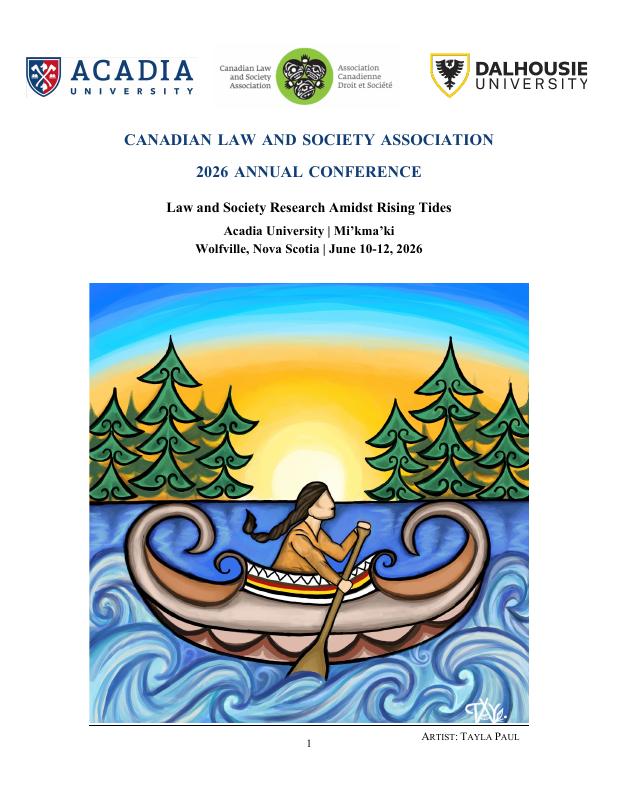
Acadia University hosted the 2026 annual conference in Wolfville, Mi’kma’ki, on 10–12 June under the theme “Law and Society Research Amidst Rising Tides”. The cover credits artist Tayla Paul. The programme records scheduled contributions, not a collection of final papers.
A route through technology and power
On page 2, session 1.a examines AI and students’ research, analytical and communication skills. Session 1.b turns to digital court forms, migrant labour and workplace surveillance. Read these together to compare how technology changes teaching, access to legal processes and relations at work.
Environment, housing and participation
Page 3 moves from environmental rights and climate-related migration in session 1.c to housing and social programmes in session 1.d. Session 1.e asks about transitional justice, meaningful participation and co-creation of knowledge. These are distinct panels: the programme does not claim they reached a common conclusion.
Try a comparative note
Choose one presentation from 1.a and one from 1.b. Write down the technology involved, the people affected, the evidence proposed and the question left open. For example, compare the proposed evaluation of digital court forms with a proposed study of workplace surveillance. Identify what you would need to read before comparing their findings.
Build a research route through the 2026 programme
The Acadia programme is a map of scholarly questions, people and parallel sessions. The June 2026 meeting has finished; the programme remains useful for locating related work and planning a reading route.
- The conference was scheduled for 10–12 June 2026 at Acadia University in Wolfville, Mi’kma’ki.Source page 1
- Session 1 ran from 8:30 to 10:00 on 10 June. The AI teaching panel occupied the KCIC Auditorium; the technology and power panel occupied the KCIC Classroom.Source page 2
- The environmental law panel was listed in Patterson Hall, room 213, alongside other parallel sessions.Source page 3
- 01Research question
- 02Named paper
- 03Session 1.b
- 04Follow-up reading
Session 1.b is the closer match to the example question. Session 1.a is a separate lead, not a second simultaneous appointment. A programme listing does not establish a paper’s findings.
Example: studying digital tools rather than AI teaching
- Write one research question before choosing a session.
- Match that question to a session title and named paper; record its page and room.
- Because these sessions overlap, choose a primary route and save the other paper as a follow-up reading lead.
Example: studying digital tools rather than AI teaching
| Question | How should the quality of digital court forms be evaluated? |
|---|---|
| Matching paper | Allison Leadley and Sarah Heath: Beyond Efficiency, in session 1.b.Source page 2 |
| Parallel alternative | Session 1.a concerns students’ research, analytical and communication skills in an age of AI.Source page 2 |
Session 1.b is the closer match to the example question. Session 1.a is a separate lead, not a second simultaneous appointment. A programme listing does not establish a paper’s findings.
19 pages of text
Source-language text, including both languages where the original is bilingual. Page numbering follows the obtained document.
Page 1
CANADIAN LAW AND SOCIETY ASSOCIATION 2026 ANNUAL CONFERENCE Law and Society Research Amidst Rising Tides Acadia University | Mi’kma’ki Wolfville, Nova Scotia | June 10-12, 2026 ARTIST: TAYLA PAUL 1
Page 2
FINAL PROGRAM Session Locations: All sessions will be held at Acadia University. [MAP] KC Irving Environmental Science Centre, 32 University Avenue (KCIC Auditorium, KCIC Classroom, KCIC Boardroom) Patterson Hall (Manning School of Business), 24 University Avenue (Rooms 107, 206, 213) Keynote Address Location: Fountain Commons, 26 Crowell Drive Wi-Fi: Individual Guest Account available at registration. Academic Press Boutique: First Floor, Patterson Hall Displays by Fernwood Press, McGill-Queen’s University Press, and UBC Press A representative from Fernwood Press will be in attendance on Wednesday, June 10. Please note: Acadia University is a scent-free campus. Day 1: Wednesday, June 10, 2026 Registration: 8:00 a.m. to 8:30 a.m. (Location: Patterson Hall Main Lobby) Light refreshments will be available. SESSION 1: 8:30 A.M. TO 10:00 A.M. 1.a. Life with AI: Developing Students’ Research, Analytical and Communication Skills in an Age of Temptation (Location: KCIC Auditorium) Mélanie Méthot (UAlberta): “Murder She Taught: Defying AI at the Undergraduate Level” Lyndsay Campbell (Calgary): “Marginalizing AI in Undergraduate and JD Classrooms” Nicole O’Byrne (UNB): “Moving Beyond the Hype and the Hysteria: An Examination of How Law Students Use AI” Paolo Bohorquez (UofT) and María M. Gómez (SMU): “Teaching (in) Crisis; Crisis (in) Teaching” Chair: Johannes Wheeldon (Acadia) 1.b. Beyond the Rules: Technology, Power, and Change in Modern Legal Systems (Location: KCIC Classroom) Allison Leadley (CLEO) and Sarah Heath (UWinnipeg): “Beyond Efficiency: Evaluating the Quality of Court Forms Produced by Digital Legal Tools for Self-Represented Litigants” Christiana Essie Sagay (UofO): “Migrant Labour and the Myth of a Borderless Web” 2
Page 3
Danielle Thompson (Waterloo): “Labour Unions and Collective Agreements as Regulatory Mechanisms in Workplace Surveillance Chair: Sarah Turnbull (Waterloo) 1.c. Law and the Environment (Location: Patterson Hall Room 213) Rachel Ariss (Ontario Tech): “Environmental Rights Decision-Making in Widely Different Statutory Contexts: Tides Rising in Isolation?” David Wright (UCalgary): “Deregulation Tidal Waves and the Erosion of Impact Assessment: Stemming the Tide or Sinking the Ship through Cost-Benefit Analysis? Heather Gill-Frerking (Carleton): “Exploring the Lack of Intangible Cultural Heritage in Law, Policy, and Practice Documents Associated with Climate-Related Migration” [virtual] Ivan Dario Vargas Roncancio (York): “‘Hiding the Metal’: Samai, Eco-legal Resistance, and the Alchemy of the Energy Transition in the Andes-Amazon” Chair: Katie Mazer (Acadia) 1.d. Housing, Social Programs, and Legal Regulation: Contemporary Challenges (Location: Patterson Hall Room 206) Felix Hoehn (USask): “Residential Densities - Can Equity Trump Zoning?” Nicolas Spallanzani-Sarrasin (Université de Montréal): “Youth, Homelessness and Conflicts with Non- criminal Legal Systems” Leanna Katz (Dal): “Financial Regulation of Social Programs: Childcare, Pension Funds, and Risk- Shifting in the Canadian Welfare State” Kate Ashley (Acadia): “Commissioning Change: Federal Royal Commissions and Postsecondary Reform in Canada” Chair: Can Mutlu (Acadia) 1.e. Transitional Justice (Location: Patterson Hall Room 107) Annie Bunting (York) and Thomas Ochen: “Swimming Against the Tide: Youth, Peace-building and Transitional Justice-making” Ghazal Andalib (Western): “Defining ‘Meaningful Participation’ in Transitional Justice Mechanisms: Conceptual and Legal Perspectives on Refugee Women” Marianna Iovenko (Waterloo): “Dual Identities and Co-Creation of Knowledge in Ukraine: Methodology of Researching Conflict-Related Sexual Violence with NGOs and Survivor-Led Networks” Can Turget (York): “Legal Mobilization of Memory Keepers: Disputing the Aesthetics of Transitional Justice in Turkiye” 3
Page 4
Chair: Heather Tasker (Dal) __________________________________________________________________ Health Break: 10:00 a.m. to 10:30 a.m. __________________________________________________________________ SESSION 2: 10:30 A.M. TO 12:00 P.M. 2.a. Practices and Theories of Judging (Location: Patterson Hall Room 206) Erin Crandall (Acadia) and Andrea Lawlor: “Comparing Confidence: Theories of Judicial Support in the United States and Canada” Clare Shrybman (Osgoode): “Is the Motion Judge the Gatekeeper to Positive Rights in Canada? Examining Motions to Strike for Justiciability and Canadian Courts’ Pre-emptive-closing of Gosselin’s Open Door” Ali Ekber Cinar (McGill): “Mapping the Social Life of Precedent: A Computational Analysis of Canadian Judicial Citations” MacIntosh Ross (SMU): “Abuse and the Autonomy of Sport in Canada” Chair: Kate Ashley (Acadia) 2.b. Sex, Surveillance, and Redress: Contemporary Challenges in Law (Location: KCIC Auditorium) Catherine Marquis Harvey (McGill): “Rising Tides, Receding Rights: Sex Workers’ Access to Justice under Canada’s End-Demand Model” Brynn Colledge (Waterloo): “Secret Surveillance: How the Popularization of Ray-Ban Meta Smart Glasses Poses a Threat to Sex Worker Safety” Sara Wideman (Trent) and Mandi Gray (Trent): “What's the Damage? A Critical Feminist Analysis of Damages Awards for Defamation and Sexual Assault in Ontario, Canada” Lara Karaian (Carleton): “Three Creeps and a Sex Crime?: Reimagining Deepfake Pornography and Pathways to Erotic Justice” Chair: Alexa Dodge (SMU) 2.c. From the Ground Up: Seeking Collective Wisdom on Creating a New Law School (Location: KCIC Boardroom) Facilitated by Kelly Gallagher-MacKay (Wilfred Laurier) and Marcia Oliver (Wilfred Laurier) Wilfrid Laurier University is proposing to open a new law school in Brantford, Ontario. The planned focus of the school is to prepare graduates to meet the acute legal needs of smaller and mid-size communities, while ensuring that students have broad academic and professional training that is a hallmark of Canadian 4
Page 5
legal education. An essential component of the plan is strong, ongoing relationships with local Haudenosaunee and Anishnaawbe communities, and a Law-Society approved Integrated Practice Program of supervised work placement and required curriculum elements that qualifies graduates to write bar admissions exams without additional articling requirements. This interactive session is designed to draw on the collective wisdom of the CLSA membership, both critical socio-legal scholars and those who teach in law schools, and to provoke reflection on opportunities within existing law schools. Core questions for discussion will be: What are powerful tools for building inclusive and dynamic sense of community and shared vision within a new law school? To improve access, we’re hoping to build in a planned part-time pathway and year-round operation – are there approaches that lead to greater success for part-time students, or other approaches that have effectively opened doors for students who have likely borne the brunt of systemic discrimination? Alongside intentional recruitment and curriculum, are there suggestions about intentional ongoing engagement with First Nations to ensure direction and two-way support? How can newcomer law schools develop a niche in a potentially skeptical legal profession to create opportunities for graduates? Any advice on hard curriculum choices facing a smaller law school? For those with experience with new law schools, any unexpected pitfalls or opportunities to which we should be alert? 2.d. Moving from Police-Based to Peer-Based Mobile Crisis Response in Rural Nova Scotia (Location: Patterson Hall Room 213) Across Nova Scotia, the police are the default first responders to people experiencing mental health or substance use crises. While critiques of police-based approaches and demands to decrease police involvement in crisis calls have existed for decades, recent advocacy eMorts and policy discussions have moved from the margins to the mainstream. Several major reports in Nova Scotia have pointed to the need to limit police involvement in health and social issues and have recommended the expansion of civilian led alternatives. In response, new community-based crisis services are emerging in Nova Scotian communities, including the Peer Outreach Support Services & Education – Crisis Intervention & Addiction Outreach (POSSECIAO) program in the rural community of West Hants. This panel examines the development and early implementation of the POSSE-CIAO program, with particular attention to its peer-based, rights respecting, trauma-informed, harm reduction-oriented, and community-grounded approach to crisis intervention. The discussion situates the POSSECIAO program within a broader global context of growing non-carceral community crisis response models alongside expanding of coercive mental health and substance use legislation. Panelists critically reflect on the rural dimensions of the program, exploring how geographic dispersion, limited-service infrastructure, and close-knit community dynamics shape mobile crisis service delivery. By intentionally centering practitioner knowledge alongside scholarly analysis, this panel models the very approach it advocates: uplifting community-driven responses, reducing reliance on institutions, and highlighting the potential of rural, civilian-led crisis services to advance community- centered care, social justice, and equity. Panelists: Benjamin Dykeman (POSSE) Kimm Kent (POSSE) Jamie Livingston (SMU) Mary Sweatman (Acadia) 5
Page 6
2.e. Policing Narratives, Accountability, and Community Safety [bilingual panel] (Location: Patterson Hall Room 107) Marcus Sibley (SMU), Eden Ward (SMU), and Kevin Walby (UWinnipeg): “Community Safety Groups and Claims-Making in Local Media” Philip Boyle (Waterloo): “The Offence of Interference: Policing Critical Infrastructure” Annie Li (UofT): “Narratives of Victim Precipitation in Police Accountability Reports: The Case of the SIU's Response to Suicide-by-Cop Declarations” Véronique Fortin (Université de Sherbrooke) : « De la police communautaire à la police de proximité : une analyse sociojuridique de la nouvelle politique ministérielle sur la police au Québec » Chair: Joao Velloso (UofO) ______________________________________________________________________________ Lunch Break: 12:00 p.m. to 1:30 p.m. (Location: Great Hall, Fountain Commons) A catered lunch will be provided. _____________________________________________________________________________________ SESSION 3: 1:30 P.M. TO 3:00 P.M. (Location: Great Hall, Fountain Commons) Welcome Address: Dr. Jeffrey Hennessy (President and Vice-Chancellor of Acadia University), Dr. Nicole O’Byrne (President of the CLSA) Keynote Speaker: Professor Lise Gotell (UAlberta) Title: From the Belly of the Beast: On Reclaiming Feminist Politics Abstract: I am old now, looking back on more than three decades of researching, writing, and teaching feminism, politics and law. This keynote is a backward glance and a forward-looking reflection: an attempt to think about feminism’s future from within a hostile and uncertain present. Returning to some of the ideas that shaped my early work, I will argue for re-centring feminist politics in all of its messiness, creativity, disagreement, and possibility. As Wendy Brown (1995) argued, periods of uncertainty and backlash often tempt feminism to retreat into the certainty of feminist Truth. Brown understood this impulse as a form of Nietzschean ressentiment: a politics that abandons struggle, contingency, and persuasion in favour of moral certainty. Against this, she defended politics as ongoing “wars of position,” sustained through contestation, argument, and the difficult labour of democratic engagement. More than thirty years later, feminism appears newly caught in the grip of competing Truth games. Just as neoliberalism has eroded the cultural and political foundations of democracy while creating fertile ground for right-wing populism, it has also transformed feminist politics. Neoliberal rationalities replace structural critiques of power, with technocratic inclusion frameworks and market-oriented understandings of the self. These individualizing logics have narrowed spaces for disagreement, pushing feminism towards increased political polarization, and making solidarity increasingly difficult to sustain. 6
Page 7
Drawing on debates within feminist legal studies, including disputes over criminal law, the so-called “rough sex defence,” and sex work/prostitution, I will explore the costs of increasingly polarized political cultures. Across these debates, opposing camps frequently advance absolute Truth claims while denying both the legitimacy of the middle ground and the partial insights of their adversaries. I will suggest that feminism’s future depends less on securing epistemological certainty than on building a democratic political culture capable of sustaining disagreement, complexity, and collective struggle. __________________________________________________________________ Health Break: 3:00 p.m. to 3:30 p.m. __________________________________________________________________ SESSION 4: 3:30 P.M. TO 5:30 P.M. 4.a. Socio-Legal Topics in Medicine and Health (1) (Location: KCIC Auditorium) Emily Snyder (UBC): “Partner Notification and STBBI Health Governance in Canada: The Need for Socio-Legal Critique” Matthew Herder (Dal): “The Security of Experiment with IP: Scientists’ Struggles to Develop Ebola and Tuberculosis Vaccines” Kyle Gordon Cayouette (Carleton): “When the Facemask Governs: Reading the Facemask as Law in Public Health Campaigns” Joshua Shaw (USask): “A Medico-Legal History of a Common Law Power to Dissect the Dead” Chair: Felix Hoehn (USask) 4.b. Carceral Spaces (Location: KCIC Classroom) Azar Mahmoudi (UAlberta): “Rising Tides Behind the Walls: Carceral Corruption and Institutional Erosion in a South African Correctional Center” Hosanah Santana Filho (Carleton): “Life Time vs. Sentence Time: Late-life Incarceration in a Brazilian Prison” Louise Borges Barbosa (Carleton): “Between Care and Obstetric Violence: Experiences of Pregnant and Postpartum Women in a Women's Prison in the Brazilian Amazon” Luana Leite Rabelo (Carleton): “Governing Through Medicalization? Gendered Prison Governance in Women's Prisons in Pernambuco, Brazil” Chair: Daniel Del Gobbo (Windsor) 7
Page 8
4.c. Technologies of Punishment (Location: Patterson Hall Room 206) Robin Whitehead (Lakehead): “Examining the Legal Implications of AI-Generated Police Reports in Canada” Sarah Turnbull (Waterloo) [and non-presenting co-authors]: “Trickle-down Punitiveness: Transparency, Carceral Cascading, and Victims’ Rights” Helene Love (Simon Fraser): “Sentencing Youth with Mental Health Diagnoses: A Quantitative Review of Case Outcomes” Chair: Adelina Iftene (Dalhousie) 4.d. Reconciliation (Patterson Hall Room 107) Johannes Wheeldon (Acadia) and Emily Richardson (Acadia): “Cannabis, Indigenous Rights, and Reconciliation: The Case of Nova Scotia” Leo Baskatawang (UManitoba) and Jeremy Patzer (UManitoba): “Historic Treaties and Contemporary Disputes: The Case for Good Relations and Living Rights” Justine Monette-Trembley (UQAM): “Truth and Reconciliation Commissions Challenged by Victims' Perceptions of Justice: Critical Reflections and Possible Solutions” Genevieve Renard Painter (Concordia): “An Invisible Pillar, and Tutor, of Canada’s Constitutional Order: The Indian Act and Indian Women” Chair: Can Mutlu (Acadia) ______________________________________________________________________________ 6:00 p.m. Conference Kick-Off Social at Lightfoot & Wolfville Vineyards Please note: This event is limited to participants who pre-purchased tickets. Unfortunately, tickets cannot be purchased at the venue. A bus will be available for attendees. Pick-up will be at 5:45pm at the Athletics Centre, Acadia University. Following the social, the bus will return attendees to campus or the Old Orchard Inn. Address: 11143 Evangeline Trail, Wolfville Tel.: +1-902-542-7774 _____________________________________________________________________________________ 8
Page 9
Day 2: Thursday, June 11, 2026 Registration: 8:00 a.m. to 8:30 a.m. (Location: Patterson Hall Main Lobby) Light refreshments will be available. SESSION 1: 8:30 A.M. TO 10:00 A.M. 1.a. Navigating Immigration and Refugee Law in a Non-Traditional Gateway City: Hidden Work and Precarious Infrastructures (Location: Patterson Hall Room 213) Katherine Pendakis (MUN): “From Policy to Practice: The Hidden Labour Behind Newcomer Settlement in Northern Ontario” Stephanie Holman (McMaster): “When Exploitation Falls Short of Trafficking: Legal Definitions and Access to Remedy for Temporary Foreign Workers in Canada” Chair: Elizabeth Rondinelli (Acadia) 1.b. Law, Citizenship, Authoritarianism (Location: Patterson Hall Room 107) Ade Olumide (UofOttawa): “Eleven Electoral Commissions, Section 3 of the Charter ‘Every Citizen,’ and Political Party Nomination Expulsions” Matvey Lomonosov (Nazarbayev University): “Citizenship Laws in Former Yogoslavia and USSR: Where the Theories of Citizenship Ethnicization do not Work and Why?” Mugambi Jouet (University of Southern California): “The Sphere of Criminality: A Window into History, Democracy, and Authoritarianism” Gamze Ovacik (McGill): “Policies for Externalization of Migration Control in North America and Europe: A Model of Containment and Illegalization of Mobility” Chair: Jeffrey Sachs (Acadia) 1.c. Economics and Rights Internationally (Location: KCIC Classroom) Unyime Abasi Odong (University of Ottawa Law): “Rising Tides, Sinking Rafts: Canada and Africa in Global Fintech Trade Flows” Adelanke Y Aremo (USask): “From Judgment to Impact: Assessing the Effectiveness of Strategic Litigation in Advancing Socio-Economic Rights in Nigeria” Mahan Ashouri (MacEwan): “Assessing the Effects of Canada's Economic Sanctions Regimes on International Dispute Settlement as a Barrier to Achieving Canada's Sustainable Development Goals” Chair: Barry Watson (Acadia) 9
Page 10
1.d. How Can Research on Palestine Contribute to Solidarist Discourse? (Location: KCIC Auditorium) Collectively, the panel reflects on how scholarly work can resist divisive narratives, challenge the policing of knowledge, and contribute to a more solidaristic and justice-oriented discourse within and beyond the academy. Given that the conference also invites participants to engage in unconventional panel presentations, we propose to engage in a fishbowl conversation by ‘unconferencing’ the conference. The question we pose is this – who gets to speak about Palestine? The format is as follows: The inner circle comprises the three of us and the moderator/discussant. The outer circle is the audience. We leave an empty chair open at all times for anyone – community members, students, and scholars – facing institutional pressure. We may also include those who are silenced or self- censoring due to fear of reprisals etc. We plan to ask anyone who may have experienced any of these institutional constraints to take the empty chair and participate in these discussions organically. This then makes the precarious nature of the academy and activism more visible. It shifts the authority from “scholarship” or “expertise” to lived experiences. We propose this format as one of the ways in which we could potentially turn solidarity into practice. Panelists: Safiyah Rochelle (York): “Palestine Is Not Past: Student Protest, Memory, and Racial Necrogeographies” Lauren Moore (York): “Silencing Palestine: How Media and Universities Contribute to Rising Anti- Palestinian Racism in Canada” Jay Ramasubramanyam (York): “Solidarity in Retreat? India’s Shifting Palestine Policy from Resistance to Realignment” ______________________________________________________________________________ Health Break: 10:00 a.m. to 10:30 a.m. __________________________________________________________________ SESSION 2: 10:30 A.M. TO 12:00 P.M. 2.a. Hate Speech (Location: KCIC Auditorium) Allyson Lunny (York): “Confusing Symbols and Hate Speech Laws: What Could Go Wrong???” Arunita Das (York): “Far-Right Women in Canada: Widening the Rising Tide of Online Hate” Kaitlyn Blaser (UBC) [and non-presenting co-author]: “Decision-Making and Hateful Expression: Insights from a Survey Experiment” Chair: Bruce Ryder (York) 2.b. Empirical and Lived Perspectives on Race and Justice (Location: Patterson Hall Room 107) Daniel Del Gobbo (Windsor): “Secondary Adversarialism: A Theory of Conflict Escalation and Agenda for Law Reform” 10
Page 11
Camisha Sibblis (Windsor) and Danardo Jones (Windsor): “Same, Same…But Different? Comparing the Assessment of Risk, Moral Blameworthiness and Utility of IRCAs in Companion Youth Cases: R v SB and R v IM” Clifton Anthony Grant (York): “Black Men, Post Incarceration, the Struggle is REAL!” Chair: Johannes Wheeldon (Acadia) 2.c. Law, Violence, and the Production of Legality (Location: KCIC Classroom) Catherine Evans (UofT): “Burning Down Wooden Towns: Making Sense of Incendiarism in Colonial Canada” Amy Swiffen (Concordia): “When Biopolitics is Not Given: Law-Preserving Violence and Juridical Authority under Legal Pluralism” Matthew P. Unger (Concordia): “Mystical Grounds: Bourdieu and Derrida on the Force of Law” Chair: Lyndsay Campbell (Calgary) 2.d. Lifting the Smallest Boats: Strengthening Children’s Access to Justice Amid Rising Tides (Location: Patterson Hall Room 206) Mona Paré (UofO): “Child and Youth Advocates in Canada: A Child Rights-based Approach to Access to Justice?" Anne Levesque (UofO): “Whose Human Rights? Children’s Access to Justice in the Canadian Human Rights Landscape” Jean-Frédéric Hübsch (UofO): “Access to Fairness for Children: Are Canadian Ombudsman Child- friendly?” Chair: Kate Ashley (Acadia) 2.e. Socio-Legal Topics in Medicine and Health (2) (Location: Patterson Hall Room 213) Chen-Meng Lam (Singapore University of Social Sciences): “Reconsidering Loss of Chance in Medical Negligence in Canada: Addressing Evidentiary Injustice” Matheus Zuliane Falcão (McGill): “From Individual Privacy to Health Data as a Common Good: A Socio-legal Comparison of Quebec, Alberta, and Ontario, Including Indigenous Data Governance in Ontario” Josephine L. Savarese (STU): “Contemplating the ‘Rough Ground’: Thoughts on the Importance of Culturally Sensitive Death Investigation Protocols” Chair: Joshua Shaw (USask) 11
Page 12
_____________________________________________________________________________________ Lunch Break 12:00 p.m. to 1:30 p.m. CLSA Annual General Meeting (Location: KCIC Auditorium; Zoom link) Lunch will be provided in KCIC Garden Room. ______________________________________________________________________________ SESSION 3: 1:30 P.M. TO 3:00 P.M. 3.a. « Comment le droit peut-il contribuer a ameliorer la situation plutot qu'a l'aggraver? » [bilingual panel] (Location: Patterson Hall Room 206) Miriam Zucker (McGill) and Deepa Mattoo (UofT): “Recontextualizing Forced Marriage as a Form of Coercive Control and Reinvigorating Alternatives to Penal Approaches” Marika Allain (UQAM) : « Entre discretion et discrimination: une reflexion critique du pouvoir discretionnaire des procureurs aux poursuites criminelles et penales au Quebec » Carmen Hojabri (UQAM): “Moralized and Pathologized: Gender, Discretion, and Parole in Quebec” Chair: Mona Paré (UofO) 3.b. Intimate Partner Violence (IPV) (Location: Patterson Hall Room 107) Julia Rowena Tolmie (University of Auckland): “Documenting Intimate Partner Violence Entrapment and Imagining Alternatives” Neela Hassan (Waterloo): “Stories of Precarity: Domestic Violence Experiences of Migrant Women in Canada” Rowan Helmer (Dal): “Turning the Tide, or Treading Water?: A Thematic Analysis of Gender-Based and Intimate Partner Violence Policy in Nova Scotia since 2023” Chair: Heather Tasker (Dal) 3.c. Aboriginal Title and Private Property: Considering the Cowichan Tribes and Wolastaqey Nation Decisions (Location: KCIC Classroom) Renee Pelletier (OTK Law): “The Wolastoqey Nation Decisions (NBKB and NBCA)” Graeme Cook: “The Cowichan Tribes Decision: Declarations of Title and Fee Simple Interests” Robert Hamilton (Calgary): “Reconsidering Title and Private Property” Arthur Paluszkiewicz-Magner (UBC): “Locating Radical Crown Title in Civil Law Ownership” 12
Page 13
Chair: John Hempstead (UNB) _____________________________________________________________________________________ Health Break 3:00 p.m. to 3:30 p.m. __________________________________________________________________ SESSION 4: 3:30 P.M. TO 5:30 P.M. 4.a. The Politics of Immigration Detention and Deportation (Location: Patterson Hall Room 107) Rine Vieth (Université Laval): “Comparing Anti-Gender Impacts: Anti-Gender Activism and SOGI Refugee Claims in Canada and the UK” Jessica Templeman (MUN) and Emma Campbell (MUN): “Accessing Inadmissibility: A Critical Analysis of Decisions to Deport” Ash De Visser (Carleton): “Navigating Post-Deportation: Ethnographic Insights into Reintegration, Language, and Identity in Small-Town Mexico” Claire Linley-Moore (York): “Between Law and Security: Procedural Fairness and the Limits of Alternatives to Immigration Detention” Chair: Sarah Turnbull (Waterloo) 4.b. Technology-Facilitated Sexual and Gender-Based Harm (Location: KCIC Auditorium) Suzie Dunn (Dal): “Staying Afloat in an Era of Image-based Abuse” Alexa Dodge (SMU): “Desperately Seeking Non-Judgemental Supports: Young Peoples’ Perceptions of Adult Responses to Technology-Facilitated Harms” Emily Lockhart (Acadia), Allison Smith (Acadia), Molly Sutherland (Acadia), and Hanna McCamon (Dal): “Meaningful Pathways to Justice: Amplifying Queer Youth Voices in Research on Technology- Facilitated Harm” Lise Gotell (UAlberta): “Canadian Sexual Assault Decisions and the Digitization of Sexual Violence” Chair: Daniel Del Gobbo (Windsor) 4.c. Socio-Legal Methodologies (Location: Patterson Hall Room 206) Liam McHugh-Russell (Dal): “What Can Legal Scholarship Do? Toward a Critical Schematic of ‘Impact’” Isabel Garrido Gomez (Universidad de Alcalá): “Legal Norms and Rights in Hard Social Times” 13
Page 14
Joao Velloso (UofO): “Fighting a Supreme Court Precedent: Law & Society Style – Uses of Empirical and Interdisciplinary Research in Quebec v. Luamba et al.” Chair: Rine Vieth (Laval) 4.d. Lessons from the Coverage of the 1899 Murder of Mary Le Blowitz and from the Police Case File (Location: KCIC Classroom) Janaya Iverson (UAlberta): “Rita and Mary: The Victims of Boxing Day 1899 Tragedies in Australia” Kenzie Ryan (UAlberta): “Local versus Metropolitan Narratives: Shock and Doubt over Procedural Niceties” Ella Phillips (UAlberta): “Breakdown of Communication: A Telegram-Based Analysis of a Murder Investigation” Dakota Jorgensen (UAlberta): “When Forensic Evidence Is Sorely Missing: Repeat, Eliminate and Invent” Brady Katchur (UAlberta): “From Sensation to Memory: Newspaper Reconstructions of the Mary Le Blowitz Murder, 1900-1937” Chair: Mélanie Méthot (UAlberta) 5:45 p.m. CLSA Board Meeting (Location: KCIC Meeting Room) __________________________________________________________________ 5:45 p.m. to 9:00 p.m. Grad Student Social (Location: The AXE Lounge, 30 Highland Avenue [on campus]) The restaurant is closed but catered food will be served and beverages will be available for purchase. _____________________________________________________________________________________ 14
Page 15
Day 3: Friday, June 12, 2026 Registration: 8:00 a.m. to 8:30 a.m. (Location: Patterson Hall Main Lobby) Light refreshments will be available. SESSION 1: 8:30 A.M. TO 10:00 A.M. 1.a. The Blackout Period in Aboriginal Law: Section 141 and Colonial Legal Governance (Location: Patterson Hall Room 107) Hannah Wyile (SMU) and Keith Cherry: “Section 141 in Historical Context: A Legal-Political Ecology” Amy Swiffen (Concordia): “Applying Section 141 in Practice: Administrative Enforcement and Individual Cases” Kris Millet (MSVU): “‘Agitators and Exploiters’: Justifying Section 141” Chair: Rachel Ariss (Ontario Tech) 1.b. Visual Art, Legal Artefacts and the Museum: Unsettling Colonial Practices (Location: KCIC Auditorium) Madeline Davis (York): “Colonialism All the Way Down: Museums, Empire and Law” Ruth Buchanan (York): “Selling off the Hudson’s Bay Charter” Natilie R. Richer (York): “Show, Don’t Tell: Display, Indigenous Legal Orders, and Research-Creation” Chair: Erin Crandall (Acadia) 1.c. Book Launch: Understanding New Brunswick Politics: A Canadian Microcosm: Nicole O’Byrne (UNB) in conversation with editor Mario Levesque (Mount A) (Location: KCIC Boardroom) New Brunswick is one of Canada’s geographically smallest and least populated provinces, yet it contains all of the different historic, cultural, linguistic, political, economic, and social experiences and challenges found in the rest of the country. This volume questions what we can learn from New Brunswick’s post- 2000 experience that can ultimately inform governance and policy-making elsewhere in Canada. New Brunswick Politics begins by situating the province’s social, linguistic, and economic dynamics regionally and nationally. Contributors then examine the governments of Bernard Lord, Shawn Graham, David Alward, Brian Gallant, and Blaine Higgs and their policies to reveal how their governance and policy directions reflected broader trends in Canadian politics while, at other times, they provided opportunities for unique new policy directions to emerge. Key socio-legal issues examined include the residual welfare state, language politics, healthcare reform, equity-denied groups, and housing. 15
Page 16
This is the first comprehensive book on New Brunswick politics in sixty-five years, and it presents a province struggling to address questions of conflict, power, marginalization, and governance as it carves out its unique path in addressing pressing public policy questions. Mario Levesque is a Professor in Political Science at Mount Allison University. He is the co-author of Environmental Governance in the Gulf of St. Lawrence (UBC Press, 2025) and the winner of the 2025 Mount Allison Students’ Union Excellence in Teaching Award. _____________________________________________________________________________________ Health Break: 10:00 a.m. to 10:30 a.m. __________________________________________________________________ SESSION 2: 10:30 A.M. TO 12:00 P.M. 2.a. Psychiatry, Law, and Institutional Entanglements (Location: Patterson Hall Room 206) Laura Beach (Carleton): “Harmful, Irrational, and Legal: An Examination of Prescription Practices in Canadian Provincial Prisons” Delphine Gauthier-Boiteau (UofO): “An Ethnography of Psychiatric Settings in a Montreal Hospital: Studying Practices in Light of Consent and Coercion” Emmanuel Nwatu (UofO): “The More Things Change the More they Stay the Same: A Critical Analysis of the Regulation of Detention Related to Madness in Canada” Sheila Wildeman (Dal): “Abolition Remedies? On Failing Better in Pursuit of Prison Decarceration and Disability Deinstitutionalization” Chair: William Hébert (Carleton) 2.b. Locating Property and the State (Location: Patterson Hall Room 107) Hone Belaye (Concordia): “Condominium Committees and the Politics of Property in Addis Ababa's Urban Margins” Douglas Harris (UBC) and Robert Clifford YELKATTE: “Deer Eradication, Ecological Restoration, and Local Government in a Propertied Landscape on Indigenous Lands” Nicolette Amrita Prashad (UofT): “Representations of Resistance: The RCMP’s Representations of Wet’suwet’en Land Defenders’ Opposition to the Coastal GasLink Pipeline” John Hempstead (UNB): “Expropriation as a Transformative Pathway for Indigenous Self-determination in New Brunswick” Chair: Rachel Brickner (Acadia) 16
Page 17
2.c. Alternative Histories of Law and Rights (Location: Patterson Hall Room 213) Michael Luba (McGill): “In Search of an Aboriginal Right to Protest” [virtual] Greg Marquis (UNBSJ): “Celebrity on Trial: The Queen vs. James Marshall Hendrix, Toronto, 1969” Chair: Joshua Shaw (USask) 2.d. Rights, Freedoms, and Law (Location: KCIC Auditorium) Gabriella L Brown (UofO): “The Racialization of Secularism: A Critical Race Theory Analysis of Quebec’s Bill 21” Bruce Ryder (York): “Anti-Semitism and the Origins of Ontario Anti-Discrimination Legislation” Iryna Ponomarenko (USask): “Reconceptualizing the Civil Standard of Proof in Charter Adjudication” Joe Byram (UCalgary Law): “Free 2(b) Queer: A Preliminary Reorientation of the Foundations of Charter Freedom of Expression” Chair: Jeffrey Sachs (Acadia) ______________________________________________________________________________ Lunch Break: 12:00 p.m. to 1:30 p.m. Lunch is not provided. ______________________________________________________________________________ SESSION 3: 1:30 P.M. TO 3:00 P.M. 3.a. In Whose Interest? Mi’kmaw Law and Resource Development in Mi’kma’ki Today (Location: Patterson Hall Room 206) In Nova Scotia, and in Canada generally, we find ourselves in a moment of renewed and intensified natural resource development. Provincial and federal governments frame resource and related infrastructure development as a necessary pathway to economic security in the face of tariff threats and unpredictable geopolitics. Meanwhile, climate change, Indigenous rights, and the prospect of a just transition seem to have suddenly fallen to the political wayside. In many places, Indigenous and settler communities have responded with great concern about these renewed state efforts to develop natural resources, insisting that a different form of economic development is both necessary and possible. The panel will take the form of a roundtable discussion that brings together Mi’kmaw legal experts and practitioners to consider the place of Mi’kmaw law-ways in this moment of intensified resource development in Nova Scotia. At the same time as Mi'kmaw communities have asserted their legal responsibilities to protect lands and waters, non-Indigenous communities are facing the limitations of their own legal tools as they attempt to intervene in unwanted projects. Drawing on contemporary examples of resource disputes and movements for water and land defence, the proposed panel will explore questions about the resurgence of Mi'kmaw law, encounters between Mi’kmaw and colonial legal systems, and the 17
Page 18
potentials and pitfalls of the peace and friendship treaties to serve as an overarching framework for protecting Mi’kma’ki and envisioning a more livable future. Panelists: Tuma Young, IPC, KC Patricia Doyle-Bedwell, JD, LLM Cheryl Maloney, Mi’kmaq activist and practitioner of Indigenous law Tuma Sakej Wilson, JD Chairs: Sadie Beaton (Dal) and Katie Mazer (Acadia) 3.b. Criminal Law and Equality (Location: KCIC Auditorium) Constance Backhouse (UofO): “Criminal Law as a Legal Avenue for Human Rights Violations? Quebec’s 1964 Experiment” Adelina Ifene (Dal): “Sentencing Vulnerability: An Empirical Study Into the Role of Personal Characteristics and the Foreseeable Experience of Confinement at the Sentencing of Older Adults” Sarah-Jane Nussbaum (UNB): “Sentencing, Pregnancy and Early Parenting, and the Experience of Punishment in Prisons for Women” Sylvia Rich (UofO): “Anger, Injustice and Criminal Law” Chair: Emily Snyder (UBC) 3.c. Feminism Against the Tides (Location: Patterson Hall Room 107) Maggie Ross (UofT): “Contesting Vagrancy in the History of Sex Work: Vice, Policing, and Queer Activism in Canada” Hiba Akbar (UofT): “Vulnerability, Gender, and the Postcolonial State” Yukiko Kobayashi Lui (UofT): “Feminism, Law, and Poverty” Jeanne Mayrand-Thibert (UofT): “Criminal Law Enforcement and Gender Justice” Chair: Brenda Cossman (UofT) ____________________________________________________________________________________ Health Break: 3:00 p.m. to 3:30 p.m. _____________________________________________________________________________________ 18
Page 19
SESSION 4: 3:30 P.M. TO 5:00 P.M. 4.a. Critical Analysis of Criminal Sentencing (Location: KCIC Classroom) Caroline Dick (Western): “Authenticity Standards and Identity Fraud in the Sentencing of Indigenous Offenders” Jaime Snow (Carleton) [non-presenting author Quimey Margarzo]: “Neoliberalism, Gender, and Carceral Policy in Argentina and the United States” Sam Ghebrai (Western): “Recognized in Law, Denied in Practice: Formerly Incarcerated Trans Women and Transfeminine People’s Experiences of Correctional Reform in Canada” Chair: Greg Marquis (UNBSJ) 4.b. Gender(ed) Justice, Community Knowledge and Armed Conflict (Patterson Hall Room 213) Ijeamaka Elizabeth Anika (UBC): “Filtering Justice: Sustaining Community Knowledge in ICC Reparations Implementation” Chika Maduakolam (York): “Sexual and Gender-Based Violence Against Men and Boys – Revising Silence and Stigma” [virtual] Heather Tasker and Cora Fletcher (Dal): “‘Justice is Protection and Reclaiming of my Rights’: Legal Decision-Making Following Sexual Violence in North Kivu, Democratic Republic of the Congo’ Chair: Annie Bunting (York) 4.c. The Rights of Children (Location: Patterson Hall Room 107) Adam Foster: “The Problem with Children These Days: Biopolitics and the Limits of Children’s Rights Liberalism” Haley Hrymak (UBC): “Economic Abuse and the High Costs of BC’s Child Support System” Kristen McKinnon (Ontario Tech): “Advocating for Inclusion: Empowering Caregivers to Uphold Autistic Children's Legal Right to In-person Education in Ontario” Chair: Liam McHugh-Russell (Dal) 19