Reading note · CLSA / ACDS
Multidimensional Equality — Section 15 at 40 records a call with its own topic, eligibility and timetable. An available document does not establish that submissions are still accepted. Read the deadline and organiser’s route in the source before taking action.
Evaluate a call
First compare your research question with the theme. Then identify the required format, length, language, eligible participants and deadline. Make a checklist using the exact wording and page number. Ask the organiser about any ambiguous criterion; do not infer an extension from an old or differently named file.
Submission planning sheet
Call and edition: __. Theme fit: __. Required format: __. Language: __. Deadline stated in source: __. Current status confirmed with: __. Submission route: __. Outstanding question: __.
2 pages of text
Source-language text, including both languages where the original is bilingual. Page numbering follows the obtained document.
Page 1
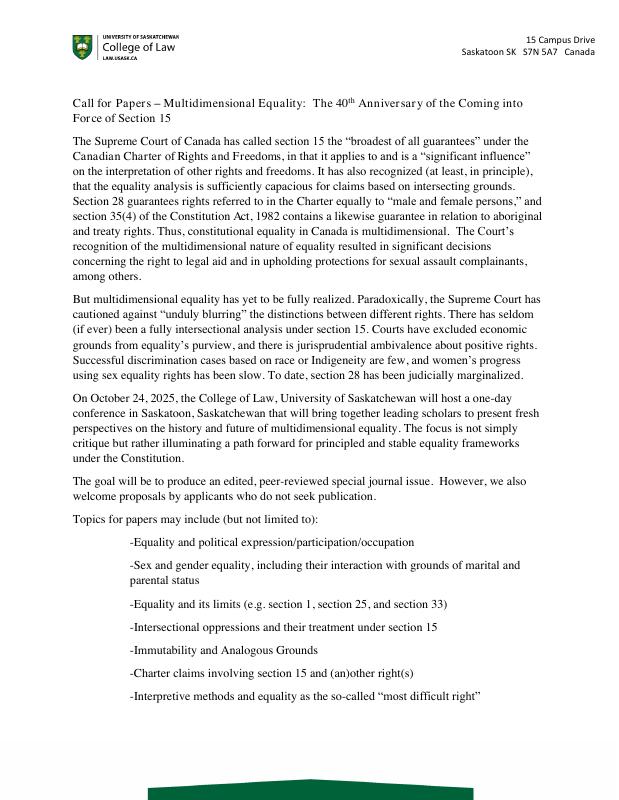
15 Campus Drive Saskatoon SK S7N 5A7 Canada Call for Papers – Multidimensional Equality: The 40th Anniversary of the Coming into Force of Section 15 The Supreme Court of Canada has called section 15 the “broadest of all guarantees” under the Canadian Charter of Rights and Freedoms, in that it applies to and is a “significant influence” on the interpretation of other rights and freedoms. It has also recognized (at least, in principle), that the equality analysis is sufficiently capacious for claims based on intersecting grounds. Section 28 guarantees rights referred to in the Charter equally to “male and female persons,” and section 35(4) of the Constitution Act, 1982 contains a likewise guarantee in relation to aboriginal and treaty rights. Thus, constitutional equality in Canada is multidimensional. The Court’s recognition of the multidimensional nature of equality resulted in significant decisions concerning the right to legal aid and in upholding protections for sexual assault complainants, among others. But multidimensional equality has yet to be fully realized. Paradoxically, the Supreme Court has cautioned against “unduly blurring” the distinctions between different rights. There has seldom (if ever) been a fully intersectional analysis under section 15. Courts have excluded economic grounds from equality’s purview, and there is jurisprudential ambivalence about positive rights. Successful discrimination cases based on race or Indigeneity are few, and women’s progress using sex equality rights has been slow. To date, section 28 has been judicially marginalized. On October 24, 2025, the College of Law, University of Saskatchewan will host a one-day conference in Saskatoon, Saskatchewan that will bring together leading scholars to present fresh perspectives on the history and future of multidimensional equality. The focus is not simply critique but rather illuminating a path forward for principled and stable equality frameworks under the Constitution. The goal will be to produce an edited, peer-reviewed special journal issue. However, we also welcome proposals by applicants who do not seek publication. Topics for papers may include (but not limited to): -Equality and political expression/participation/occupation -Sex and gender equality, including their interaction with grounds of marital and parental status -Equality and its limits (e.g. section 1, section 25, and section 33) -Intersectional oppressions and their treatment under section 15 -Immutability and Analogous Grounds -Charter claims involving section 15 and (an)other right(s) -Interpretive methods and equality as the so-called “most difficult right”
Page 2
15 Campus Drive Saskatoon SK S7N 5A7 Canada -Indigenous peoples and equality under sections 15, 25 and 28 of the Charter and 35(4) of the Constitution Act, 1982 -Linguistic equality -Inclusion and positive rights under section 15 -Autonomy under section 15: is the thwarting of “choice” discriminatory per se? -New strategies for throwing a section 15 lifeline to the poor and other “constitutional castaways.” Please send your abstract (300 word maximum) and one-paragraph biography to kerri.froc@usask.ca by June 30, 2025. Please also indicate whether you would be interested in publication and whether you would require funding to participate. You may expect a response as to whether your presentation has been accepted by August 1, 2025.