Reading note · CLSA / ACDS
Bulletin — Autumn 2019 brings together the Association’s activities and scholarly notices in one dated issue. Read the page headings to distinguish reports on completed work from announcements of planned events. Names and offices reflect the issue, not necessarily the current board.
How to use this issue
Choose one theme or author. Search their name below, record the page, then note whether the item is a report, a call, a prize announcement or a publication reference. Follow the named publication or organising institution for subsequent developments.
Reading note template
Issue: Bulletin — Autumn 2019. Page: __. Item or author: __. Type of item: __. What the source states: __. What needs checking elsewhere: __. This separates the document’s evidence from your interpretation.
24 pages of text
Source-language text, including both languages where the original is bilingual. Page numbering follows the obtained document.
Page 1
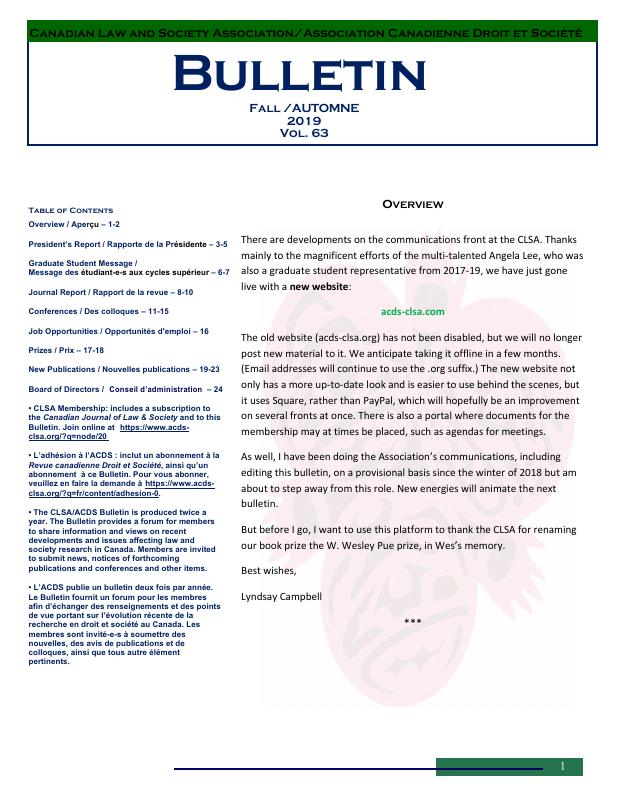
Canadian Law and Society Association/Association Canadienne Droit et Société Bulletin Fall /AUTOMNE 2019 Vol. 63 Table of Contents OVERVIEW Overview / Aperçu – 1-2 President’s Report / Rapporte de la Présidente – 3-5 There are developments on the communications front at the CLSA. Thanks mainly to the magnificent efforts of the multi-talented Angela Lee, who was Graduate Student Message / Message des étudiant-e-s aux cycles supérieur – 6-7 also a graduate student representative from 2017-19, we have just gone Journal Report / Rapport de la revue – 8-10 live with a new website: Conferences / Des colloques – 11-15 acds-clsa.com Job Opportunities / Opportunités d'emploi – 16 The old website (acds-clsa.org) has not been disabled, but we will no longer Prizes / Prix – 17-18 post new material to it. We anticipate taking it offline in a few months. New Publications / Nouvelles publications – 19-23 (Email addresses will continue to use the .org suffix.) The new website not Board of Directors / Conseil d’administration – 24 only has a more up-to-date look and is easier to use behind the scenes, but it uses Square, rather than PayPal, which will hopefully be an improvement • CLSA Membership: includes a subscription to the Canadian Journal of Law & Society and to this on several fronts at once. There is also a portal where documents for the Bulletin. Join online at https://www.acds- clsa.org/?q=node/20 membership may at times be placed, such as agendas for meetings. • L’adhésion à l’ACDS : inclut un abonnement à la As well, I have been doing the Association’s communications, including Revue canadienne Droit et Société, ainsi qu’un abonnement à ce Bulletin. Pour vous abonner, editing this bulletin, on a provisional basis since the winter of 2018 but am veuillez en faire la demande à https://www.acds- clsa.org/?q=fr/content/adhesion-0. about to step away from this role. New energies will animate the next bulletin. • The CLSA/ACDS Bulletin is produced twice a year. The Bulletin provides a forum for members to share information and views on recent But before I go, I want to use this platform to thank the CLSA for renaming developments and issues affecting law and society research in Canada. Members are invited our book prize the W. Wesley Pue prize, in Wes’s memory. to submit news, notices of forthcoming publications and conferences and other items. Best wishes, • L’ACDS publie un bulletin deux fois par année. Le Bulletin fournit un forum pour les membres Lyndsay Campbell afin d’échanger des renseignements et des points de vue portant sur l’évolution récente de la recherche en droit et société au Canada. Les *** membres sont invité-e-s à soumettre des nouvelles, des avis de publications et de colloques, ainsi que tous autre élément pertinents. 1
Page 2
APERÇU Il y a des développements sur le front des communications à l'ACDS. Grâce aux efforts remarquables de la talentueuse Angela Lee, également représentante des étudiant-e-s aux cycles supérieurs de 2017 à 2019, nous venons de mettre en ligne un nouveau site Web: acds-clsa.com L'ancien site Web (acds-clsa.org) n'a pas été désactivé, mais nous n’y publierons plus de nouveau matériel. Nous prévoyons de le déconnecter dans quelques mois. (Les adresses courriel continueront d'utiliser le suffixe .org.) Le nouveau site Web a non seulement une apparence plus moderne et est plus facile à utiliser en coulisse, mais il utilise Square, plutôt que PayPal, ce qui, espérons-le, constituera une amélioration sur plusieurs fronts à la fois. Il existe également un portail sur lequel des documents pour les membres peuvent parfois être placés, tels que des ordres du jour pour des réunions. De plus, je suis responsable des communications de l’Association, notamment la rédaction de ce bulletin, à titre provisoire depuis l’hiver 2018, mais je suis sur le point de me retirer de ce rôle. Les nouvelles énergies animeront le prochain bulletin. Mais avant de quitter ce rôle, je souhaite utiliser cette plate-forme pour remercier l’ACDS d’avoir renommé notre prix du livre "le prix W. Wesley Pue," à la mémoire de Wes. Meilleurs vœux, Lyndsay Campbell 2
Page 3
President’s Report Dear Members: I trust that everyone is settling into the fall semester! I am pleased to report that we had a very successful annual conference at the Allard School of Law on the preternaturally beautiful University of British Columbia campus on June 3-5. Highlights included an overlap day with the Canadian Association of Law Teachers as well as a joint banquet (no one will soon forget dancing to the tunes spun by CALT President and DJ David Wiseman!). And we were fortunate to hear from three distinguished plenary speakers: Dr. Elizabeth Mancke (CRC Atlantic Canada Studies, UNB): The Royal Proclamation of 1763 in the Long Eighteenth Century: Rethinking Imperial Sovereignty and Indigenous Relations Prof. James (Sákéj) Youngblood Henderson (Native Law Centre, U of S): Constitutional Reconciliation: Aboriginal and Treaty Rights and the Public Interest Prof. Jeremy Webber (UVic): Law of the Feast Hall, Law of the Courts: Bringing State and Non-State into Conversation in the Classroom All three speakers presented thought-provoking work on various aspects of Canadian history and legal education in response to the Truth and Reconciliation Calls to Action. For the first time, we recorded the livestreamed keynote addresses; please inquire (info@acds-clsa.org) if you would like access to any of them. As I write, I am anticipating an excellent CLSA Fall symposium at the University of Ottawa on October 18-19: “Law and Learning in an Era of Partnerships.” The symposium will be an excellent opportunity to bring together law and society scholars to engage in one another’s research on a more personal level. Board member Joao Velloso has organized a fantastic program featuring several prominent law and society scholars such as Constance Backhouse (Ottawa), Annie Bunting (York), Josephine Savarese (STU), Thomas McMorrow (UOIT) and many, many others. Other highlights include a graduate student work about pursuing careers outside of academia. The program can be found here: https://www.acds-clsa.com/upcoming-meeting.html. The conference theme will give us an opportunity to reflect on the continuing and profound influence of the 1983 Arthurs Report on Law and Learning. The contributors to the report, the Consultative Group on Research and Education in Law, included notable educators and administrators such Dean F. Murray Fraser (UVic), Professor John C. Courtney (Saskatchewan), Dean Dale Gibson (Manitoba), Professor Douglas Hay (Osgoode), Professor William Lederman (Queen’s) and Principal David Johnston (McGill), Dean Ed Veitch (UNB), and many others. Chaired by the inimitable Harry Arthurs, the group produced a collaborative and ground-breaking report that changed the nature of legal education throughout the country. For our symposium, Professor Arthurs has written a discussion paper for our consideration and debate entitled “Will Socio-Legal Scholars ever Make Partner?” I hope (and fully expect) that Professor Arthurs’s ideas will compel us all to deeply think about the evolution and current direction of Canadian legal education and socio-legal scholarship. I look forward to our conversation. I would like to extend my thanks to Joane Martel and Marie-Ève Sylvestre for their work as editors-in-chief of the Canadian Journal of Law and Society and to the Journal’s outgoing editorial assistants Robyn A. Pepin and Alexandre Audesse. The Journal is grateful to Dominique Bernier for her willingness to join Eric Reiter and Jula 3
Page 4
Hughes as an editor-in-chief, and to Justine Monette-Tremblay for taking over as editorial assistant. Finally, I would like to express our heart-felt gratitude to former CLSA President Lyndsay Campbell. After completing her term as President, she continued her service to the CLSA as Communications Officer and Bulletin Editor. She has been busy working on our new website with graduate student representative Angela Lee. Please check out our new website at https://www.acds-clsa.com/. Thank you for your dedication, Lyndsay! Your CLSA Board is eager to serve your interests and we continually strive to promote socio-legal, law and society and interdisciplinary scholarship. Please feel free to contact me anytime. All the best! Nicole O’Byrne, Ph.D. (Law and Society) Associate Professor, Faculty of Law, University of New Brunswick CLSA President nobyrne.ca@gmail.com ******* Rapport de la présidente Chers membres / Chères membres, J’espère que le début de la session d’automne se déroule bien pour chacun d’entre vous. La réunion générale annuelle, qui a eu lieu à l’École de droit Allard sur le campus de la très belle Université de Colombie-Britannique du 3 au 5 juin dernier, a été un franc succès. Parmi les faits saillants, on compte une journée de chevauchement avec la conférence de l’Association canadienne des professeurs de droit ainsi qu’un banquet conjoint (nous ne sommes pas prêts d’oublier la soirée dansante sur la musique choisie par le président de l’ACPD et dj à ses heures, David Wiseman!). Nous avons eu la chance d’entendre trois distingués invités : Dr Elizabeth Mancke (CRC en études sur le Canada atlantique, UNB) : la Proclamation royale de 1763 durant le long dix-huitième siècle : repenser les relations entre la souveraineté impériale et les Autochtones Professeur James (Sákéj) Youngblood Henderson (Centre de droit autochtone, U de S) : La réconciliation constitutionnelle : les Autochtones, les droits issus de traités et l’intérêt public Professeur Jeremy Webber (UVic) : Le droit des salles de célébration et le droit des cours : l’État et le non-État dans la conversation en classe En réponse à l’appel à l’action de la Commission de vérité et réconciliation, les trois invités ont présenté des travaux novateurs sur divers aspects de l’histoire du Canada et de l’enseignement du droit. Pour la première fois, nous avons enregistré les discours principaux diffusés en direct; veuillez vous informer (info@acds- clsa.org) si vous souhaitez avoir accès à l'un d'entre eux. 4
Page 5
Au moment d’écrire, j’attends un excellent colloque d’automne de l’ACDS qui se déroulera à l’Université d’Ottawa les 18 et 19 octobre : « Le droit et le savoir à l’ère des partenariats. » Le Symposium est une excellente occasion de réunir les chercheurs en droit et société et de favoriser les échanges. Joao Velloso, membre du comité d’administration, a préparé un superbe programme comportant plusieurs éminents chercheurs en droit et société tels Constance Backhouse (Université d’Ottawa), Annie Bunting (Université de York), Josephine Savarese (Université St-Thomas), Thomas McMorrow (Institut universitaire de technologie de l’Ontario) et plusieurs autres. Par ailleurs, on compte également des travaux de recherche d’étudiants diplômés sur les carrières en dehors du monde universitaire. Le programme se trouve ici : www.acds- clsa.com/upcoming-meeting. Le thème de la conférence sera l’occasion de réfléchir à l’influence profonde du rapport Arthurs sur le droit et le savoir (1983). Le groupe consultatif sur la recherche et l’éducation juridique, qui a préparé ce rapport, comportait d’éminents pédagogues et administrateurs tels le doyen F. Murray Fraser (Université de Victoria), le professeur John C. Courtney (Université de la Saskatchewan), Dean Dale Gibson (Université du Manitoba), le professeur Douglas Hay (Université Osgoode), le professeur William Lederman (Université Queen’s), le principal David Johnston (Université McGill), le doyen Ed Veitch (Université du Nouveau-Brunswick) et bien d’autres. Présidé par l’inimitable Harry Arthurs, le groupe a produit un rapport fondateur qui a changé la nature de l’enseignement juridique au pays. À l’occasion du colloque, le professeur Arthurs a rédigé un texte incitant à la discussion et au débat intitulé « Les universitaires du domaine sociojuridique deviendront associés un jour? » Je suis certaine que les idées du professeur Arthurs favoriseront une réflexion profonde sur l’évolution et l’orientation actuelle de l’enseignement du droit et les études sociojuridiques. Au plaisir d’échanger avec vous! Mes remerciements vont également à Joane Martel et Marie-Ève Sylvestre pour leur travail en tant que rédactrices en chef de la Revue canadienne droit et société, ainsi qu’aux assistantes à la rédaction sortantes de la Revue, Robyn A. Pepin et Alexandre Audesse. La Revue remercie Dominique Bernier de sa volonté de se joindre à Eric Reiter et Jula Hughes en tant que rédactrice en chef, et à Justine Monette-Tremblay d’avoir assumé les fonctions d’adjointe à la rédaction. Enfin, j’aimerais exprimer toute ma gratitude à l’ancienne présidente de l’ACDS, Lyndsay Campbell. Après son mandat de présidente, elle est demeurée au service de l’ACDS en tant qu’agente des communications et éditrice du bulletin d’information. Elle a d’ailleurs été très occupée à l’élaboration du nouveau site Web avec la précieuse aide de la représentante des étudiant-e-s aux cycles supérieurs, Angela Lee. Consultez le nouveau site ici : www.acds-clsa.com. Merci à Lyndsay pour son dévouement! Fier de servir vos intérêts, le conseil d’administration de l’ACDS fait la promotion des études sociojuridiques, des études en droit et société et des études interdisciplinaires. N’hésitez pas à communiquer avec moi en tout temps. Au plaisir! Nicole O’Byrne, Ph. D. (droit et société) Professeure agrégée, Faculté de droit, Université du Nouveau-Brunswick Présidente de l’ACDS nobyrne.ca@gmail.com 5
Page 6
Graduate Student Message / Message aux étudiant-e-s aux cycles supérieurs Dear ACDS/CLSA Graduate Students, We hope your fall semester is off to a great start and that you are looking forward to exciting projects! “Law & Learning in an Era of Partnerships” Conference – October 17-19th We hope to meet many of you at the “Law & Learning in an Era of Partnerships” Conference, to be held at the University of Ottawa, from October 17th to the 19th! The conference is free to attend. Please register here: https://www.eventbrite.ca/e/law-learning-in-an-era-of-partnerships-registration-68458576445. We are excited to be holding a special graduate student event on Thursday, October 17th, from 5 to 7pm, about alternative careers to academia. Our panelists come from different backgrounds and work in varied environments, so this promises to be an informative event about professional development outside of professorship. The panel will be followed by our social event, at Browns Socialhouse, an accessible venue with gender-neutral bathrooms. Roderick A. Macdonald Graduate Student Essay Prize The ACDS/CLSA will hold the essay competition for the Roderick A. Macdonald Graduate Student Essay Prize once again in 2020. The entries will be due this spring, at a date to be announced this winter. This prize is awarded annually for the best essay on a topic in law and society written by a graduate student at a Canadian University. Previous winners are listed on the CLSA/ACDS website. The winning submission receives feedback from the Prize Committee, and promotion through ACDS/CLSA channels. Therefore, keep this in mind if you write a paper this academic year that will not be published, or under consideration for publication, at the time of submission for the prize! Comments, questions, suggestions? Please feel welcome in emailing us comments, questions, or suggestions about how we can further represent your interests within the ACDS/CLSA as your Graduate Student Representatives, at acdsgradsclsa@gmail.com. You can follow us on our Twitter page @acds_clsa. We look forward to seeing you in Ottawa! Elise Wohlbold and Sabrina Tremblay-Huet ACDS/CLSA Graduate Student Representatives ******* 6
Page 7
Chers étudiants, chères étudiantes aux cycles supérieurs de l'ACDS, Nous espérons que votre session d’automne se déroule bien, et que vous avez plusieurs projets excitants de prévus! Colloque « Le droit et le savoir à l’ère des partenariats » - 17 au 19 octobre Nous espérons voir plusieurs d’entre vous au colloque « Le droit et le savoir à l’ère des partenariats », qui aura lieu à l’Université d’Ottawa, du 17 au 19 octobre! L’admission au colloque est gratuite. Veuillez vous y inscrire ici : https://www.eventbrite.ca/e/law-learning-in-an-era-of-partnerships-registration-68458576445. Nous sommes très heureuses d’y tenir un évènement spécial destiné aux étudiant-e-s aux cycles supérieurs le jeudi 17 octobre, de 17h à 19h, sur les carrières alternatives au monde universitaire. Nos panélistes sont issu-e-s de milieux différents et travaillent au sein d’environnements variés, promettant un évènement très informatif sur le développement professionnel hors du professorat. Ce panel sera suivi de notre évènement social, au Browns Socialhouse, un bar accessible avec des salles de bain mixtes. Prix Roderick A. Macdonald pour un essai étudiant L’ACDS offrira cette année encore le Prix Roderick A. Macdonald récompensant un-e étudiant-e aux cycles supérieurs pour un essai. Les soumissions seront à remettre ce printemps, à une date qui sera annoncée cet hiver. Le prix est accordé sur une base annuelle pour un essai en droit et société rédigé par un-e étudiant-e aux cycles supérieurs d’une université canadienne. Les personnes ayant remporté ce prix au cours des années précédentes sont énumérées sur le site de l’ACDS. La soumission gagnante recevra de la rétroaction détaillée du comité du prix, ainsi qu’une promotion de celle-ci à travers le réseau de l’ACDS. Ainsi, gardez cela en tête si vous rédigez un essai en cette année universitaire, qui ne sera pas encore publié ou soumis pour publication à la date de soumission des essais! Commentaires, questions, suggestions? Vous êtes toujours les bienvenu-e-s à nous écrire pour tout commentaire, question ou suggestion portant sur la façon dont nous pouvons le mieux représenter vos intérêts au sein de l’ACDS en tant que vos représentantes des étudiant-e-s aux cycles supérieurs, à l’adresse courriel : acdsgradsclsa@gmail.com. Vous pouvez également suivre notre compte Twitter : @acds_clsa. Au plaisir de vous voir à Ottawa! Elise Wohlbold et Sabrina Tremblay-Huet Représentantes des étudiant-e-s aux cycles supérieurs de l’ACDS 7
Page 8
Canadian Journal of Law and Society Editors’ Report / Compte rendu des rédacteur-ice-s en chef The CJLS/RCDS welcomes Dominique Bernier (Université du Québec à Montréal) as our new Editor-in Chief (French manuscripts) alongside Eric Reiter and Jula Hughes who continued their mandate with us. Our team has another addition: Justine Monette-Tremblay who will be our Editorial Assistant starting from November. The CJLS/RCDS wishes to thank Joane Martel (Université Laval) for all of her hard work and dedication as a CJLS/RCDS Editor-in-Chief for the past 5 years. The CJLS/RCDS also wishes to thank Marie-Ève Sylvestre (University of Ottawa) and wishes her the best in her new role as Dean. A special thank you to Robyn A. Pepin (Carleton University) for her hard work as our Editorial assistant for the last 6 years and to Alexandre Audesse who was Editorial assistant for the French manuscripts for the past year. ***** La CJLS/RCDS accueille Dominique Bernier (Université du Québec à Montréal) à titre de nouvelle Rédactrice en chef (manuscrits français) pour travailler en collaboration d’Eric Reiter et de Jula Hughes qui poursuivent leurs mandats. Notre équipe a aussi un autre ajout : Justine Monette-Tremblay qui sera notre assistante à l’édition dès novembre prochain. La CJLS/RCDS souhaite remercier Joane Martel (Université Laval) pour son grand travail et son dévouement comme Rédactrice en chef des manuscrits français lors des 5 dernières années. La CJLS/RCDS souhaite aussi remercier Marie-Ève Sylvestre (Université d’Ottawa) et lui souhaite le meilleur des succès comme nouvelle Doyenne de la Faculté de droit. Un remerciement très spécial à Robyn A. Pepin (Carleton University) pour son travail d’importance comme Assistante à l’édition durant les 6 dernières années et à Alexandre Audesse comme assistant à l’édition pour les manuscrits français lors de la dernière année. ***** Check out this year’s special (34:2): Explorations in Sensori-Legal Studies Découvrez le numéro spécial de cette année (34:2) : Introduction aux études sensori-juridique Guest editor / Rédacteur invité : David Howes Prologue: Introduction to Sensori-Legal Studies David Howes 8
Page 9
Sensorium®: The Splash of Sensory Trademarks Charlene Elliot Le tournant sensorial en droit: vers un droit sensible et sensé? Mark Antaki High Altitude Legality: Visuality and Jurisdiction in the Adjudication of NATO Air Strikes Christiane Wilke Encountering the ‘Muslim’: Guantanamo Bay Detainees, and Apprehensions of Violence Safiyah Rochelle Exploiter des techniques cinélégales pour mieux ressentir les effets qu'a la règlementation sur les personnes en situation d’itinérance Suzanne Bouclin The law of bad smells: making and adjudicating claims of offensiveness in contemporary law Mariana Valverde Silence and attunement in legal performance Sean Mulcahy The nuclear sensorium: Cold War nuclear imperialism and sensory violence John Shiga Howling Winds: Sound, sense, and the politics of noise regulation Michael Mopas 9
Page 10
Play-by-Play Justice: Tweeting Criminal Trials in the Digital Age Kate Puddister Hands in Cont(r)act: The Resiliency of Business Handshakes in Pandemic Culture Sheryl Hamilton Eric H. Reiter, Editor-in-Chief (English Manuscripts) / Rédacteur en chef (Manuscrits en anglais) Jula Hughes, Editor-in-Chief (English Manuscripts) / Rédacteur en chef (Manuscrits en anglais) Dominique Bernier, Editor-in-Chief (French Manuscripts) / Rédacteur en chef (Manuscrits en français) Dayna Scott, Book Review Editor (English) / Responsable des recensions critiques en anglais Sophie Thériault, Book Review Editor (French) / Responsable des recensions critiques en français Melanie Adrian, Managing Editor / Rédactrice-gérant 10
Page 11
Announcements / Des Annonces Conferences and Calls for papers / Des Réunions et des Appels à propositions “Critical Perspectives on Cannabis in Canada”, Journal of Canadian Studies. The Journal of Canadian Studies has issued a call for submissions to a special issue entitled “Critical Perspectives on Cannabis in Canada,” to be edited by Michael Boudreau and Sarah Hamill. Details are here: https://www.utpjournals.press/pb-assets/utoronto/JCS/documents/JCS_CFP_cannabis.pdf. By December 1, authors should submit a 500-word abstract and a 50-word biography, in French or English, to both co-editors. ******* Canadian Law and Society Association annual meeting / Colloque annuel de l’Association canadienne droit et société [La version française apparaît ci-dessous.] The annual meeting of the Canadian Law and Society Association will take place June 3-5, 2020 at Western University, on the traditional lands of the Anishinaabek, Haudenosaunee, Lūnaapéewak, and Attawandaron nations. This location has a complex history of Indigenous-non-Indigenous relations and is not far from where some of the earliest Black refugees arrived after fleeing slavery in the United States. The Canadian Law and Society Association Program Committee joins with Congress in adopting as its theme this year: “Bridging Divides: Confronting Colonialism and Anti-Black Racism.” Congress describes the theme as follows: The river’s Forks downstream from the Western University campus are a traditional meeting place where two tributaries converge, a place to come together to listen to the land and water, to build resilience as we confront what divides us. Congress 2020 will encourage multidisciplinary engagement under the broad concept of bridging divides, while specifically emphasizing the dispossession of Indigenous peoples and the enslavement of Africans in the [so-called] new world. Settler colonialism, as part of a broader imperial project, erases Indigenous peoples by appropriating land and delegitimizing traditional knowledge, and dehumanizes Black people, subjecting them to the tropes of everyday anti-Black racism. As we come together to confront white privilege and white supremacy, and examine experiences shared by Indigenous peoples and African Canadians, we also invite our community to reflect critically on social, ethnic, political and epistemological divisions more broadly, forming a future vision that bridges divides between divergent ways of knowing and navigating our world. The Program Committee invites law and society scholars to present research that examines the ways in which racism and settler colonialism can be both operationalized and challenged through law. We encourage contributions that explore intersectional socio-legal analyses including Indigenous laws. We also welcome submissions on other issues including law and religion, crime and punishment, legal history, or other areas of interest. The Canadian Association of Law Teachers annual conference will be held June 1-3. The programs for both conferences will overlap on June 3rd and will be coordinated to encourage full participation and exchange by 11
Page 12
attendees at both conferences. The Program Committee encourages proposals for organized panels. Panels should be comprised of three or four related papers including a suggested chair. A panel proposal of no more than 250 words should be submitted, in addition to an abstract of no more than 250 words for each paper. A one-page curriculum vitae should also be submitted for each presenter. These documents should be submitted in a single PDF document. Proposals for individual papers are also welcome. Please submit an abstract of no more than 250 words and a one-page curriculum vitae. These documents should be submitted in a single PDF document. Please send all submissions to clsalondon2020@acds-clsa.org no later than November 25, 2019. No late submissions will be considered. Only one paper proposal per individual will be accepted. The organizers reserve the right to request additional information and modify panels if necessary. Please note than all presenters must be members of the CLSA at the time of the conference. All presenters must register for Congress and the CLSA conference. Generally, presenters must attend the conference and present in person. However, we will also plan for a very limited number of remote presentations via Skype or another video conference service. Those proposing a remote presentation will be asked for provide a justification for presenting remotely. ******* Le colloque 2020 de l’Association canadienne droit et société se déroulera du 3 au 5 juin 2020 à l’Université Western sur les terres ancestrales des peuples Anishinaabek, Haudenosaunee, Lūnaapéewak, et Attawandaron. Ce lieu où s’est déroulée une histoire des plus complexes entre des acteurs autochtones et non-Autochtones se situe tout près de l’endroit où sont venus les premiers réfugiés noirs fuyant l’esclavagisme américain. L’Association canadienne droit et société se joint au Congrès des sciences humaines et adopte le thème de cette année : « Bâtir des passerelles : combattre le colonialisme et le racisme anti-Noirs. » Le Congrès décrit ce thème comme suit : Les fourches de la rivière, en aval du campus de l’Université Western, sont un lieu de rencontre traditionnel où convergent deux affluents, un endroit où aller écouter la terre et l’eau, et renforcer la résilience malgré nos divergences. Le Congrès 2020 encouragera la mobilisation multidisciplinaire permettant de bâtir des passerelles, en mettant l’accent sur l’expropriation des peuples autochtones et l’esclavage des Africains dans le Nouveau Monde. Le colonialisme de peuplement, dans le cadre d’un projet impérialiste à grande échelle, efface les Autochtones en s’appropriant leurs terres et en rejetant la légitimité du savoir traditionnel. Il déshumanise les Noirs en les soumettant à toutes les facettes du racisme anti-Noirs. Ce rassemblement sera l’occasion de reconnaître les privilèges accordés aux Blancs et la suprématie blanche, et de se pencher sur les expériences des Autochtones et des Afro- Canadiens. Nous invitons aussi la collectivité à jeter un regard critique sur les divisions sociales, ethniques, politiques et épistémologiques dans leur ensemble, de manière à imaginer un avenir où des passerelles relient différents savoirs et différentes visions du monde. Le comité invite les chercheur-se-s en droit et société à présenter leurs travaux de recherche étayant comment le racisme et le colonialisme des premiers colons ont pu à la fois être mis en œuvre par le droit et remis en question par le droit également. Les contributions comportant des analyses interdisciplinaires, y compris le droit autochtone, sont les bienvenues. Les contributions peuvent également porter sur le thème de la 12
Page 13
conférence ainsi que sur d’autres questions sociojuridiques, notamment le droit et la religion, les crimes et les peines, l’histoire du droit ou tout autre enjeu d’intérêt. Le colloque annuel de l’Association canadienne des professeurs de droit se déroulera du 1er au 3 juin. Les programmes des deux événements se chevaucheront le 3 juin et seront coordonnés en vue de favoriser la participation aux deux événements et de multiplier les occasions d’échanges. Le Comité de programme encourage la soumission de propositions de panels complets. Les panels doivent être constitués de trois ou quatre travaux propositions connexes et un-e président-e de panel devrait également être proposé. Une résumé de panel ne dépassant pas 250 mots, en plus d’un résumé ne dépassant pas 250 mots pour chaque participant-e au panel, doivent être soumis. Un curriculum vitae d’une page doit également être joint pour chaque présentateur-ice. Ces documents doivent être soumis dans un seul document PDF. Les propositions de communications individuelles sont également les bienvenues. Veuillez soumettre un résumé de 250 mots maximum ainsi qu'un curriculum vitae d'une page. Ces documents doivent être soumis dans un seul document PDF. Veuillez envoyer toutes les soumissions à l’adresse courriel clsalondon2020@acds-clsa.org au plus tard le 25 novembre 2019. Aucune soumission tardive ne sera considérée. Le Comité de programme n’acceptera qu’une proposition de communication par personne. Les organisateur-ice-s se réservent le droit de demander des informations supplémentaires et de modifier les panels proposés si nécessaire. Veuillez noter que tous les présentateur-ice-s doivent être membres de l’ACDS au moment du colloque. Tous les présentateur-ice-s doivent s’inscrire à la fois au Congrès et au colloque de l’ACDS. Règle générale, les présentateur-ice-s doivent assister au colloque et faire leur présentation en personne. Toutefois, un nombre très limité de présentations seront effectuées via Skype ou autre service de vidéoconférence. Les présentateur-ice-s désireux de faire une présentation à distance devront fournir une justification. ******* 13
Page 14
Beyond Boundaries: 15th Annual Communication Graduate Caucus Conference February 27-28, 2020 | Carleton University, Ottawa, ON What are we bound by? Whether physical, social, cultural, geographical, or political confinements, we routinely encounter boundaries which communication and media cut and cross. While it is a truism that culture and communication inevitably overlap, critical approaches to media studies should interrogate the erosion of clear boundaries between historically demarcated categories, such as: local/global, nature/culture, private/public, and human/non- human. The study of communication and media requires that we confront boundaries – those related to academic disciplines, methodological approaches, and objects of analysis – and question their significance in how we understand our discipline. Are there breaking points, transgressions, leakages, or liminality along the edges of communities or objects? How do we move beyond them? Beyond Boundaries, the 15th annual Communication Graduate Caucus (CGC) Conference, invites explorations of the ways that communication and media cross social, political, technical, and cultural boundaries. Communication studies often grafts on, collaborates, and cross- pollinates, and we thus encourage research that steps outside or extends research domains and practices. We are particularly interested in insights which examine boundaries as sites of struggle and encourage submissions that focus on practices, communities, objects, bodies of knowledge, or activities that are often ignored, violated, invisible, or deleted due to the presence of boundaries. The CGC welcomes proposals for 15-minute individual presentations, research-creation (research that includes creative production, artistic experimentation, and innovation in understanding and mobilizing knowledge). We also welcome proposals for pre-constituted panels composed of 3-4 speakers for a total of 60 minutes of presentation time. Topics and themes may include but are not limited to: • Research that crosses disciplinary boundaries (e.g. gender studies and media, science communication, health communication, law and communication) • Work that expands traditional theoretical or methodological boundaries (e.g., art-based research, sound studies, participant action research, media archeology) • The role of media in redefining epistemological boundaries (e.g. fantasy versus reality, information versus knowledge, data versus experience, facts versus fiction) • Research that interrogates themes of power and control (e.g. who gets to set boundaries? For whom? Under what circumstances?) • Critical examinations of socio-technical phenomena that obscure and shift social and cultural boundaries (e.g. surveillance, privacy, Big Data, the Internet of Things, artificial intelligence, algorithms) • Discourses of boundary formation, legitimation, and maintenance of boundaries (terms of service, user agreements, laws, policies, guidelines) • Social movements, activism, and resistance at the margins • Identity construction and performativity • Environmental effects of moving beyond ecological limitations 14
Page 15
Beyond Boundaries is pleased to announce our keynote speaker, Dr. Bobby Benedicto, Assistant Professor in the Department of Art History and Communication Studies at McGill University. Dr. Benedicto’s research re- examines long-held associations at the intersections of queer theory, critical race theory, urban studies, and theories of death and temporality. His current book project “Fatal Sex” highlights cross-disciplinary work that breaks down boundaries by connecting an archive of aesthetic and cultural practices to stage an encounter between psychoanalytic and necropolitical accounts. All submissions should include a 250-word abstract with the full name, current academic affiliation, biography of 50-100 words, and contact information of the individual presenters. Panel proposals should contain abstracts for the panel and for each individual paper (250 words each). It should also include a brief description of the topic’s relevance to the conference theme. Research-creation proposals should outline technical requirements needed for their presentation. Please fill out the submission form at https://forms.gle/7uqYUt895ELPYFfQA by December 15, 2019. The CGC Conference provides graduate students and emerging scholars from across the social sciences and humanities an opportunity to present their work, receive feedback, participate in professional development, and network with leading experts in their fields. Upon acceptance, students are encouraged to submit their full paper for the Canadian Journal of Communication Student Paper Prize by January 15, 2020. We look forward to reading your submissions! Anna Hum, Sarah MacLean & Stephan Struve 2019-2020 CGC Conference Co-Chairs, Carleton University cgcbeyondboundaries@gmail.com 15
Page 16
Job Opportunities / Opportunités d'emploi The Institute of Criminology and Criminal Justice at Carleton University invites applications from qualified candidates for two tenure-track appointments in Critical Criminology at the rank of Assistant Professor, beginning July 1, 2020. Both positions are open with respect to specialization; however one position requires the ability to teach quantitative research methods. Consideration of complete applications will begin on October 31, 2019 and continue until the position is filled. About the ICCJ The Institute of Criminology and Criminal Justice has a unique structure and its undergraduate program is delivered with the collaboration of the Department of Psychology, the Department of Sociology & Anthropology, and the Department of Law & Legal Studies. The Institute is a dynamic national hub for interdisciplinary critical criminological research, teaching, and engagements. For more information about the ICCJ, please visit: https://carleton.ca/criminology/. For the full postings see: https://carleton.ca/provost/2019/assistant-professor-criminology-and-criminal-justice-open/ https://carleton.ca/provost/2019/assistant-professor-criminology-and-criminal-justice-open-2/ ******* The Department of Criminology in the Faculty of Arts at Ryerson University invites applications for a full-time tenure-track position at the rank of Assistant Professor in the area of Green Criminology. The appointment shall be effective July 1, 2020, subject to final budgetary approval. The application deadline is November 1, 2019. Candidates must hold an earned Ph.D. in Criminology or a closely related field by the appointment date. Candidates who are all-but-dissertation (ABD) and are very close to completion in the field of Green Criminology may also be considered. The full job ad is available here: https://www.csn-rec.ca/job- postings/31258-green-criminology-assistant-professor-ryerson-university. ******* CRC Tier 2 SSHRC Chair in Autonomous Technologies and Social Change, Tenure-Track Assistant Professor, Department of Sociology and Legal Studies, Faculty of Arts, University of Waterloo The Department of Sociology and Legal Studies in the Faculty of Arts at the University of Waterloo is seeking an exceptional scholar and researcher for a Tier 2 SSHRC Canada Research Chair (CRC) and tenure track appointment at the rank of Assistant Professor in the area of the Autonomous Technologies and Social Change beginning July 1, 2020. The closing date for applications is December 1, 2019. The full job ad is available here: https://www.academicwork.ca/jobs/assistant-professor-crc-t2-chair-in-autonomous-technologies-and-social- change-university-of-waterloo. For more information please contact Dr. Daniel O’Connor at daniel.oconnor@uwaterloo.ca or by phone, at (519) 888-4567 ext. 31366. 16
Page 17
Prizes / Prix It is not too early to consider nominations for the 2020 W. Wesley Pue Book Prize or the Roderick A. Macdonald Graduate Student Essay Prize. See our website for details: acds-clsa.com/prizes.html. The June winners were W. Wesley Pue Book prize: Elaine Craig, Putting Trials on Trial: Sexual Assault and the Failure of the Legal Profession (Montreal & Kingston: McGill-Queen’s University Press, 2018). • Honourable mention: Philip Girard, Jim Phillips and R. Blake Brown, A History of Law in Canada. Vol. 1: Beginnings to 1866 (Toronto: University of Toronto Press for the Osgoode Society, 2018). Article Prize (English): Anna C. Pratt and Jessica Templeman, “Jurisdiction, Sovereignties and Akwesasne: Shiprider and the Re-Crafting of Canada-US Cross-Border Maritime Law Enforcement” (2018) 33 CJLS/RCDS 335-57. • Honourable mention: Andrea Sterling and Emily van der Meulen, “‘We Are Not Criminals’: Sex Work Clients and the Constitution of Risk Knowledge" (2018) 33 CJLS/ACDS 291-308. Article Prize (French): Brieg Capitaine, « Sortir de la violence : La Commission de vérité et de réconciliation du Canada sur les pensionnats indiens » (2018) 33 CJLS/RCDS 41-59. • Honourable mention: Marie-Neige Laperrière, « Perspective féministe sur l’article 1974.1 du Code Civile du Québec : Une protection efficace dans la vie des femmes locataires victimes de violences? » (2018) 33 CJLS/RCDS 41-59. Roderick A. Macdonald CLSA Student Essay Prize: Daniel del Gobbo, “Negotiating Campus Sexual Violence.” ******* Il n'est pas trop tôt pour examiner les candidatures pour le Prix W. Wesley Pue (prix du meilleur ouvrage) ou le Prix Roderick A. Macdonald pour le meilleur essai étudiant en 2020. Consultez notre site Web pour plus de détails: acds-clsa.com/prizes.html. Les lauréat-e-s de 2019 (annoncés en juin) étaient Prix W. Wesley Pue : Elaine Craig, Putting Trials on Trial: Sexual Assault and the Failure of the Legal Profession (Montreal & Kingston: McGill-Queen’s University Press, 2018). • Mention honorable : Philip Girard, Jim Phillips and R. Blake Brown, A History of Law in Canada. Vol. 1: Beginnings to 1866 (Toronto: University of Toronto Press for the Osgoode Society, 2018). Prix du meilleur article (anglais) : Anna C. Pratt and Jessica Templeman, “Jurisdiction, Sovereignties and Akwesasne: Shiprider and the Re-Crafting of Canada-US Cross-Border Maritime Law Enforcement” (2018) 33 CJLS/RCDS 335-57. • Mention honorable : Andrea Sterling and Emily van der Meulen, “‘We Are Not Criminals’: Sex Work Clients and the Constitution of Risk Knowledge" (2018) 33 CJLS/ACDS 291-308. 17
Page 18
Prix du meilleur article (français) : Brieg Capitaine, « Sortir de la violence : La Commission de vérité et de réconciliation du Canada sur les pensionnats indiens » (2018) 33 CJLS/RCDS 41-59. • Mention honorable : Marie-Neige Laperrière, « Perspective féministe sur l’article 1974.1 du Code Civile du Québec : Une protection efficace dans la vie des femmes locataires victimes de violences? » (2018) 33 CJLS/RCDS 41-59. Prix Roderick A. Macdonald : Daniel del Gobbo, “Negotiating Campus Sexual Violence.” 18
Page 19
Recent & Forthcoming Publications / Publications récentes et à venir Books and Special Issues / Livres et numéros spéciaux Shauna Labman, Crossing Law’s Border: Canada’s Refugee Resettlement Program (Vancouver: UBC Press, 2019). The UN Refugee Agency considers resettlement – the selection and transfer of refugees from the state where they seek asylum to another state – to be a tool of refugee protection and an expression of international burden sharing. Resettlement is voluntary and ad hoc, and Canada is one of three leading resettlement countries in the world. In this account of Canada’s resettlement program from the Indochinese crisis of the 1970s to the Syrian crisis of the 2010s, Shauna Labman explores how rights, responsibilities, and obligations intersect in the absence of a legal scheme for refugee resettlement. She asks: How does law influence the voluntary act of resettlement, and how does resettlement affect asylum policy? She reveals that the core concept of refugee protection, non-refoulement, which prevents countries from turning away asylum-seekers, can be compromised by resettlement, both by the resettlement selection process and the influence of resettlement practices on in-country asylum. This pathbreaking look at the interplay between resettlement and asylum in one of the world’s most successful refugee protection programs shows that resettlement can either complement or complicate in-country asylum claims at a time when refugee crises and fear of outsiders are causing countries to close their borders to asylum-seekers around the world. This book will appeal not only to scholars in law, sociology, and refugee and migration studies but also to general readers and policy makers interested in refugees and resettlement programs. Heather McLeod Kilmurray, Angela Lee & Nathalie Chalifour, eds., Food Law and Policy in Canada (Toronto: Carswell, 2019). While “food law” has not yet crystallized into a systematic field of study in Canada, rapid unification of this field has recently occurred in the USA, the UK, and the EU, among other jurisdictions. What can we learn from them? What is unique about Canadian physical, cultural and social realities that require different approaches to the study of food law and policy in Canada? What is the most effective path to developing coherent and effective food laws that not only serve Canada, but also provide an inspirational model for other countries and enhance international collaboration on creating sustainable and just food systems. This book, the first of its kind in the Canadian context, includes chapters from leading experts in the various sub-fields of food law and policy in Canada. The book has two parts. The chapters in Part I, "Foundations of Food Law and Policy in Canada", provide a broad overview of content pertaining to the essential laws, regulations, and policies relevant to food law and policy in Canada, including issues like food safety, food labelling, and food and sustainability. Part II offers “Critical Perspectives on Food Law and Policy in Canada” on issues like emerging food technologies, animal rights, and food and 19
Page 20
gender, among others. As such, this book provides the basics for beginners, but also advanced critical and innovative thinking on emerging issues in this burgeoning field of law. Table of Contents 1. Introduction: Food Law and Policy in Canada – Angela Lee, Heather McLeod-Kilmurray & Nathalie Chalifour Part I: Foundations of Food Law and Policy in Canada 2. Canada’s National Food Policy: The Political Basis for Coordination and Integration – Peter Andrée, Mary Coulas & Patricia Ballamingie 3. Transforming Buffalo: Plains Cree Constitutionalism and Food Sovereignty – Darcy Lindberg 4. It’s Complicated: Food and Federalism in Canada – Don Buckingham 5. Cities in a Time of Uncertainty: Food and Canadian Municipal Law – Jamie Baxter & Jessica Rose 6. Sustainable Food Systems – Heather McLeod-Kilmurray & Nathalie Chalifour 7. Protecting Farmland in Canada: Provincial Legislative Frameworks – David J. Connell, Chris Bryant, Wayne Caldwell, Greg Cameron & Tom Johnston 8. Foodlands Protection in Canada: Indigenous and Colonial Foodscapes in Law – Deborah Curran 9. Food Safety – Kiri A. Latuskie & Jacob J. Shelley 10. Food Safety in Canada: Regulatory Approaches to Public Health – Sarah Berger Richardson 11. Finding Concordance between Nutrition Law Reform and Epidemiological Estimates of Public Health Impact – Bill Jeffery 12. A Recipe for Effective Front-Of-Pack Nutrition Labelling: Lessons From Canada, Codex, and the World Health Organization – Bill Jeffery 13. Food Advertising and Marketing to Children – Jacob J. Shelley & Melanie L. McPhail 14. The Consumers’ Rights to Information about Animal Welfare: The Canadian Framework for Labelling of Food Products of Animal Origin – Marie-Claude Desjardins & Sabrina Tremblay-Huet 15. Cultivating Healthier, More Sustainable Food Choices through Taxation – Nathalie Chalifour & Josiane Rioux Collin 16. Social Justice and the Food System – Nadia C.S. Lambek 20
Page 21
17. La justice alimentaire au Canada : la gouvernance locale comme vecteur d’une politique alimentaire nationale / Food Justice in Canada: Local Governance as a Vehicle for a National Food Policy – Jessica Dufresne Part II: Critical Perspectives on Food Law and Policy in Canada 18. Eat This! Gender Inequality, Culture and the Politics of Food – Bita Amani 19. The Fox Regulating the Henhouse: How the Law Fails Animals Farmed for Food – Anna Pippus 20. Regulation of Genetically Novel Crops and Food in Canada: It’s About PNTs, not GMOs – Stan Benda 21. The New Frontiers of Flesh Food: Regulating Genetically Engineered Animals and In Vitro Meat – Angela Lee 22. Accès et valorisation des semences autochtones au Canada : Opportunités et limites des cadres juridiques existants pour l’encadrement des collaborations entre autochtones et chercheurs / Access and Valorization of Aboriginal Seeds in Canada: Opportunities and Limits of Existing Legal Frameworks to Frame Collaborations between Aboriginal Peoples and Researchers – Thomas Burelli Sara Ross, Law and Intangible Cultural Heritage in the City. New York: Routledge, 2019. With disappearing music venues, and arts and culture communities at constant risk of displacement in our urban centers, the preservation of intangible cultural heritage is of growing concern to global cities. This book addresses the role and protection of intangible cultural heritage in the urban context. Using the methodology of Urban Legal Anthropology, the author provides an ethnographic account of the civic effort of Toronto to become a Music City from 2014-18 in the context of redevelopment and gentrification pressures. Through this, the book elucidates the problems cities like Toronto have in equitably protecting intangible cultural heritage and what can be done to address this. It also evaluates the engagement that Toronto and other cities have had with international legal frameworks intended to protect intangible cultural heritage, as well as potential counterhegemonic uses of hegemonic legal tools. Understanding urban intangible cultural heritage and the communities of people who produce it is of importance to a range of actors, from urban developers looking to formulate livable and sustainable neighbourhoods, to city leaders looking for ways in which their city can flourish, to scholars and individuals concerned with equitability and the right to the city. This book is the beginning of a conservation about what is important for us to protect in the city for future generations beyond built structures, and the role of intangible cultural heritage in the creation of full and happy lives. 21
Page 22
Robert Heynen and Emily van der Meulen, eds., Making Surveillance States: Transnational Histories. Toronto: University of Toronto, 2019. Making Surveillance States: Transnational Histories opens up new and exciting perspectives on how systems of state surveillance developed over the nineteenth and twentieth centuries. Taking a transnational approach, the book challenges us to rethink the presumed novelty of contemporary surveillance practices, while developing critical analyses of the ways in which state surveillance has profoundly shaped the emergence of contemporary societies. Contributors engage with a range of surveillance practices, including medical and disease surveillance, systems of documentation and identification, and policing and security. These approaches enable us to understand how surveillance has underpinned the emergence of modern states; sustained systems of state security; enabled practices of colonial rule; perpetuated racist and gendered forms of identification and classification; regulated and policed migration; shaped the eugenically inflected medicalization of disability and sexuality; and contained dissent. While surveillance is thus bound up with complex relations of power, it is also contested. Emerging from the book is a sense of how state actors understood and legitimized their own surveillance practices, as well as how these practices have been implemented in different times and places. At the same time, contributors explore the myriad ways in which these systems of surveillance have been resisted, challenged, and subverted. Lyndsay Campbell, Ted McCoy and Mélanie Méthot, eds., Canada’s Legal Past: Looking Forward, Looking Back (Calgary: University of Calgary Press, forthcoming 2020). Canada’s Legal Past: Looking Forward, Looking Back is a collection of essays on Canadian legal history written with an eye to exploring Canada’s fascinating legal past for a wide range of readers, especially those who are new to the field. The topics range from a story of a fishing vessel that became the subject of an extraordinarily long diplomatic dispute with the United States to the peculiar experiences of young Northwest Mounted Police constables who found themselves subjected to an odd mixture of police discipline and criminal procedure. The authors explicitly discuss their sources and methodologies, while several chapters are devoted exclusively to particular kinds of sources and how they can be used: provincial archival records that suggest how people used Quebec courts when their relatives challenged their family honour; newspaper records that disclose the details of bigamy cases; penitentiary records that reveal details of society’s most marginal people. Canada’s Legal Past: Looking Forward, Looking Back will serve a wide range of readers interested in Canadian legal history. Table of Contents Foreword: A Student’s Take on Canada’s Legal Past – Nick Austin Canada’s Legal Past: Looking Forward, Looking Back – Ted McCoy, Lyndsay Campbell, Mélanie Méthot Part A: Illuminating Cases Family Defamation in Quebec: The View from the Archives – Eric H. Reiter Writing Penitentiary History – Ted McCoy 22
Page 23
Analyzing Bigamy Cases without Archival Records: It Is Possible – Mélanie Méthot Trial Pamphlets and Newspaper Accounts – Lyndsay Campbell The Last Voyage of the Frederick Gerring, Jr. – Christopher Shorey The Textbook Edition of Kent’s Commentaries Used in the Gerring – Angela Fernandez Part B: Exploring Systems Empire’s Law: Archives and the Judicial Committee of the Privy Council – Catharine MacMillan Practising Law in the “Lawyerless” Colony of New France – Alexandra Havrylyshyn Poursuivre son mari en justice au Bas-Canada: femmes mariées et coutume de Paris devant la cour du Banc du roi (1795-1830) – Jean-Philippe Garneau Getting Their Man: The NWMP as Accused in the Territorial Criminal Court in the Canadian North- West, 1876-1905 – Shelley A.M. Gavigan Part C: Writing Legal History: Past, Present and Future Sex Discrimination in Law: From Equal Citizenship to Human Rights Law – Dominique Clément Legal-Historical Writing for the Canadian Prairies: Past, Present, Future – Louis A. Knafla Articles and Book Chapters / Articles et chapitres de livres Michael Boudreau, “A ‘Backwoods Tragedy’: The Bannister Brothers and Capital Punishment in New Brunswick, 1936,” Acadiensis blog, August 15, 2019, https://acadiensis.wordpress.com/2019/08/15/a-backwoods-tragedy- the-bannister-brothers-and-capital-punishment-in-new-brunswick-1936/. 23
Page 24
Canadian Law & Society Association Board of Directors Conseil d’administration de l’Association canadienne Droit et Société 2019 – 2020 Officers Communications Officer & Bulletin Editor: Joanne Prince Lyndsay Campbell PhD student President & Director: Faculties of Law and Arts (History) Osgoode Hall Law School Nicole O’Byrne University of Calgary York University Faculty of Law University of New Brunswick, Sabrina Tremblay-Huet Directors Fredericton Graduate Student Representative Université de Sherbrooke (Elected 2019) Vice-President (Membership): Dale Ballucci (Elected 2017) Bruce Ryder Western University Rachel Ariss Osgoode Hall Law School Faculty of Social Sciences and Humanities York University Blair Major University of Ontario Institute of Technology Thompson Rivers University Vice-President (Conferences): Lori Chambers Palma Paciocco Rachel Ariss Women’s Studies York University University of Ontario Institute of Lakehead University Technology Elise Wohlbold Kelly Gallagher-Mackay Graduate Student Representative Faculty of Liberal Arts Secretary: Carleton University Wilfred Laurier University Shauna Labman Faculty of Law (Elected 2018) Sida Liu University of Manitoba Robert Hamilton Department of Sociology Faculty of Law University of Toronto University of Calgary Treasurer: Maura Matesic Pierre Pariseau-Legault Howard Kislowicz Social Science & Communications Department of Nursing Faculty of Law Studies Librarian Université de Québec en Outouais University of Calgary York University Sara Ross Michelle Lawrence Acting Programme Coordinator: PhD Candidate in Law Faculty of Law Nicole O’Byrne York University University of Victoria Faculty of Law University of New Brunswick, Emily Snyder Maura Matesic Fredericton College of Arts & Science Social Science & Communications Studies University of Saskatchewan Librarian Local Arrangements Coordinator: York University Dale Ballucci Joao Velloso Western University Faculty of Law University of Ottawa • CLSA Membership: includes a subscription to the Canadian Journal of Law and Society (two issues per annum) & the CLSA/ACDS Bulletin. To join, apply online at www.acds-clsa.com. • L’adhésion à l’ACDS : inclut un abonnement à la Revue canadienne Droit et Société (deux numéros par année), ainsi qu’un abonnement au Bulletin de l’ACDS/CLSA. Pour vous abonner, veuillez en faire la demande à www.acds-clsa.com. • The CLSA/ACDS Bulletin is produced twice a year for members of the Canadian Law & Society Association. The purpose of the Bulletin is to provide a forum for CLSA members to share information and views on recent developments and issues affecting law and society research in Canada. CLSA members are invited to submit editorials, notices of forthcoming publications and conferences and other items of interest to members of the Association. • L’ACDS publie un bulletin deux fois par année pour ses membres. Le Bulletin a pour but de fournir un forum pour les membres de l’ACDS afin d’échanger des renseignements et des points de vue portant sur l’évolution récente de certains enjeux relatifs à la recherche en droit et société au Canada. Les membres de l’ACDS sont invités à soumettre des éditoriaux, des avis de publications et de colloques, ainsi que tous autres éléments pertinents pour les membres de l’Association. 24