Reading note · CLSA / ACDS
2024 prizes — awarded scholarship documents an award description, nomination route or recognition statement. Distinguish eligibility rules from the committee’s explanation of a particular winning work. A citation is a useful way into the research, not a substitute for the book or article.
Make a reading card
Record the author, exact title, year and publication details. Note which contribution the committee recognises, then read the original work and identify its evidence and argument. If using the rules for a nomination, confirm the applicable year, language, publication window and destination with the Association.
Reading card template
Author: __. Work: __. Publication: __. Award year: __. Source page: __. Committee’s stated reason: __. Question to investigate in the work itself: __.
Turn a jury citation into a reading plan
An award citation is a concise account of why a jury valued a work. It can guide a literature search, but it is not a replacement for the book or article it discusses.
- The 2024 W. Wesley Pue Book Prize winner was Emilie Biland’s Family Law in Action, published by UBC Press in 2023 in translation by Annelies Fryberger and Miranda Richardson Mouillot.Source page 1
- The jury describes comparative empirical material from Quebec and France and data collected between 2009 and 2021.Source page 1
- The honourable mention was Rabiat Akande’s Entangled Domains (2023); the citation characterizes its archival approach to law, religion and empire in Northern Nigeria.Source page 2
- 01Citation
- 02Bibliographic record
- 03Method question
- 04Original work
The comparison identifies methods for further reading. The specific descriptions come from the jury; no new evaluation of either full book is claimed.
Example: a two-book methodological comparison
- Copy the title, author, publication year and award year into separate fields.
- Mark the jury’s descriptions as assessments attributed to the jury.
- Choose one methodological question and locate the original book before using its findings.
Example: a two-book methodological comparison
| Biland | Comparative empirical work, Quebec and France; award 2024, book 2023.Source page 1 |
|---|---|
| Akande | Archival legal history, Northern Nigeria; honourable mention 2024, book 2023.Source page 2 |
| Question | How do observational and archival materials support different kinds of socio-legal comparison? |
The comparison identifies methods for further reading. The specific descriptions come from the jury; no new evaluation of either full book is claimed.
5 pages of text
Source-language text, including both languages where the original is bilingual. Page numbering follows the obtained document.
Page 1
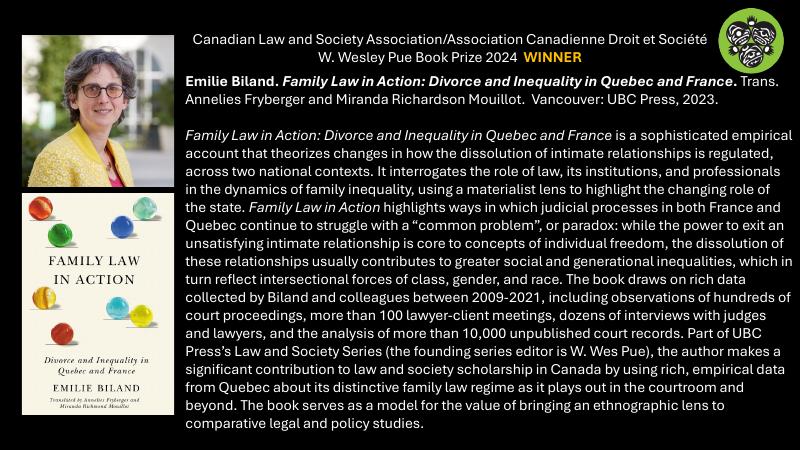
Canadian Law and Society Association/Association Canadienne Droit et Société W. Wesley Pue Book Prize 2024 WINNER Emilie Biland. Family Law in Action: Divorce and Inequality in Quebec and France. Trans. Annelies Fryberger and Miranda Richardson Mouillot. Vancouver: UBC Press, 2023. Family Law in Action: Divorce and Inequality in Quebec and France is a sophisticated empirical account that theorizes changes in how the dissolution of intimate relationships is regulated, across two national contexts. It interrogates the role of law, its institutions, and professionals in the dynamics of family inequality, using a materialist lens to highlight the changing role of the state. Family Law in Action highlights ways in which judicial processes in both France and Quebec continue to struggle with a “common problem”, or paradox: while the power to exit an unsatisfying intimate relationship is core to concepts of individual freedom, the dissolution of these relationships usually contributes to greater social and generational inequalities, which in turn reflect intersectional forces of class, gender, and race. The book draws on rich data collected by Biland and colleagues between 2009-2021, including observations of hundreds of court proceedings, more than 100 lawyer-client meetings, dozens of interviews with judges and lawyers, and the analysis of more than 10,000 unpublished court records. Part of UBC Press’s Law and Society Series (the founding series editor is W. Wes Pue), the author makes a significant contribution to law and society scholarship in Canada by using rich, empirical data from Quebec about its distinctive family law regime as it plays out in the courtroom and beyond. The book serves as a model for the value of bringing an ethnographic lens to comparative legal and policy studies.
Page 2
Canadian Law and Society Association/Association Canadienne Droit et Société W. Wesley Pue Book Prize 2024 HONOURABLE MENTION Rabiat Akande. Entangled Domains: Empire, Law, and Religion in Northern Nigeria. Cambridge: Cambridge University Press, 2023. Professor Rabiat Akande’s Entangled Domains: Empire, Law, and Religion in Northern Nigeria is an elegant study of secularism, religion, law, and empire. It advances a fresh, compelling analysis of secularism as “a contested yet contingent mode of governing religion and religious difference” in Colonial Northern Nigeria. Using a sophisticated theoretical framework, and drawing on careful archival research, Entangled Domains develops vital, nuanced insights from a richly textured narrative. It is an exemplary work of legal history.
Page 3
Canadian Law and Society Association/Association Canadienne Droit et Société 2024 Roderick A. Macdonald Graduate Student Essay Prize WINNER Olaoluwa Oni. “The Transit Visa: International Law, Language, And More, More, More Borders” The author’s original contribution is an ambitious, and textually satisfying, exploration of the dark side of what are known as transit visas as covertly discriminatory tools wielded to impeded the movement of unwanted bodies through European borders. A solidly constructed argument presented by a bold, and up and coming academic who does not shy from writing with wit to showcase a distinctive voice, of which the Canadian academy needs more, more, more!
Page 4
Canadian Law and Society Association/Association Canadienne Droit et Société Le Prix CLSA de L’Article Français 2024 WINNER Joao Velloso. « La gouvernance plurinormative des manifestants : reconfigurations pénales, exceptionnalité et dégradation des droits pendant le G20 à Toronto » Le jury a été impressionné par le caractère novateur de l’analyse, et par l’importance de sa contribution originale à la recherche socio-juridique portant sur la diversification des modes de pénalisation et de contrôle social. L’analyse des configurations juridiques à l’œuvre dans la gouvernance des manifestations en lien avec le G20 à Toronto, en particulier l’examen rigoureux du déploiement dans ce contexte de l’obscure Loi sur la protection des ouvrages publics et de ses conséquences répressives, apportent un éclairage des plus pertinents sur les implications de l’utilisation punitive du droit administratif pour la démocratie et les droits fondamentaux. Le jury a aussi jugé remarquable la finesse et la profondeur de la contribution de l’article sur le plan théorique, qui pavent la voie à de futures études fécondes de la gouvernance d’autres manifestations ou mobilisations sociales. Enfin, le jury souligne le style vivant et imagé de l’article qui en rend la lecture hautement agréable. Toutes nos félicitations à Joao Velloso!
Page 5
Canadian Law and Society Association/Association Canadienne Droit et Société English Article Prize 2024