Reading note · CLSA / ACDS
This announcement relates to the dates and conditions reproduced below. Check the organiser’s current notice before applying or planning travel.
David Sugarman and Abdul Paliwala introduced a 2021 International Journal of Law in Context special issue celebrating Peter Fitzpatrick, who lived from 1941 to 2020. The notice connects his work to postcolonial legal studies and law and the humanities. The temporary free-access period ending in June 2021 does not establish today’s access terms.
3 pages of text
Source-language text, including both languages where the original is bilingual. Page numbering follows the obtained document.
Page 1
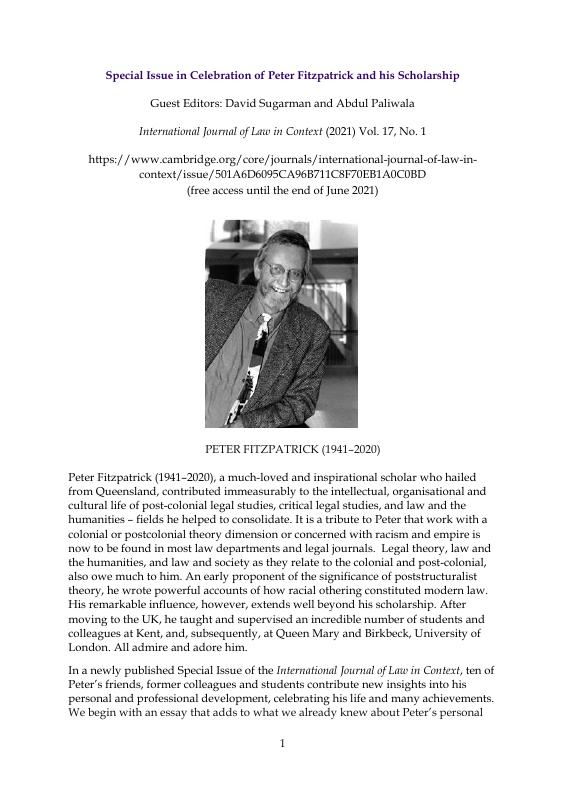
Special Issue in Celebration of Peter Fitzpatrick and his Scholarship Guest Editors: David Sugarman and Abdul Paliwala International Journal of Law in Context (2021) Vol. 17, No. 1 https://www.cambridge.org/core/journals/international-journal-of-law-in- context/issue/501A6D6095CA96B711C8F70EB1A0C0BD (free access until the end of June 2021) PETER FITZPATRICK (1941–2020) Peter Fitzpatrick (1941–2020), a much-loved and inspirational scholar who hailed from Queensland, contributed immeasurably to the intellectual, organisational and cultural life of post-colonial legal studies, critical legal studies, and law and the humanities – fields he helped to consolidate. It is a tribute to Peter that work with a colonial or postcolonial theory dimension or concerned with racism and empire is now to be found in most law departments and legal journals. Legal theory, law and the humanities, and law and society as they relate to the colonial and post-colonial, also owe much to him. An early proponent of the significance of poststructuralist theory, he wrote powerful accounts of how racial othering constituted modern law. His remarkable influence, however, extends well beyond his scholarship. After moving to the UK, he taught and supervised an incredible number of students and colleagues at Kent, and, subsequently, at Queen Mary and Birkbeck, University of London. All admire and adore him. In a newly published Special Issue of the International Journal of Law in Context, ten of Peter’s friends, former colleagues and students contribute new insights into his personal and professional development, celebrating his life and many achievements. We begin with an essay that adds to what we already knew about Peter’s personal 1
Page 2
and professional biography, and assesses and clarifies his key ideas and their intersection with his ethics and lived experiences (Sugarman, in this issue). It provides a backdrop and context for the subsequent papers that elucidate Peter’s significant contribution to scholarship, engage with his ideas and illuminate specific junctures in his life. The issue ends with an edited transcript of Peter’s final seminar in February 2020 and addresses a variety of themes in his work, including his critique of H.L.A. Hart, his notion of ‘slow reading’, the relationship between theory and grounded engagement with people, the idea of community and relationality, the role of the critic, self-criticism, the impossibility of law, decoloniality, occidentalism, mythologies and governmentality, and the significance of narratives (Paliwala, in this issue). The contributors also consider how specific fields and subjects not usually associated with Peter – including international law (Pahuja, in this issue) and the relationship between musical improvisation and law (Ramshaw, in this issue) – might be advanced through an engagement with his ideas. We hope these papers convey something of the special person that was Peter: the person whose support as a supervisor and friend regularly exceeded the norm; his tireless innovation; his community building; his empathy towards ‘outsiders’ and ‘others’; and his delightful individuality and sense of humour. The recent eruption of the Black Lives Matter movement; the toppling of statues associated with the Atlantic slave trade and a colonizing empire; the movement to Decolonise the Curriculum, and the attendant pushback, all testify to the ongoing struggles over the extent to which we recognise the enduring legacies of colonialism, post-colonialism, imperialism and empire. In these as in other respects, Peter’s work and example remain as important and relevant as ever. Contributors: Upendra Baxi (Warwick Law School and O.P. Jindal Global University); Eve Darian-Smith (Global Studies, University of California Santa Barbara); Ben Golder (Law, University of New South Wales); Sundhya Pahuja (Melbourne Law School); Abdul Paliwala (Warwick Law School); George Pavlich (Sociology, University of Alberta); Sara Ramshaw (Law, University of Victoria); David Sugarman (Law, Lancaster; IALS, London; CSLS, Oxford); Patricia Tuitt (Legal Academic); William Twining (Law, UCL). Editorial introduction David Sugarman and Abdul Paliwala Becoming Peter Fitzpatrick (1941–2020) David Sugarman Transformation William Twining Post-colonial attitudes and the relevance of incommensurability Eve Darian-Smith 2
Page 3
Not to save, but to encounter: Fitzpatrick as transnational jurisprudent Sundhya Pahuja Myth and concealment at colonial law’s foundations George Pavlich Deconstruction, dissipation and death, and the ‘casting-away of the law’? Upendra Baxi A concise note on Peter Fitzpatrick’s ‘Racism and the innocence of law’ Patricia Tuitt Improvising with Peter Sara Ramshaw How to do things with Foucault (legally) Ben Golder Ultimate conversation: Fitzpatrick at Warwick, February 2020 Abdul Paliwala 3