Reading note · CLSA / ACDS
This announcement relates to the dates and conditions reproduced below. Check the organiser’s current notice before applying or planning travel.
Jordan House and Kelly Struthers Montford’s Prison Labour call appeared in the Journal of Prisoners on Prisons, volume 29(1&2), 2020, printed pages 155–157. It sought accounts and analysis from current and former prisoners, including co-authored work, across vocational programmes, re-entry, organising and exploitation. The original manuscript deadline was 1 May 2021; later revision dates and a proposed 2022 publication belonged to that process. A reading worksheet should identify whose experience is represented, the form of evidence and the broader question, rather than mistaking the invitation for a published finding.
3 pages of text
Source-language text, including both languages where the original is bilingual. Page numbering follows the obtained document.
Page 1
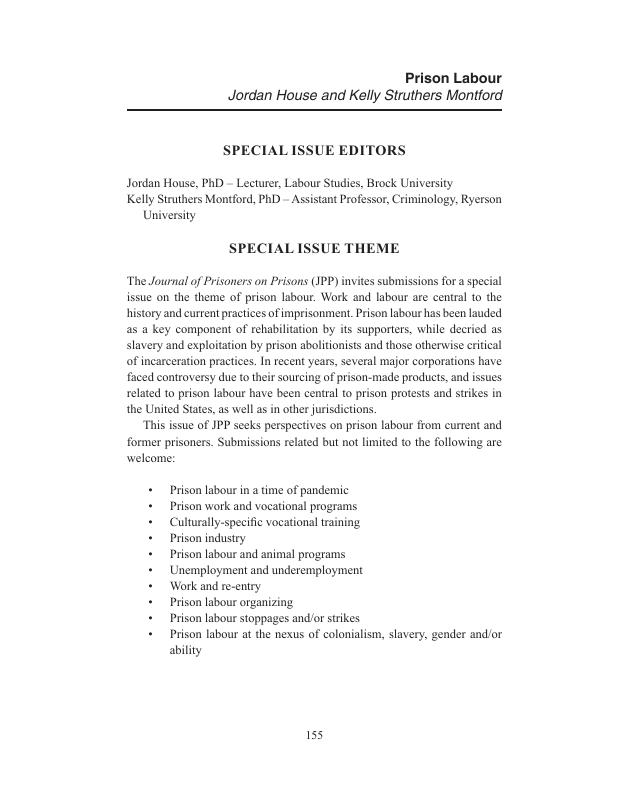
Prison Labour Jordan House and Kelly Struthers Montford SPECIAL ISSUE EDITORS Jordan House, PhD – Lecturer, Labour Studies, Brock University Kelly Struthers Montford, PhD – Assistant Professor, Criminology, Ryerson University SPECIAL ISSUE THEME The Journal of Prisoners on Prisons (JPP) invites submissions for a special issue on the theme of prison labour. Work and labour are central to the history and current practices of imprisonment. Prison labour has been lauded as a key component of rehabilitation by its supporters, while decried as slavery and exploitation by prison abolitionists and those otherwise critical of incarceration practices. In recent years, several major corporations have faced controversy due to their sourcing of prison-made products, and issues related to prison labour have been central to prison protests and strikes in the United States, as well as in other jurisdictions. This issue of JPP seeks perspectives on prison labour from current and former prisoners. Submissions related but not limited to the following are welcome: • Prison labour in a time of pandemic • Prison work and vocational programs • Culturally-specific vocational training • Prison industry • Prison labour and animal programs • Unemployment and underemployment • Work and re-entry • Prison labour organizing • Prison labour stoppages and/or strikes • Prison labour at the nexus of colonialism, slavery, gender and/or ability 155
Page 2
156 Journal of Prisoners on Prisons, Volume 29(1&2), 2020 PAPER FORMATS AND SUBMISSION GUIDELINES Fundamental to the JPP and this special issue are the accounts, experiences and criticisms of criminalized populations. Prisoners and former prisoners, along with other co-authors (where applicable) are encouraged to submit: • Theoretical, critical and analytical essays; • Scholarly research articles based on quantitative, qualitative, arts- based and/or mixed-methods research; • Book reviews; • Artistic content – photo or graphic essays, digital art, etc.; • Interviews or discussions transcribed from tape; or • Commentaries. All contributions must follow the journal’s submission guidelines (see http://www.jpp.org/submissions.html) • The Journal will not publish any subject matter that advocates hatred, sexism, racism, violence or that supports the death penalty. • The Journal does not publish material that usually focuses on the writer’s own legal case, although the use of the writer’s personal experiences as an illustration of a broader topic is encouraged. • The Journal does not usually publish fiction and does not generally publish poetry. Illustrations, drawings and paintings may be submitted as potential cover art. • Articles should be no longer than 20 pages typed and double-spaced or legibly handwritten. Electronic submissions are gratefully received. • Writers may elect to write anonymously or under a pseudonym. • For references cited in an article, writers should attempt to provide the necessary bibliographic information. Refer to the references cited in past issues for examples. • Editors look for developed pieces that address topics substantially. Manuscripts go through a preliminary reading and then are sent to review by the Editorial Board. Those that are of suitable interest are returned to the author with comments or suggestions. Editors work with writers on composition and form, and where necessary may
Page 3
Jordan House and Kelly Struthers Montford 157 help the author with referencing and bibliographic information, not readily available in prisons. Selected articles are returned to authors for their approval before publication. Papers not selected are returned with comments from the editor. Revised papers may be resubmitted. • Please submit biographical and contact information, to be published alongside articles unless otherwise indicated. IMPORTANT DATES Submissions by authors: 1 May 2021 Editorial decision and reviewer comments to authors: 1 July 2021 Revised manuscripts: 1 November 2021 Final editorial decision to authors: 1 January 2022 Publication date: 2022 SUBMISSIONS Via email to ksm@ryerson.ca or by mail to the address below: Journal of Prisoners on Prisons c/o Justin Piché, PhD Department of Criminology University of Ottawa 120 University Private – Room 14049 Ottawa, Ontario, Canada K1N 6N5