Note de lecture · ACDS / CLSA
Bulletin — Printemps /PRINTEMPS 2018 réunit les activités de l’Association et des annonces scientifiques dans un numéro daté. Les titres permettent de distinguer les comptes rendus des projets annoncés. Les noms et fonctions correspondent à ce numéro et ne désignent pas nécessairement le conseil actuel.
Utiliser ce numéro
Choisissez un thème ou un nom. Recherchez-le ci-dessous, notez la page et identifiez le type de contenu : compte rendu, appel, prix ou référence bibliographique. Consultez ensuite la publication ou l’organisation citée pour connaître la suite.
Modèle de note
Numéro : Bulletin — Printemps /PRINTEMPS 2018. Page : __. Texte ou nom : __. Type : __. Ce que la source affirme : __. Ce qui demande une vérification ailleurs : __. Ce modèle distingue les éléments du document de votre interprétation.
13 pages de texte
Texte dans la langue du document, y compris les deux langues pour les originaux bilingues. La numérotation suit le document obtenu.
Page 1
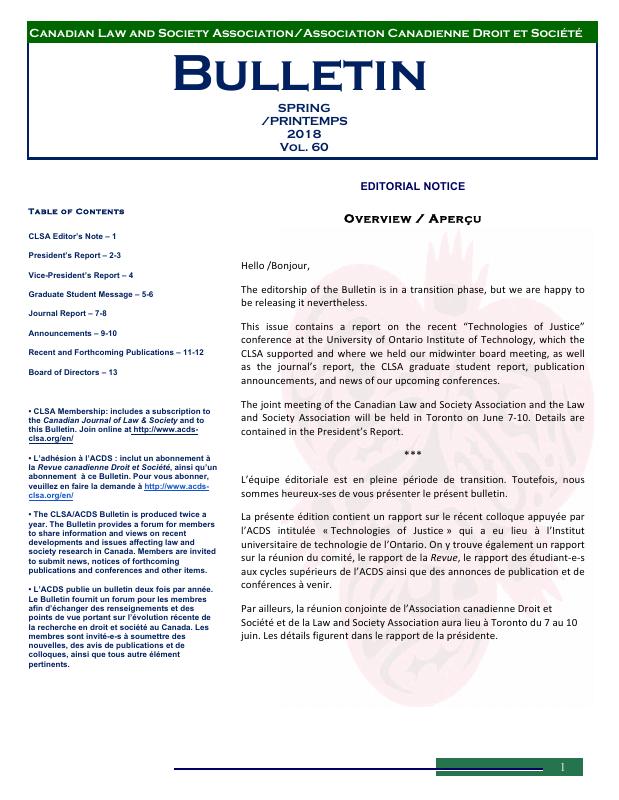
Canadian Law and Society Association/Association Canadienne Droit et Société Bulletin SPRING /PRINTEMPS 2018 Vol. 60 EDITORIAL NOTICE Table of Contents O VERVIEW / A PERÇU CLSA Editor’s Note – 1 President’s Report – 2-3 Hello /Bonjour, Vice-President’s Report – 4 Graduate Student Message – 5-6 The editorship of the Bulletin is in a transition phase, but we are happy to be releasing it nevertheless. Journal Report – 7-8 This issue contains a report on the recent “Technologies of Justice” Announcements – 9-10 conference at the University of Ontario Institute of Technology, which the Recent and Forthcoming Publications – 11-12 CLSA supported and where we held our midwinter board meeting, as well Board of Directors – 13 as the journal’s report, the CLSA graduate student report, publication announcements, and news of our upcoming conferences. The joint meeting of the Canadian Law and Society Association and the Law • CLSA Membership: includes a subscription to the Canadian Journal of Law & Society and to and Society Association will be held in Toronto on June 7-‐10. Details are this Bulletin. Join online at http://www.acds- contained in the President’s Report. clsa.org/en/ • L’adhésion à l’ACDS : inclut un abonnement à *** la Revue canadienne Droit et Société, ainsi qu’un abonnement à ce Bulletin. Pour vous abonner, veuillez en faire la demande à http://www.acds- L’équipe éditoriale est en pleine période de transition. Toutefois, nous clsa.org/en/ sommes heureux-‐ses de vous présenter le présent bulletin. • The CLSA/ACDS Bulletin is produced twice a La présente édition contient un rapport sur le récent colloque appuyée par year. The Bulletin provides a forum for members to share information and views on recent l’ACDS intitulée « Technologies of Justice » qui a eu lieu à l’Institut developments and issues affecting law and universitaire de technologie de l’Ontario. On y trouve également un rapport society research in Canada. Members are invited to submit news, notices of forthcoming sur la réunion du comité, le rapport de la Revue, le rapport des étudiant-‐e-‐s publications and conferences and other items. aux cycles supérieurs de l’ACDS ainsi que des annonces de publication et de • L’ACDS publie un bulletin deux fois par année. conférences à venir. Le Bulletin fournit un forum pour les membres afin d’échanger des renseignements et des Par ailleurs, la réunion conjointe de l’Association canadienne Droit et points de vue portant sur l’évolution récente de la recherche en droit et société au Canada. Les Société et de la Law and Society Association aura lieu à Toronto du 7 au 10 membres sont invité-e-s à soumettre des juin. Les détails figurent dans le rapport de la présidente. nouvelles, des avis de publications et de colloques, ainsi que tous autre élément pertinents. 1
Page 2
President’s Report It seems amazing to think that my two-‐year term as president is almost over, as is that of our vice-‐ president Tom McMorrow. We are about to embark on our annual search for new directors and officers, which will include the program and local arrangements coordinators for our annual conference in 2019, to be held in Vancouver with Congress. We are also reconsidering how we do our communications. If you are interested in joining the board or taking on any of these roles, speak up! In January, Tom McMorrow and his colleagues and students in the Legal Studies program at the University of Ontario Institute of Justice put together a great conference on the theme of “Technologies of Justice.” The CLSA was delighted to support this endeavour and grateful to UOIT for accommodating our annual board meeting. Members planning conferences are encouraged to seek support from the CLSA for these endeavours: visit the website (under Activities) or email conferencesupport@acds-‐clsa.org. The program committee for the June conference, chaired by Mariana Valverde of the University of Toronto, has put together an impressive (and, as always, large) program, around the theme “ Law at the Crossroads / Le droit à la croisée des chemins.” The Honourable Rosalie Silberman Abella of the Supreme Court of Canada has agreed to give a keynote address in the early afternoon on Thursday, June 7. We are also looking forward to four “mini-‐plenaries” late in the day on Friday, June 8, on Indigenizing the Academy, Racism and the Criminal Justice System in Canada and the United States, Surveillance and Big Data, and The Rising Wave of Authoritarianism. Also at the conference the CLSA and LSA will hold a joint awards ceremony, and the CLSA will hold its annual general meeting and a meeting of the new board. We are excited to be planning a francophone socio-‐legal workshop to be held on June 6, just before the main conference begins. The theme is “Le droit et la société au sein de la francophonie : défis et développements.” Pierre Noreau has agreed to give a keynote address. We hope the workshop will draw in not only our Canadian colleagues but also those travelling internationally to the main meeting. It is not, however, necessary to register for the main meeting in order to attend the workshop. The deadline for proposals is April 22. Please email atelier@acds-‐ clsa.org or check our website for more information. In an effort to reciprocate for our 2013 meeting, when the Law and Society Association of Australia and New Zealand (LSAANZ) joined us at the University of British Columbia for our “Law on the Edge” conference, the CLSA will be joining LSAANZ at its annual meeting in Wollongong, NSW December 12-‐15, 2018. The theme is “Inclusion, Exclusion and Democracy.” The call for papers is available on LSAANZ’s website and is open until July 6. As well, legal historians will be interested to know that the Australia and New Zealand Law and History Society (ANZLHS) is holding its annual meeting December 10-‐12, also in Wollongong. The CLSA has set aside funds to support members travelling to the LSAANZ conference; please inquire (info@acds-‐clsa.org). We would like to send as many Canadians as we can. See you in Toronto. Lyndsay Campbell, CLSA President (lyndsay@iii.ca) 2
Page 3
Rapport de la présidente Presque deux ans se sont écoulés et mon mandat de présidente tire à sa fin ainsi que celui de notre vice-‐président Tom McMorrow. Nous nous apprêtons à débuter notre recherche annuelle de nouveaux-‐elles directeur-‐rice-‐s et administrateur-‐ice-‐s, recherche qui inclura celle d’un-‐e coordonnateur-‐rice de programme et coordinateur-‐rice local-‐e pour le colloque annuel qui aura lieu à Vancouver en 2019 en même temps que le Congrès. Nous envisageons également une nouvelle façon de gérer nos communications. Si vous souhaitez vous joindre à notre équipe dans l’un ou l’autre de ces rôles, faites-‐nous en part. En janvier, Tom McMorrow et ses collègues et étudiant-‐e-‐s du programme d’études juridiques de l’Institut universitaire de technologie de l’Ontario ont organisé un colloque intéressant sur le thème « Technologies of Justice. » L’ACDS a été ravie d’appuyer cette initiative et est reconnaissante à l’Institut d’avoir accueilli notre réunion annuelle. Nous encourageons les membres qui planifient des colloques à solliciter le soutien de l’ACDS. Visitez le site (section Activités) ou écrivez à conferencesupport@acds-‐clsa.org. Le comité du programme du colloque de juin, présidé par Mariana Valverde de l’University of Toronto, a préparé un programme vaste et impressionnant sur le thème « Law at the Crossroads / Le droit à la croisée des chemins ». L’honorable Rosalie Silberman Abella de la Cour suprême du Canada a accepté de prononcer un discours au début de l’après-‐midi du jeudi 7 juin. Par ailleurs, quatre mini séances plénières des plus prometteuses se tiendront en fin de journée le vendredi 8 juin et porteront sur « L’indigénisation de l’académie », « Le racisme et le système de justice criminelle au Canada et aux États-‐Unis », « La surveillance et les mégadonnées » et « La vague montante d’autoritarisme ». De plus, lors du colloque, l’ACDS et la Law and Society Association tiendront une cérémonie conjointe de prix, et l’ACDS tiendra sa réunion générale annuelle ainsi qu’une réunion de son nouveau conseil d’administration. Nous sommes très heureux-‐ses de planifier un atelier francophone socio-‐légal le 6 juin, juste avant le début du colloque principal. Le thème est « Le droit et la société au sein de la francophonie : défis et développements. » Pierre Noreau a accepté d’agir à titre de conférencier d’honneur. Nous espérons que l’atelier attirera non seulement nos collègues canadien-‐ne-‐s mais également ceux et celles venu-‐e-‐s de l’étranger pour assister au colloque principale. Toutefois, il n’est pas nécessaire de s’inscrire au colloque principale pour assister à l’atelier. L’échéance pour les propositions est le 22 avril. Veuillez écrire à atelier@acds-‐clsa.org ou consulter le site web pour de plus amples renseignements. Dans une optique de réciprocité pour la réunion de 2013, alors que la Law and Society Association of Australia and New Zealand (LSAANZ) s’était jointe à nous à la University of British Columbia pour le colloque « Law on the Edge », l’ACDS se joindra à la LSAANZ lors de sa réunion annuelle à Wollongong du 12 au 15 décembre 2018. Le thème sera « L’inclusion, l’exclusion et la démocratie ». Un appel de communications est en vigueur jusqu’au 6 juillet et se trouve sur le site de LSAANZ. De plus, les historien-‐ne-‐s juridiques seront heureux-‐ses d’apprendre que la Australia and New Zealand Law and History Society (ANZLHS) tiendra sa réunion annuelle du 10 au 12 décembre, également à Wollongong. L’ACDS a prévu des fonds pour appuyer les membres qui s’y rendront. Pour de plus amples renseignements écrivez à info@acds-‐clsa.org. Nous aimerions y envoyer autant de Canadien-‐ne-‐s que possibles. Au plaisir de vous voir à Toronto! Lyndsay Campbell, Présidente, ACDS (lyndsay@iii.ca) 3
Page 4
Vice-President Tom McMorrow’s Report on “Technologies of Justice” This year’s mid-‐winter meeting took place in downtown Oshawa. Hosted by the Legal Studies program at the University of Ontario Institute of Technology, the “Technologies of Justice” conference welcomed scholars, students, and members of the wider public for two intensive days of research presentations and lively discussions on a range of law and society themes. The conference program is available at uoit.ca/justicetech and the real-‐time Twitter interventions of participants and observers are saved for posterity at #justicetech. The lunchtime plenary panel explored the roles of technology and justice in relation to the automotive sector and the labour movement. Vanessa Dion Fletcher opened the Friday night plenary event with a challenging and evocative artistic performance. Anne Taylor, Johnny Mack, Karen Drake, Michael Coyle and moderator Natalie Oman engaged with the proposition of “Treaties as Technologies of (In)justice?” The local salience of the question was brought home to conference-‐goers earlier in the day with the screening of the documentary Inaakonigewin andaada aki: Michi Saagiig treaties produced by Curve Lake First Nation. The wide-‐ranging topics, inter-‐disciplinary nature, local engagement and public outreach signaled by the event built on the example set at the University of New Brunswick Faculty of Law when Nicole O’Byrne and her colleagues hosted the CLSA’s midwinter conference in 2017. The success of “Technologies of Justice” augurs well for making our mid-‐winter gathering a marquee occasion for the kind of scholarly and community engagement the CLSA seeks to foster. *** Rapport du vice-président Tom McMorrow sur la conférence « Technologies of Justice » Cette année, la réunion d’hiver a eu lieu au centre-‐ville d’Oshawa. Tenue par le programme des études juridiques de l’Institut universitaire de technologie de l’Ontario, le colloque « Technologies of Justice » a accueilli des chercheur-‐se-‐s, des étudiant-‐e-‐s et des membres du public pendant deux journées intensives de présentations de recherche et de discussions animées sur de nombreux thèmes liés au droit et à la société. Le programme de la conférence se trouve à uoit.ca/justicetech et les interventions des participant-‐e-‐s et des observateur-‐ice-‐s en temps réel sur Twitter ont été sauvegardées pour la postérité à #justicetech. La séance plénière de l’heure du dîner a été l’occasion d’explorer les rôles de la technologie et de la justice en lien avec le secteur automobile et le mouvement ouvrier. Vanessa Dion Fletcher a débuté la séance plénière vendredi soir avec une performance artistique évocatrice et stimulante. Anne Taylor, Johnny Mack, Karen Drake, Michael Coyle et l’animatrice Natalie Oman ont lancé le débat avec la proposition des « Treaties as Technologies of (In)justice? ». L’aspect local de la question a été mis de l’avant plus tôt dans la journée avec la projection du documentaire intitulé « Inaakonigewin andaada aki: Michi Saagiig treaties » produit par la Première Nation Curve Lake. Nicole O’Byrne et ses collègues de la Faculté de droit de l’Université du Nouveau Brunswick, qui ont été hôtes du colloque de l’ACDS en 2017, par leur exemple ont inspiré les sujets divers abordés, l’aspect interdisciplinaire, l’engagement local et le rayonnement de l’événement. Le succès du colloque « Technologies of Justice » est de bon augure dans l’optique que la réunion de mi-‐hiver reflète le type d’engagement académique et communautaire que l’ACDS souhaite favoriser. 4
Page 5
Graduate Student Message Dear ACDS/CLSA Graduate Students, We hope spring is bringing along renewed energy and exciting projects! Roderick A. Macdonald Graduate Student Essay Prize Entries are due by 5:00pm EST on May 1st! This prize is awarded annually for the best essay on a topic in law and society written by a graduate student at a Canadian University. Papers can be submitted in .doc or .docx format in either English or French, and should be between 5,000-‐ 10,000 words long (including footnotes, abstract, title, appendices, and bibliography). Submissions should include an abstract of no more than 250 words that establishes the main arguments/contributions of the paper. Previous winners are listed on the CLSA/ACDS website. The winning submission receives detailed feedback from the Prize Committee, and promotion through ACDS/CLSA channels. Don’t miss this opportunity to have your research recognized! For any questions concerning this prize, or to submit your work for consideration, please contact Angela Lee, Chair of the Committee, at angela.lee@uottawa.ca. Graduate Student Representative Election 2018 Candidacies for the position of CLSA Graduate Student Representative for the 2018-‐2020 mandate are due April 27th. If you are interested in running for this position, please send us a short paragraph about yourself, and a short paragraph about why you would like to be a CLSA Graduate Student Representative for us to circulate during the election period. CLSA/LSA Joint Meeting in Toronto – June 7-‐10, 2018 We hope to meet many of you at the joint CLSA/LSA meeting in Toronto this upcoming June! Keeping in mind the preferences some of you have expressed for the best time to hold a social gathering, we will be in touch closer to the meeting to invite you to join us for this opportunity to meet. CLSA Graduate Student Members Collaborative Google Calendar Our CLSA Google calendar for graduate student members is up and running, connected to our Gmail account. The calendar is meant to unite in one tool important dates, such as meetings, deadlines for call for papers and contests, etc. Please email us at acdsgradsclsa@gmail.com should you wish to be added to the calendar. Comments, questions, suggestions? Please feel welcome in emailing us comments, questions, or suggestions about how we can further represent your interests within the ACDS/CLSA as your Graduate Student Representatives, at acdsgradsclsa@gmail.com. You can also follow us on our Twitter page @acds_clsa. We look forward to seeing you in Toronto! Angela Lee and Sabrina Tremblay-‐Huet ACDS/CLSA Graduate Student Representatives *** 5
Page 6
Chères étudiantes de l’ACDS, chers étudiants de l’ACDS, Nous espérons qu’avec le printemps viennent une énergie renouvelée et des projets excitants! Prix Roderick A. Macdonald pour la meilleure dissertation d’un-‐e étudiant-‐e aux cycles supérieurs Les soumissions sont dues à 17h HNE le 1er mai! Le prix est attribué de façon annuelle pour la meilleure dissertation portant sur un sujet de droit et société, écrite par un-‐e étudiant-‐e aux cycles supérieurs d’une université canadienne. Les dissertations peuvent être soumises en format .doc ou bien .docx, en français ou en anglais, et doivent comprendre 5000 à 10 000 mots (incluant les notes de bas de page, le résumé, le titre, les annexes et la bibliographie). Les soumissions doivent inclure un résumé d’au plus 250 mots, établissant les arguments/contributions principaux de la dissertation. Les gagnant-‐e-‐s des éditions précédentes sont énuméré-‐e-‐s sur le site internet de l’ACDS. La dissertation gagnante se voit mériter de la rétroaction détaillée de la part du Comité du prix, et une promotion par les réseaux de l’ACDS. Ne manquez pas cette opportunité de voir votre recherche être reconnue! Pour toutes questions concernant ce prix, ou pour soumettre votre dissertation pour considération pour le prix, veuillez contacter Angela Lee, Présidente du Comité, à l’adresse angela.lee@uottawa.ca. Élection pour la fonction de Représentant-‐e des étudiant-‐e-‐s aux cycles supérieurs de l’ACDS 2018 Les candidatures pour la fonction de Représentant-‐e des étudiant-‐e-‐s aux cycles supérieurs de l’ACDS pour le mandat 2018-‐2020 sont à soumettre au plus tard le 27 avril. Si vous intéressé-‐e-‐s à vous présenter pour cette fonction, veuillez nous envoyer un court paragraphe à propos de vous ainsi qu'un court paragraphe explicitant votre intérêt pour cette fonction afin que nous puissions les faire circuler durant la période des élections, au plus tard le vendredi 27 avril. Colloque conjoint ACDS/LSA à Toronto – 7-‐10 juin 2018 Nous espérons rencontrer plusieurs d’entre vous au colloque conjoint ACDS/LSA à Toronto en juin prochain! Gardant en tête les préférences que vous avez exprimées quant au meilleur moment pour tenir le rassemblement social, nous communiquerons avec vous à l’approche du colloque afin de vous inviter à nous joindre pour cette opportunité de se rassembler. Calendrier collaboratif Google des étudiant-‐e-‐s aux cycles supérieurs de l’ACDS Notre calendrier Google ACDS pour les membres étudiant-‐e-‐s aux cycles supérieurs est fonctionnel, lié à notre adresse courriel Gmail. Le calendrier a pour fonction d’unir en un seul instrument des dates importantes, telles que des colloques, des dates limites pour des appels à propositions et des concours, etc. Veuillez nous écrire au acdsgradsclsa@gmail.com si vous souhaitez y être ajouté-‐e-‐s. Commentaires, questions, suggestions Faites-‐nous parvenir vos commentaires, questions ou suggestions par courriel et dites-‐nous comment mieux représenter vos intérêts au sein de l’ACDS à acdsgradsclsa@gmail.com. Vous pouvez également nous suivre sur Twitter @acds_clsa. Au plaisir de vous rencontrer à Toronto! Angela Lee et Sabrina Tremblay-‐Huet Représentantes des étudiant-‐e-‐s aux cycles supérieurs de l’ACDS 6
Page 7
Canadian Journal of Law and Society Editors’ Report With volume 32 now complete, we are into final production of the first issue of volume 33, which will soon be in your real or virtual hands. This issue will be continuing proof of the breadth and vitality of law and society scholarship, as the titles show: “Oligopolist Speech and the Public Interest in Pharmaceutical Patent Law Reform” (Chris Dent and Yvonne Haigh) “Fighting Human Smuggling or Criminalizing Refugees? Regimes of Justification in and around R. v. Appulonappa” (David Moffette and Nevena Aksin) “Perspective féministe sur l’article 1974.1 du Code civil du Québec. Une protection efficace dans la vie des femmes locataires victimes de violences?” (Marie-‐Neige Laperrière) “Economic Development and Treaty Reparations in New Zealand and Canada” (Myra Tait and Kiera Ladner) “After Exoneration: How Attributions of Responsibility Impact Perceptions” (Kimberley Clow, Meaghan Savage, Regina Schuller and Rose Ricciardelli) Editing is well underway for the 2018 special issue, entitled “Transnational Labour Law and Development / Le droit transnational du travail et le développement” and guest edited by Adelle Blackett (Law, McGill University). The issue brings together an impressive array of scholars and will be a timely contribution to a rapidly developing field. We are also pleased to announce that 2019’s special issue will be on Sensori-‐Legal Studies, guest edited by David Howes (Sociology and Anthropology, Concordia University). The editorial board met at UOIT in Oshawa in January and reported to the CLSA board at that time. The Journal continues to be in good financial health. This summer we will be preparing the application for renewed SSHRC funding. The Journal continues to be strong on a scholarly level as well, with the number of submissions going up, which bodes well for our impact factor, the approval of which is underway. We encourage submissions from CLSA members, and hope that you will also spread word of the journal through your networks. The Journal’s web page continues to evolve and expand, so check it out regularly. Alongside information about submissions, current and upcoming issues, and FirstView pre-‐publication access to upcoming articles, it now includes links to our “Most Cited” and “Most Read” articles. Which are they? Visit the site to find out: https://www.cambridge.org/core/journals/canadian-‐journal-‐of-‐law-‐and-‐society-‐la-‐revue-‐ canadienne-‐droit-‐et-‐societe. We hope you have a productive and pleasant summer, Melanie Adrian, Managing Editor Benjamin L. Berger, Editor-‐in-‐Chief (English Manuscripts) Joane Martel, Editor-‐in-‐Chief (French Manuscripts) Eric H. Reiter, Editor-‐in-‐Chief (English Manuscripts) 7
Page 8
C om pte rendu des rédacteur-ice-s en chef Après 32 volumes complétés, nous en sommes à finaliser la production du premier numero du volume 33, qui sera bientôt à votre portée, réelle ou virtuelle. Ce numéro constitue une nouvelle preuve de l’importance et de la vitalité de la littérature dans le domaine du droit et de la société, tout comme en témoignent les titres suivants. « Oligopolist Speech and the Public Interest in Pharmaceutical Patent Law Reform » (Chris Dent et Yvonne Haigh) « Fighting Human Smuggling or Criminalizing Refugees? Regimes of Justification in and around R. v. Appulonappa » (David Moffette et Nevena Aksin) « Perspective féministe sur l’article 1974.1 du Code civil du Québec. Une protection efficace dans la vie des femmes locataires victimes de violences? » (Marie-‐Neige Laperrière) « Economic Development and Treaty Reparations in New Zealand and Canada » (Myra Tait et Kiera Ladner) « After Exoneration: How Attributions of Responsibility Impact Perceptions » (Kimberley Clow, Meaghan Savage, Regina Schuller et Rose Ricciardelli) L’édition du numéro spécial de 2018 est présentement en cours. Intitulé « Transnational Labour Law and Development / Le droit transnational du travail et le développement », son édition est prise en charge par l’éditrice invitée Adelle Blackett (droit, Université McGill). Ce numero, qui réunit une vaste gamme de chercheur-‐se-‐s, constitue une contribution à propos à un champ en pleine évolution. Nous sommes heureux d’annoncer que le numero spécial de 2019 portera sur les études sensori-‐ juridiques (Sensori-‐Legal Studies), et l’éditeur invité de cette édition sera David Howes (sociologie et anthropologie, Université Concordia). Le comité éditorial s’est réuni à l’Institut universitaire de technologie de l’Ontario en janvier et a soumis un rapport à l’ACDS à cette occasion. La Revue continue à être en bonne santé financière. Cet été, nous préparerons la demande de renouvellement du financement du CRSH. Par ailleurs, la Revue demeure solide sur le plan de la recherche, et le nombre de propositions continue d’augmenter, ce qui est de bon augure pour le facteur d’impact, dont l’approbation est en cours. Nous encourageons les membres de l’ACDS à soumettre des manuscrits, et nous espérons que vous diffusiez l’appel de propositions à travers vos réseaux respectifs. La page Web de la Revue ne cesse d’évoluer et de prendre de l’expansion; visitez-‐la régulièrement. En plus des renseignements au sujet de soumissions, de numéros actuels et à venir ainsi que l’accès à des articles à venir au moyen de FirstView, le site comprend maintenant des liens vers les « Articles les plus cités » et les « Articles les plus lus ». Pour les découvrir, visitez: https://www.cambridge.org/core/journals/canadian-‐journal-‐of-‐law-‐and-‐society-‐la-‐revue-‐ canadienne-‐droit-‐et-‐societe. En vous souhaitant un été agréable et productif, Melanie Adrian, directrice-‐rédactrice en chef Benjamin L. Berger, éditeur en chef (manuscrits en anglais) Joane Martel, éditrice en chef (manuscrits en français) Eric H. Reiter, éditeur en chef (manuscrits en anglais) 8
Page 9
Announcements / Des Annonces Conferences and Calls for papers / Des Réunions et des Appels à propositions Atelier francophone sur la recherche et la pratique socio-‐légale L’Association canadienne droit et société (ACDS) vous invite à soumettre une proposition de présentation, panel ou table-‐ronde dans le cadre d’un atelier francophone portant sur la recherche et la pratique socio-‐ légale, qui aura lieu le mercredi 6 juin 2018, au Sheraton Centre à Toronto. Le thème est « Le droit et la société au sein de la francophonie : défis et développements ». Nous aurons le grand plaisir d'accueillir Professeur Pierre Noreau (Université de Montréal) en tant que conférencier d'honneur de cet atelier. Nous espérons recevoir des propositions sur une variété de sujets d’intérêt pour celles et ceux accomplissant de la recherche socio-‐légale et enseignant dans ce domaine en langue française, au Québec ainsi qu’ailleurs au Canada et dans le monde. Nous anticipons que certains panels seront orientés vers l’aspect recherche tandis que d’autres le seront vers des enjeux professionnels touchant l’enseignement, la recherche et la publication, incluant des réflexions sur des expériences personnelles. Nous sommes ouvert-‐e-‐s à une variété de formats. Cet atelier aura lieu la journée précédant le début du colloque conjoint de l’ACDS et de la Law and Society Association (LSA). Il y aura un frais d’inscription pour participer à cet atelier, mais il n’est PAS requis de s’inscrire au colloque conjoint ACDS-‐LSA pour ce faire. Veuillez soumettre vos propositions d'environ 300 mots au plus tard le 22 avril à l’adresse : atelier@acds-‐ clsa.org. S'il vous plaît inclure votre affiliation et veuillez nous notifier de tout besoin spécifique, technologique ou autre. *** Law and Society Association of Australia and New Zealand Conference 2018: Inclusion, Exclusion and Democracy Papers or panel proposals (of three to four papers) are invited on a broad range of law and society topics relating to ‘Inclusion, Exclusion and Democracy’ within the following sub-‐themes: § Navigating vulnerability, empowerment and identity of individuals, groups or communities; § Indigenous and cultural perspectives; § Crime, justice and punishment; § The environment; § The rise and impact of new technologies, the internet or social media; § Theorising, rethinking or challenging democratic constructions, principles or approaches; § Democracy in context – local, regional, country, global or comparative perspectives; or § The role of the judiciary, lawyers and academics in fostering democracy and inclusion, or facilitating exclusion. Papers are also invited on all other law and society topics. The committee welcomes proposals across a range of disciplines including (but not limited to) law, humanities, social science, or the sciences. 9
Page 10
SUBMISSION OF ABSTRACTS Abstracts of no more than 250 words for a 15–20 minute paper must be submitted through the conference website (http://www.uowblogs.com/lsaanz2018/call-‐for-‐abstracts/) by 6 July 2018. Panel proposals must: identify a theme for the panel; nominate a panel chair; include a 250 word description of the panel; and include a 250 word abstract for each individual paper that is part of the proposed three to four paper panel. The organising committee will endeavour to notify presenters whether their proposed paper has been accepted by 31 July 2018. Job Opportunities / Opportunités d'emploi Chair in Constitutional Governance, Trinity College Dublin The Law School in Trinity College Dublin, the University of Dublin is seeking to enhance its existing research strength in the area of international and comparative constitutional governance. To this end, the School is creating a Chair in Constitutional Governance (full professorship) and invites applications from suitably qualified candidates working in fields that focus on issues of constitutional governance, including comparative public law, constitutional law, administrative law, the constitutional law of the European Union, and public international law. For more information, please visit their website, http://www.tcd.ie/law/news-‐events/chair-‐constitutional-‐ governance. 10
Page 11
Recent & Forthcoming Publications / Publications récentes et à venir Books and Special Issues / Livres et numéros spéciaux Jane Barker and D. Scharie Tavcer eds., Women and the Criminal Justice System: A Canadian Perspective, 2d ed. Toronto: Emond Publishing, 2017. Featuring a variety of Canadian regions, the book is broken into four parts: Overview of Women and the Canadian Criminal Justice System; Female Offenders in Canada; Victimization and Criminalization; and Women Working in the Canadian Criminal Justice System. This edition also features a case study in each part, and a new chapter, written by Scharie Tavcer, on Prostitution and the Missing and Murdered Women and Girls in Canada. Philip Girard, Jim Phillips, and Blake Brown. A History of Law in Canada Volume 1: Beginnings to 1866. University of Toronto Press for the Osgoode Society, 2018. This book, the first of 2 volumes, presents the history of law in what is now Canada, from the first European contacts with northern North America in the very early sixteenth century to immediately before Confederation. Divided into four parts, the book first looks at the roots of Canada’s three legal traditions, Indigenous, French and English, in North America, France and England. Part 2 examines the period down to 1701 and the signing of the treaty known as the Great Peace of Montreal in 1701, during which New France was established. Part 3 deals with the eighteenth century – Anglo-‐French conflict, New France until 1760, the establishment and growth of English colonies of settlement, and, throughout, relations with indigenous peoples and governance of indigenous nations. Part 4 is devoted to the British North American period, after 1815. Indigenous people are central of the narrative throughout, including after 1815 when their influence waned as their land base was largely lost in central and eastern Canada. Included in Part 4 are the Red River settlement and early British Columbia. Although the background to this history are the well-‐known major political, military, social and economic transformations of this part of North America, the book is principally a legal history set against and integrated with that background. Court systems, the judiciary, the legal professions, are dealt with in every period and for each of the legal traditions, and the areas of law covered include criminal, family, constitutional, commercial, land, succession, and civil and criminal procedure. This volume combines the remarkable flowering of scholarship on Canadian legal history, so much of it fostered and published by the Osgoode Society over 35 years, and much new research. 11
Page 12
Isabel Grant and Susan B. Boyd eds., Remembering Judith Mosoff: Special Issue of the Canadian Journal of Family Law (2018) 31(1). Articles: • Jonas-‐ Sebastien Beaudry, “The Vanishing Body of Disability Law: Power and the Making of the Impaired Subject” • Suzanne Zaccour, “Crazy Women and Hysterical Mothers: The Gendered Use of Mental-‐Health Labels in Custody Disputes” • Natasha Bakht and Lynda M. Collins, “Are You My Mother? Parentage in a Nonconjugal Family” • Hon. Donna J. Martinson and Caterina E. Tempesta, “Young People as Humans in Family Court Processes: A Child Rights Approach to Legal Representation” • Regine Tremblay, “Quebec's Filiation Regime, The Roy Report's Recommendations, and the ‘Interest of the Child’” Emily Snyder, Gender, Power, and Representations of Cree Law. Vancouver: UBC Press, 2018. As UBC Press puts it: This powerful book investigates the relationship between the oversimplification of gender in representations of Cree law and its effect on perceptions of Indigenous women as legal agents and citizens. Articles and Book Chapters / Articles et chapitres de livres Josephine L. Savarese, “Leaving a Light on for Ash: Explorations into the Activist Mothering of Coralee Smith (Mother of Ashley Smith, 1988-‐2007),” (2017) 8(1/2) Journal of the Motherhood Initiative for Research & Community Involvement 99. 12
Page 13
Canadian Law & Society Association Board of Directors Conseil d’administration de l’Association canadienne Droit et Société 2017 - 2018 Officers Directors Lyndsay Campbell (Elected 2017) Angela Lee President & Director Rachel Ariss PhD Student in Law Faculties of Law and Arts Faculty of Social Sciences and Humanities University of Ottawa (History) University of Ontario Institute of University of Calgary Technology (Elected 2016) Bruce Ryder Lori Chambers Thomas McMorrow Osgoode Hall Law School Women’s Studies Vice-President (Membership) York University Lakehead University Faculty of Social Sciences and Humanities Michael Boudreau Kelly Gallagher-Mackay University of Ontario Institute of Department of Criminology & Criminal Justice Faculty of Liberal Arts Technology St. Thomas University Wilfred Laurier University Sabrina Tremblay-Huet Emily Snyder Kelly Hannah-Moffat LL.D. candidate Vice-President (Conferences) Centre for Criminology & Sociolegal Université de Sherbrooke College of Arts & Science Studies University of Saskatchewan University of Toronto (Elected 2015) Maura Matesic Sida Liu Shauna Labman Social Science & Communications Studies Department of Sociology Secretary Librarian University of Toronto Faculty of Law York University University of Manitoba Pierre Pariseau-Legault Thomas McMorrow Department of Nursing Faculty of Social Sciences and Humanities Maura Matesic Université de Québec en Outouais University of Ontario Institute of Technology Treasurer Social Science & Communications Sara Ross Studies Librarian PhD Candidate in Law York University York University Mariana Valverde Emily Snyder Programme Coordinator College of Arts & Science Centre for Criminology & Sociolegal University of Saskatchewan Studies University of Toronto Joao Velloso Faculty of Law Audrey Macklin University of Ottawa Local Arrangements Coordinator Faculty of Law Preet Virdi University of Toronto John Jay College of Criminal Justice City University of New York (CUNY) • CLSA Membership: includes a subscription to the Canadian Journal of Law and Society (two issues per annum) & the CLSA/ACDS Bulletin. To join apply online at http://www.acds-clsa.org/en/ • L’adhésion à l’ACDS : inclut un abonnement à la Revue canadienne Droit et Société (deux numéros par année), ainsi qu’un abonnement au Bulletin de l’ACDS/CLSA. Pour vous abonner, veuillez en faire la demande à http://www.acds-clsa.org/en/ • The CLSA/ACDS Bulletin is produced twice a year for members of the Canadian Law & Society Association. The purpose of the Bulletin is to provide a forum for CLSA members to share information and views on recent developments and issues affecting law and society research in Canada. CLSA members are invited to submit editorials, notices of forthcoming publications and conferences and other items of interest to members of the Association. • L’ACDS publie un bulletin deux fois par année pour ses membres. Le Bulletin a pour but de fournir un forum pour les membres de l’ACDS afin d’échanger des renseignements et des points de vue portant sur l’évolution récente de certains enjeux relatifs à la recherche en droit et société au Canada. Les membres de l’ACDS sont invités à soumettre des éditoriaux, des avis de publications et de colloques, ainsi que tous autres éléments pertinents pour les membres de l’Association. 13