Note de lecture · ACDS / CLSA
Boyle et Dafnos — prix de l’article anglophone 2020 présente des règles, un parcours de candidature ou une déclaration de reconnaissance. Distinguez l’admissibilité de l’explication donnée par le comité pour une œuvre particulière. La référence ouvre une piste de lecture, mais ne remplace pas l’ouvrage ou l’article.
Préparer une fiche
Relevez le nom, le titre exact, l’année et les références. Notez la contribution reconnue par le comité, puis lisez l’œuvre et identifiez ses données et son argument. Pour une candidature, confirmez l’année, la langue, la période de publication et la destination auprès de l’Association.
Modèle de fiche
Nom : __. Œuvre : __. Publication : __. Année du prix : __. Page source : __. Motif indiqué par le comité : __. Question à approfondir dans l’œuvre : __.
1 pages de texte
Texte dans la langue du document, y compris les deux langues pour les originaux bilingues. La numérotation suit le document obtenu.
Page 1
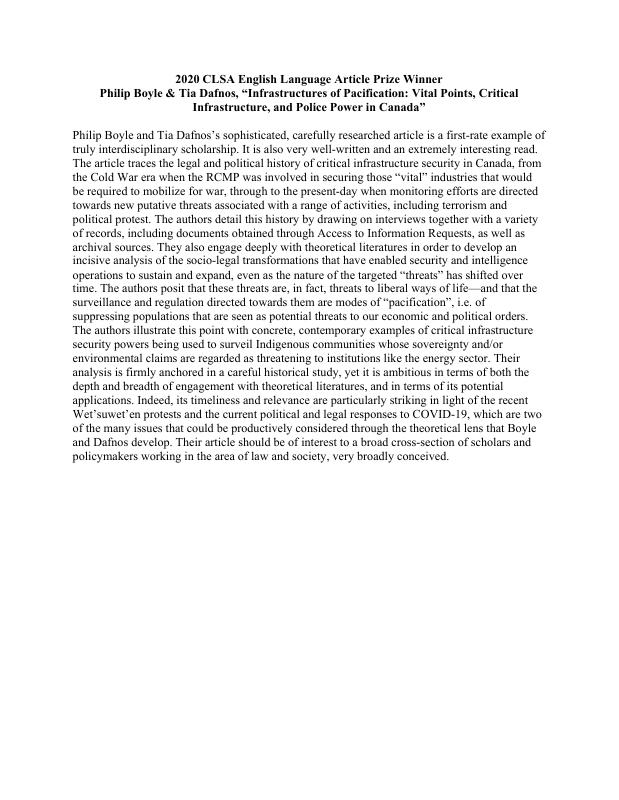
2020 CLSA English Language Article Prize Winner Philip Boyle & Tia Dafnos, “Infrastructures of Pacification: Vital Points, Critical Infrastructure, and Police Power in Canada” Philip Boyle and Tia Dafnos’s sophisticated, carefully researched article is a first-rate example of truly interdisciplinary scholarship. It is also very well-written and an extremely interesting read. The article traces the legal and political history of critical infrastructure security in Canada, from the Cold War era when the RCMP was involved in securing those “vital” industries that would be required to mobilize for war, through to the present-day when monitoring efforts are directed towards new putative threats associated with a range of activities, including terrorism and political protest. The authors detail this history by drawing on interviews together with a variety of records, including documents obtained through Access to Information Requests, as well as archival sources. They also engage deeply with theoretical literatures in order to develop an incisive analysis of the socio-legal transformations that have enabled security and intelligence operations to sustain and expand, even as the nature of the targeted “threats” has shifted over time. The authors posit that these threats are, in fact, threats to liberal ways of life—and that the surveillance and regulation directed towards them are modes of “pacification”, i.e. of suppressing populations that are seen as potential threats to our economic and political orders. The authors illustrate this point with concrete, contemporary examples of critical infrastructure security powers being used to surveil Indigenous communities whose sovereignty and/or environmental claims are regarded as threatening to institutions like the energy sector. Their analysis is firmly anchored in a careful historical study, yet it is ambitious in terms of both the depth and breadth of engagement with theoretical literatures, and in terms of its potential applications. Indeed, its timeliness and relevance are particularly striking in light of the recent Wet’suwet’en protests and the current political and legal responses to COVID-19, which are two of the many issues that could be productively considered through the theoretical lens that Boyle and Dafnos develop. Their article should be of interest to a broad cross-section of scholars and policymakers working in the area of law and society, very broadly conceived.